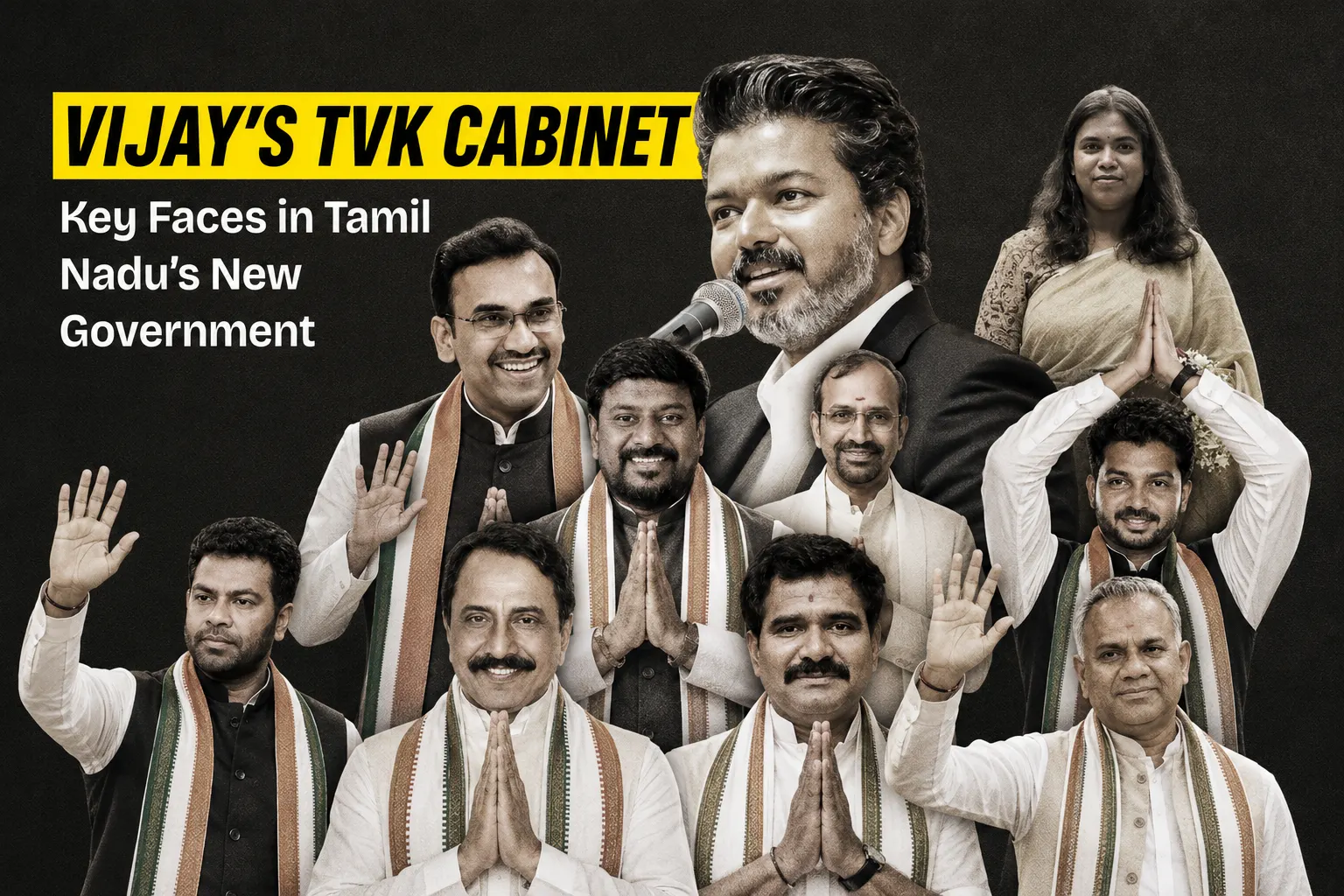
Tamil Nadu has witnessed one of the biggest political upheavals in its modern history. With actor-turned-politician C. Joseph Vijay taking oath as Chief Minister and Tamilaga Vettri Kazhagam (TVK) forming the government, the state has broken away from decades of political control by the DMK and AIADMK. But beyond the election numbers and coalition arithmetic, what has truly shaken the political landscape is the striking difference between the new generation of MLAs and ministers and the traditional power structures that ruled both Tamil Nadu and much of Indian politics for years.
The rise of TVK is being described by political observers as more than just an electoral victory — it is being projected as a rebellion against entrenched political culture. Unlike earlier governments dominated by senior party loyalists, dynastic figures, and career politicians, Vijay’s cabinet is packed with younger faces, professionals, social activists, former bureaucrats, and first-time legislators. The message is deliberate: this government wants to appear closer to ordinary people and farther from the image of inaccessible political elites.
Several leaders in the new government reflect this dramatic shift in political identity. Former IRS officer K.G. Arunraj, now handling a key administrative portfolio, represents the entry of technocrats into mainstream politics. Another first-time MLA, Dr. R. Keerthana, a public health activist from Madurai, built her reputation during rural medical outreach campaigns rather than through party networks. Youth leader Aravind Kumar, who rose through student activism and digital campaigns, has become one of the youngest ministers in the cabinet. In contrast to earlier governments where cabinet positions were often linked to seniority, caste equations, or political inheritance, these appointments highlight merit, grassroots visibility, and public engagement as emerging political currency.
The contrast has become sharper when compared with the BJP’s style of leadership at the national level. Critics of the BJP have often accused the party of centralising power around a handful of dominant figures, relying heavily on ideological control, aggressive political campaigns, and top-down decision-making. In contrast, Vijay’s administration is attempting to build an image of consultative politics, softer rhetoric, and emotional public connection — a strategy that strongly resonates with Tamil Nadu’s long-standing resistance to northern political dominance.
Political analysts say the symbolism matters as much as the governance itself. Several ministers in the new Tamil Nadu cabinet do not come from powerful political families. Many entered politics through social work, administration, cinema fan movements, or grassroots activism rather than through inherited influence. This is a visible departure from the political culture seen not only in previous Tamil Nadu governments but also in several BJP-led states where leadership is often driven by highly disciplined party structures and ideological hierarchy.
One of the strongest signals came immediately after the swearing-in ceremony. Vijay’s public interaction with opposition leaders, including DMK chief M. K. Stalin, was marked by warmth and civility rather than confrontation. In today’s highly polarised political climate, the gesture stood out. Supporters quickly projected it as evidence that Tamil Nadu may be entering a phase of less aggressive and more dialogue-driven politics — a sharp contrast to the combative style often associated with national political discourse.
Inside the Assembly, the atmosphere itself appears transformed. Young MLAs, women representatives, educated professionals, and first-time legislators now occupy spaces once controlled almost entirely by seasoned political veterans. Supporters believe this shift reflects changing voter expectations, especially among urban youth who increasingly prefer accountability, transparency, and direct communication over personality cult politics.
Vijay’s speeches have further intensified the political conversation. His repeated emphasis on “real secularism,” social justice, welfare politics, and state autonomy is being interpreted as an indirect challenge to the BJP’s ideological narrative. Without directly attacking the central government, TVK leaders have consistently reinforced Tamil identity, linguistic pride, and federal rights — themes that have historically carried enormous emotional weight in Tamil Nadu politics.
However, critics argue that image alone cannot guarantee governance. While the new government has succeeded in generating excitement and emotional momentum, it now faces enormous pressure to deliver results on employment, inflation, industrial growth, education, and welfare schemes. Opposition parties have warned that political branding cannot substitute administrative experience.
Yet the public mood in Tamil Nadu suggests something larger is unfolding. For many voters, especially younger generations, the arrival of Vijay’s government represents not just a political transition but a cultural shift — away from rigid political machinery and toward leaders perceived as more relatable and emotionally connected to the people.
Whether TVK can sustain this momentum remains uncertain. But one thing is already clear: Tamil Nadu politics has entered a new era, and the old rules of leadership are being rewritten in real time.