


Google Ranks as India’s Most Attractive Employer, Followed by Tata Group and Amazon
The CSR Journal Magazine

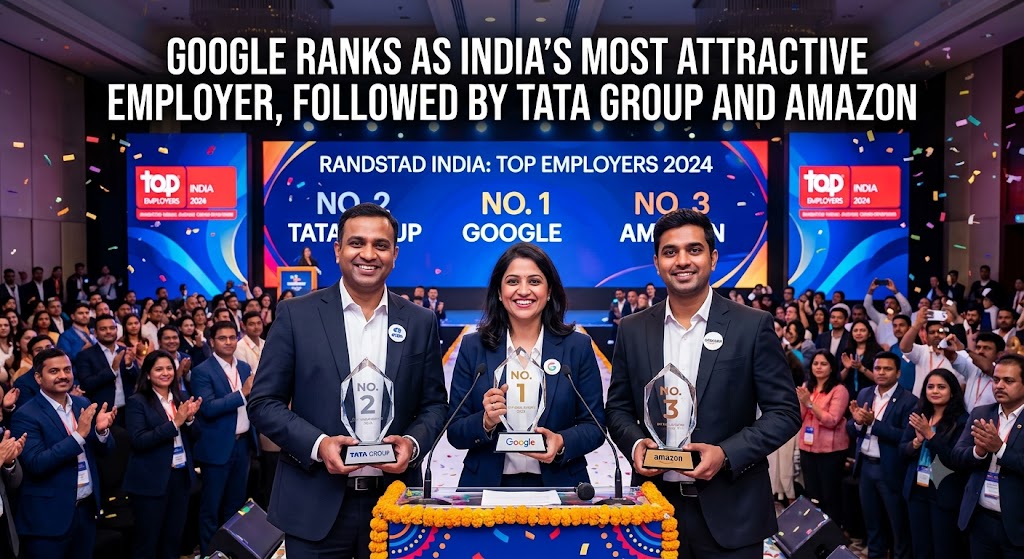
Google has been identified as the most appealing employer brand in India, according to the Randstad Employer Brand Research (REBR) 2026. In this annual assessment, Tata Group and Amazon secured the second and third positions, respectively. The findings were released on 5 August 2026 and highlight the significant factors influencing employee choices across the Indian workforce.

The REBR study included nearly 3,500 respondents within India, forming part of a broader global analysis that encompassed over 1.75 lakh participants across 34 nations. The insights emphasised that employees are gravitating towards employers who focus on a blend of career development, workplace culture, flexibility, wellbeing, and financial remuneration, rather than merely on isolated benefits.

Insights on Employee Mobility and Job Preferences

The research indicated a notable level of employee mobility, with close to fifty per cent of the workforce contemplating a change in employment within the upcoming six months. Work-life balance surfaced as the predominant reason for such transitions, as cited by 49 per cent of participants. Following this, 42 per cent reported a lack of career advancement opportunities as a contributing factor, while 41 per cent pointed to inadequate remuneration.

When broken down by age demographics, millennials appeared most inclined to shift jobs due to restricted career progression, with 43 per cent indicating this as a principal concern. In comparison, 42 per cent of Generation Z and 39 per cent of Generation X agreed that limited advancement opportunities were significant reasons for considering job changes.

The report portrays the Indian workforce as entering into a phase where organisations are expected to adopt what it describes as a “balanced employer” approach. Employees are increasingly assessing employers based on an overall value proposition, which encompasses meaningful work, inclusive environments, flexibility, and competitive wages.

Workplace Dynamics and the Importance of Digital Roles

The study further revealed that employees in digital roles possess distinct expectations compared to their counterparts in other sectors. Digital professionals prioritise competitive salaries over work-life balance. Notably, 55 per cent of individuals in digital positions cited career growth as a primary reason for job changes, compared to 40 per cent of operational staff and 43 per cent of professionals.

Hybrid work arrangements have become prevalent in the Indian job market, with approximately three in five employees engaging in remote work at least part of the time. About 42 per cent reported adapting to a hybrid model. Younger employees are particularly inclined towards remote work, with 63 per cent of Generation Z and 62 per cent of millennials participating in it, as compared to 51 per cent of Generation X.

Comments from Narayan Iyer, Managing Director of Randstad India, underscore the necessity for employers to re-evaluate their talent acquisition strategies amidst evolving workforce expectations. Iyer emphasised that organisations which effectively integrate opportunities for growth, flexibility, fairness, purpose, and competitive compensation will be better equipped to attract and retain talent in a competitive job market.

Long or Short, get news the way you like. No ads. No redirections. Download Newspin and Stay Alert, The CSR Journal Mobile app, for fast, crisp, clean updates!

App Store –  https://apps.apple.com/in/app/newspin/id6746449540 

Google Play Store – https://play.google.com/store/apps/details?id=com.inventifweb.newspin&pcampaignid=web_share

Latest News

Popular Videos
