


From Glasgow Glory to Asian Games Test, Indian Boxing Eyes Lasting Success
The CSR Journal Magazine

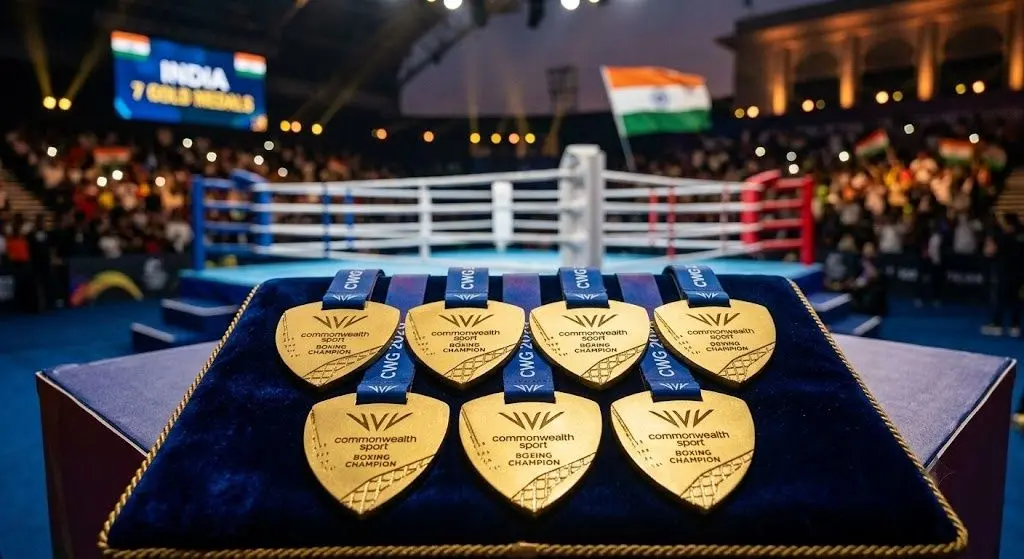
India’s record-breaking performance in boxing at the Commonwealth Games 2026 has underlined the sport’s growing depth and maturity, with the country finishing atop the podium with seven gold and three silver medals. While the achievement marks a significant leap from previous editions, the next challenge will be proving that the success can be replicated against stronger competition at the Asian Games.

India’s dominance in Glasgow has prompted questions about whether the country’s boxing programme has reached a new level or merely capitalised on a relatively weaker field. Coaches and experts believe the answer lies in improved preparation, better sports science, stronger mental resilience and a deeper pool of talented boxers.

Record Medal Haul Reflects Growing Depth

Even before the finals began, India had already secured 10 medals, guaranteeing one of its best-ever boxing campaigns at the Commonwealth Games. By the end of the competition, the contingent had converted those opportunities into seven gold and three silver medals.

The performance represented a marked improvement from recent editions. India won three gold, three silver and three bronze medals at Gold Coast in 2018, followed by three gold, one silver and three bronze in Birmingham in 2022.

With seven gold medals, the 2026 campaign has become India’s most successful Commonwealth Games boxing performance to date.

Women’s Boxing Emerges as India’s Biggest Strength

India’s women’s boxing squad has developed into one of the country’s strongest medal prospects across major international events.

Sakshi Chaudhary, who competed in place of Nikhat Zareen in the 51kg category, joined Preeti Pawar, Jaismine Lamboriya, Lovlina Borgohain and Priya Ghanghas in showcasing the growing depth of the women’s programme.

Reigning Commonwealth champion Jaismine Lamboriya further strengthened her credentials by defeating multiple-time Commonwealth Games medallist Michaela Walsh in the 57kg division.

The men’s contingent also impressed, with Sachin Siwach, Jadumani Singh, Ankush Panghal and Preet delivering composed performances throughout the tournament. The depth in the 54kg division, regarded as one of India’s most competitive weight categories, highlighted the increasing internal competition among Indian boxers.

Hard Work and Sports Science Driving Progress

Former Commonwealth Games medallist and Jadumani Singh’s coach Sarita Devi believes the transformation in Indian boxing has been visible since the last Olympic cycle.

According to her, the current generation has combined greater discipline with improved access to coaching, overseas exposure and sports science.

“Last Olympics, if we talk, our women’s boxing has gone very high, and at that level, our position has come to a very good level. And one more thing, the children who are playing now are working very hard. And they are focusing much better. They work harder than before,” Devi said.

She credited the government’s investment in training facilities and international exposure, along with advances in sports science, for helping Indian athletes recover better and prepare more effectively for competition.

“The government is giving facilities. Training facilities are very good. They are giving such good training facilities and taking them abroad for training, and continuously keeping foreign camps,” she said.

Devi added that India’s understanding of recovery and sports science has improved considerably over the past six to seven years, contributing to better performances at the international level.

Composure Becoming India’s Competitive Edge

One of the defining features of India’s campaign was the composure displayed by its boxers inside the ring.

Ankush Panghal’s gold medal bout illustrated that change. After losing the opening round, he resisted the temptation to chase the contest recklessly. Instead, he followed instructions from his coaches, gradually took control of the bout and secured victory through tactical discipline rather than aggression.

Similar maturity was visible across the Indian squad, with several boxers remaining patient even after difficult opening rounds instead of abandoning their game plans.

Sarita Devi attributed that composure to the fighters’ mental strength and their willingness to trust instructions from the coaching staff.

“Our child has a lot of will power. All our Indian boxers have it. But if you motivate them a little, and if they motivate properly and change the game plan, they will get the win,” she said.

Asian Games to Offer Tougher Examination

Despite the historic medal haul, experts caution that the Commonwealth Games did not feature many of the world’s strongest boxing nations.

Only two men and three women from India’s Commonwealth squad had previously competed at the Olympic Games, while six men and six women had World Championship experience.

The broader international landscape also highlights the challenge ahead. Commonwealth countries won five boxing medals at the Paris 2024 Olympics and 10 at Tokyo 2020, while Asian nations secured 22 medals in Paris compared to 13 in Tokyo.

The Asian Games in Japan will therefore provide a much sterner test, with powerhouses such as Uzbekistan, Kazakhstan and China returning to the competition.

“Uzbekistan and Kazakhstan have quite good boxers. Uzbekistan has quite a good team. So when these come in Asia, these people are not participating in the Commonwealth Games,” Devi said.

She added that England remained one of the stronger teams at the Commonwealth Games, but acknowledged that several participating nations were comparatively less competitive.

Recovery and Focus Key Before Next Challenge

With back-to-back international competitions approaching, Sarita Devi believes recovery should become the immediate priority for India’s boxers.

She advised the athletes to celebrate their Commonwealth success without allowing it to affect their focus ahead of the Asian Games.

“I want to tell all the boxers, you have to take 5-6 days of good rest. With the Asian Games, we are getting back-to-back competitions. So recovery is the first part,” she said.

Devi also urged the athletes to remain grounded despite the widespread praise following their performances.

“Whatever medal you have won, celebrate, but it should not be over… they should not become arrogant. The focus that we have now, the performance we have done in the Games, the focus that the coaches and players kept, the hard work they did they should continue that,” she said.

Confidence to Fuel India’s Olympic Ambitions

Sarita Devi believes the greatest gain from Glasgow is not the medal tally but the confidence the boxers have developed through sustained success.

“Asia will be stronger. But we will do well. The Indian team boxers are right now in full swing, and on top of that, there is full confidence in the coach and the federation. The confidence that has been built inside the players, that is not easily going to break. They will do well in the Asian Games also,” she said.

India’s record Commonwealth Games campaign has established a new benchmark for its boxing programme. The immediate challenge is carrying that momentum into the Asian Games, while the longer-term objective remains building a team capable of delivering consistent success at the Los Angeles Olympics in 2028.

Long or Short, get news the way you like. No ads. No redirections. Download Newspin and Stay Alert, The CSR Journal Mobile app, for fast, crisp, clean updates!

App Store –  https://apps.apple.com/in/app/newspin/id6746449540 

Google Play Store – https://play.google.com/store/apps/details?id=com.inventifweb.newspin&pcampaignid=web_share

Latest News

Popular Videos
