


Typhoon Dolphin Affects India’s Monsoon From 4,000 Kilometres Away
The CSR Journal Magazine

Typhoon Dolphin has made significant landfall near Yuhuan in Zhejiang province on August 9, 2026, with sustained winds of approximately 151 kmph. The typhoon has unleashed severe rains and strong winds, leading to major flooding concerns in the region. In response, authorities evacuated over one million residents to ensure their safety amidst the storm’s destructive potential.

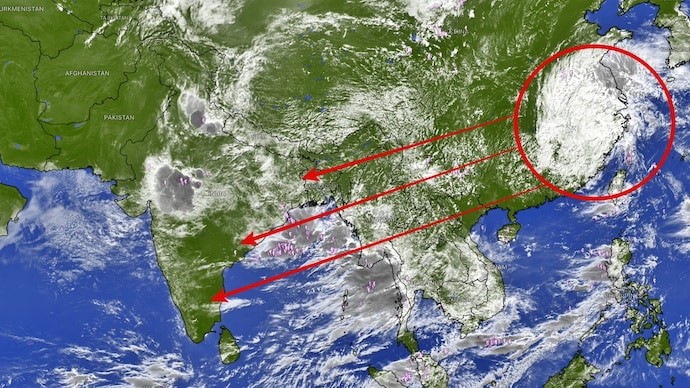
As the most powerful tropical cyclone to strike China this year, the impacts of Dolphin extend beyond its immediate vicinity. The storm’s activity in the Pacific has triggered extensive changes in atmospheric conditions, which could have serious implications for India’s monsoon season, nearly 4,000 kilometres distant.

Impact on Indian Monsoon Conditions

Current satellite imagery reveals a highly active Pacific Ocean, characterised by multiple weather systems forming across the tropical and western Pacific. This intense climatological activity can significantly influence the large-scale atmospheric patterns that connect the Pacific to the Indian subcontinent.

A critical factor in this interaction is the phenomenon of El Niño. Under El Niño conditions, the movement of tropical convection shifts eastward toward the Pacific, altering the atmospheric circulation and potentially suppressing rainfall in India. Studies indicate a strong correlation between Pacific convection and variations in the Indian monsoon, suggesting that significant atmospheric disturbances could directly impact rainfall patterns.

While disturbances from the western North Pacific can travel westward and potentially stimulate low-pressure systems in the Bay of Bengal, the ongoing El Niño-like conditions complicate the situation. Research has shown that over one-third of India’s monsoon low-pressure systems may stem from disturbances generated in the Pacific, with some western North Pacific tropical cyclones playing a role in this context.

Current Monsoon Situation and Future Projections

In India, the warning signs of a weakening monsoon are becoming increasingly evident. Cloud cover has diminished across vast areas, including the Bay of Bengal, leading to fewer organised rain-bearing systems forming within the country. The ongoing changes in the atmosphere may not be a direct consequence of Typhoon Dolphin ‘stealing’ rain, but rather part of a broader atmospheric scenario.

The critical issue at hand is whether the disturbances from the Pacific will lead to the development of a new low-pressure system over the Bay of Bengal. Alternatively, the ongoing unfavourable atmospheric conditions could continue to suppress the monsoon, threatening its effectiveness as a seasonal rain producer for India.

Overall, while Typhoon Dolphin is indeed impacting atmospheric conditions, it is merely one component of a complex interplay affecting monsoon dynamics. The next few weeks will be crucial in determining how these atmospheric disturbances will shape India’s monsoon and rainfall outcomes moving forward.

Long or Short, get news the way you like. No ads. No redirections. Download Newspin and Stay Alert, The CSR Journal Mobile app, for fast, crisp, clean updates!

App Store –  https://apps.apple.com/in/app/newspin/id6746449540 

Google Play Store – https://play.google.com/store/apps/details?id=com.inventifweb.newspin&pcampaignid=web_share

Latest News

Popular Videos
