




Why a Booming Book Market Does Not Mean India Reads More

The CSR Journal Magazine

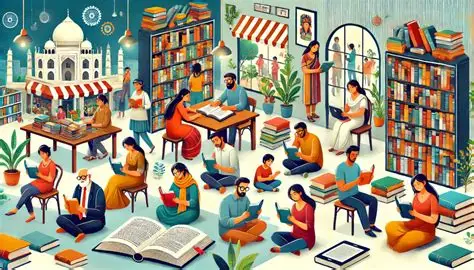
There is a particular sound that libraries used to make. It was not silence, not exactly. It was the sound of pages turning, chairs creaking, someone clearing their throat before asking the librarian for a title they had heard about but never seen. I have spent 14 years inside classrooms and corridors of Indian higher education, and I can tell you that this sound is disappearing. It has been replaced by a different sound: the tinny leak of audio from a phone speaker, a reel playing at double volume in a crowded train compartment, a canteen full of laughter and notifications where a library once stood half full and fully quiet.

Every semester I walk from my department to the library, and every semester the walk gets lonelier, not because the corridor has changed but because fewer people are making the same walk. Meanwhile the canteen, three buildings away, hums like a beehive. I do not blame my students for this. They are not lazy or shallow. They are simply living inside an architecture of attention that was built without their consent, by companies who profit from every second they do not spend reading.

But the numbers agree with what my eyes see. Indians now spend close to 2.5 hours a day on social media alone, according to industry estimates for 2025, with the youngest users, Gen Z, crossing three hours daily.

Add general screen time and the figure climbs past 6 hours a day for many young Indians. Compare this to the time an average Indian spends reading books for pleasure, which surveys consistently place at a fraction of that, often under 30 minutes a day, and mostly among an already shrinking population of committed readers. We have not lost the appetite for stories. We have simply handed that appetite to a machine that serves it back to us in fifteen-second increments, algorithmically tuned to keep us scrolling rather than thinking.

I see this most starkly on trains and buses. A decade ago, the daily commuter in Mumbai or Delhi would often carry a paperback, a newspaper, sometimes a worn copy of a novel borrowed from a colleague. Today the same commuter holds a phone at chest height, a reel autoplaying into the next reel, sound often turned up rather than down, so that an entire compartment becomes an unwilling audience to a stranger’s algorithm. Nobody asked for this noise. It simply became normal; the way pollution becomes normal to a city that has stopped noticing its own air.

The Numbers Behind the Feeling

India’s public library system, one of the largest in the world on paper, remains one of the most starved in practice. Research going back years and still cited today shows that India’s per capita government expenditure on public libraries works out to a matter of paise, not rupees, compared to the United States, where public libraries receive tens of dollars per person annually and serve well over 90% of the population.

India has an estimated 70,000 public libraries, yet a large share of them survive without adequate staff, without new acquisitions, without so much as reliable electricity, let alone digital catalogues. Central schemes exist to fund state libraries, but year after year, many states fail to even submit proposals to claim the money that is available to them. The result is a strange and quiet tragedy: a country that speaks constantly of its ancient intellectual traditions, of Nalanda and Takshashila, is simultaneously allowing its modern public reading infrastructure to wither from simple neglect.

Private lending libraries, which once filled the gap left by government indifference, particularly for the middle class in the 80s and 90s, have themselves been hollowed out by cheap smartphones and free content. The subscription library, once a fixture in almost every middle class neighbourhood in urban India, has become rare enough that when a new one opens, it is treated as a novelty rather than a return to normalcy.

Independent bookstores tell a similar story. Storied outlets have shut their doors or converted into stationery and lifestyle shops simply to survive rising rents and falling footfall. The overall Indian book market, measured in rupees, is not shrinking. It is in fact growing, driven largely by textbooks, exam preparation material, and online sales through platforms that deliver to your doorstep. But this is precisely the point I want to make as an academic rather than as a merchant. A market can grow in value while a culture shrinks in depth. Growth in exam guides is not growth in the habit of reading for its own sake. A student buying a coaching manual for an entrance exam is not the same as a citizen who reads a novel on a Sunday afternoon because it enlarges her understanding of another human life. We are buying more books than ever and reading less than ever, and these two facts are not contradictory. They describe two different economies, one of transaction and one of transformation, and only the first is thriving.

Why This Matters More, Not Less, in the Age of AI?

There is a temptation, especially among the young, to believe that reading is an old technology being replaced by a better one. I want to push back against this gently but firmly, because I think it misunderstands what reading actually does to a human mind.

A reel gives you information. A book gives you thought. These are not the same product wearing different packaging. When you read a book, particularly a long one, your brain is forced to hold an argument or a story in memory across hours or days, to connect a detail on page twelve with a revelation on page 200, to sit with discomfort and ambiguity rather than have it resolved for you in 15 seconds by an algorithm optimised for immediate gratification. This capacity, the ability to sustain attention on a single, demanding, uncertain thing, is precisely the capacity that artificial intelligence cannot replicate and precisely the capacity we are losing.

We are entering a decade where machines can summarise, translate, and even argue on our behalf. In such a world, the most valuable human skill will not be the ability to retrieve information, because a search engine or an AI model will always retrieve it faster than we can. The most valuable human skill will be the ability to think slowly, to doubt, to build an original argument out of scattered material, to notice when a machine’s answer is confident but wrong. This is exactly the muscle that deep reading builds and that reel culture atrophies.

A society that stops reading books in the age of AI is not choosing a modern path over an ancient one. It is quietly disarming itself at the precise moment it most needs its wits.

This is true everywhere, not only in India. Studies across the world, from the United States to parts of Europe, show falling attention spans and falling literary reading rates among the young even as overall screen time climbs. But the stakes are arguably higher here, in a country still building its institutions, still deciding what kind of public culture it wants, still home to the largest population of young people on earth. What that generation reads, or fails to read, will shape the next fifty years of Indian public life far more than any single policy document.

The Students’ Paradox

Let me be blunt, because 14 years of classroom experience has earned me the right to be. Some of the most confident young people I meet are MBA students chasing the highest paying job on campus, and some of the most intellectually hollow conversations I have ever had are with the very same students.

Ask an MBA aspirant about geopolitics and you often get a headline, not an understanding. Ask about basic economics beyond what a placement guide has fed them and the answers thin out quickly. Mention philosophy or the idea that ethics might actually matter in business decisions and you are met with a polite blankness, sometimes even mild irritation, as though the subject is a distraction from the real business of getting hired. Bring up something as old and human as spirituality, not religion, but the deeper question of meaning and purpose, and the room goes quiet in a way that has nothing to do with respect and everything to do with unfamiliarity. These are not unintelligent young people. They are bright, hardworking, and desperately eager to succeed. What they are missing is not intellect. It is exposure, the kind that only sustained reading provides.

And here is the real irony, the one that should worry every business school in this country.

These same students, so eager for the corner office and the 6 figure package, often cannot communicate a simple idea clearly in a room. Give them a case study to present and watch the jargon multiply to hide the absence of a real argument underneath. Ask a follow up question and watch the confidence wobble, because what looked like knowledge was actually memorised vocabulary, borrowed frameworks repeated without being understood, phrases lifted from a slide rather than thought through by a mind.

This is what happens when a generation is trained to clear an exam rather than build a worldview, when the last serious book many of them read closely was assigned in school and never revisited by choice. Reading is not decoration for future managers and consultants. It is the raw material of judgment, of the ability to make an argument, defend it, and adjust it when someone pushes back. Without it, ambition simply has nothing to stand on.

The ChatGPT Shortcut

If reels stole our attention, generative AI is now quietly finishing the job by stealing our effort, and I say this as someone who uses these tools myself and sees real value in them when used with discipline.

What I increasingly see in my own classroom is a student who has not read the case study, has not opened the recommended article, has not sat with the discomfort of not knowing, but has instead pasted the question into a chatbot and submitted whatever came back, often word for word, sometimes with the AI’s own hedging language still intact. The assignment gets finished faster than ever. The student understands it less than ever. This is a new and dangerous kind of doubling. First reel culture eroded the willingness to sit with a long, difficult text. Now AI tools remove even the need to try, because the summary, the argument, even the counterargument arrives instantly, pre-digested, requiring nothing of the reader but a copy and paste.

The tragedy is that these tools could make a well-read student formidable, sharpening research that already has a foundation, testing arguments the student has already formed through independent reading. Instead, for a growing number of students, AI has become a replacement for the reading and thinking that should have come first, not an accelerant for it.

A model can summarise a hundred pages in a paragraph, but it cannot give a student the experience of struggling through those hundred pages, of getting confused, doubling back, and eventually understanding something on their own terms. That struggle is not an inefficiency to be optimised away. It is the entire point of an education.

A generation that outsources its thinking before it has learned how to think is not being augmented by artificial intelligence. It is being quietly hollowed out by it, one skipped case study at a time.

What Karl Marx Might Have Noticed

I want to make one more observation, and I make it carefully, because it is easy to sound preachy here.

There is something quietly ideological about the shift from library to canteen, from book to reel. A library, at its best, is a rare kind of space. It is one of the few public institutions where a person’s access to knowledge does not depend on how much money they have or which family they were born into. The book on the shelf costs the same attention from the richest student and the poorest one. It does not perform for you, it does not know your background, it does not sort you by caste, class, or clout the way so much of Indian institutional life still quietly does. In this sense, reading is one of the last genuinely democratic acts left to us, an equaliser hiding in plain sight on a dusty shelf.

The reel, by contrast, is not neutral. It is built by platforms whose business model depends on capturing and holding your attention for as long as possible, then selling that attention to advertisers. It thrives on spectacle rather than substance, on outrage rather than argument, on comparison rather than contemplation. It quietly sorts and stratifies its audience too, showing the well-off different content from the poor, the urban different content from the rural, each trapped in a feed engineered to keep them scrolling rather than thinking about why the world is organised the way it is. Where the library asks nothing of you but attention and rewards you with understanding, the platform asks for your attention and gives you back only more appetite for the platform. One builds a public. The other builds a market of isolated consumers who happen to be looking at their phones in the same room.

I do not say this to romanticise the past. Libraries in India have their own history of exclusion, and no institution is innocent. But there was, in the collective act of reading together, something that resembled solidarity. A shared canon, a shared reference point, a shared argument that could be had across class lines because everyone had at least encountered the same handful of books in school or college. The fragmentation of attention into millions of personalised feeds has fragmented that shared ground as well. We increasingly do not even disagree about the same things anymore, because we are not looking at the same things. This, too, is a kind of hierarchy, quieter than caste or class, but no less real: a hierarchy of who still has the discipline to read deeply in a world engineered to prevent exactly that.

What Is Actually Lost?

When focus goes, motivation tends to follow it. I have watched this happen in real time in my own classroom. Students who once could sit through a 180-minute lecture and take structured notes now visibly struggle to hold a single train of thought for more than a few minutes without reaching for a phone. This is not a moral failing on their part. It is what happens to any mind that has been trained, for years, on content engineered to reward the shortest possible attention span. You cannot spend six hours a day being fed fifteen-second bursts of stimulation and expect your brain to remain equally capable of sitting with a two-hundred-page argument. The muscle that reading builds, patience, delayed gratification, the tolerance for boredom that eventually gives way to insight, is being allowed to waste away.

And with it goes something larger than individual academic performance. A citizenry that reads widely and deeply is harder to manipulate, harder to distract, and more capable of holding power accountable, because it has practised the discipline of following a complicated argument to its end rather than accepting the first simple answer offered to it. A citizenry raised on reels is a citizenry optimised for consumption, not for judgment.

A Small, Stubborn Hope

I do not want to end on despair, because despair is itself a kind of surrender, and reading has never been a lost cause in India, only a neglected one. Independent bookstores in some cities report devoted, if smaller, communities of readers who return again and again. Regional language publishing remains genuinely vibrant, with a significant share of Indian trade books still sold outside English, carrying stories to audiences the metropolitan literary world often forgets exists. Reading clubs, however small, still meet in flats and offices across the country. My own students, the ones who do walk into the library, read with an intensity that reminds me why I chose this profession fourteen years ago.

What is needed now is not nostalgia but investment and intention. Real government spending on public libraries, not per capita paise but per capita rupees that mean something. School curricula that build reading stamina deliberately rather than assuming it will happen on its own. And a personal, almost private act of resistance from each of us: choosing, at least once a day, to open a book instead of a feed, to let an idea sit in the mind long enough to become our own, rather than letting 15 seconds of someone else’s spectacle pass through us and vanish.

The library will not save itself. But it is still there, half empty, patiently waiting, its silence not yet gone, only waiting to be filled again by the sound of a page turning.

Views of the author are personal and do not necessarily represent the website’s views.

Dr. Jaimine Vaishnav is a faculty of geopolitics and world economy and other liberal arts subjects, a researcher with publications in SCI and ABDC journals, and an author of 6 books specializing in informal economies, mass media, and street entrepreneurship. With over a decade of experience as an academic and options trader, he is keen on bridging the grassroots business practices with global economic thought. His work emphasizes resilience, innovation, and human action in everyday human life. He can be contacted on jaiminism@hotmail.co.in for further communication.

Long or Short, get news the way you like. No ads. No redirections. Download Newspin and Stay Alert, The CSR Journal Mobile app, for fast, crisp, clean updates!

App Store –  https://apps.apple.com/in/app/newspin/id6746449540 

Google Play Store – https://play.google.com/store/apps/details?id=com.inventifweb.newspin&pcampaignid=web_share

Latest News

Popular Videos