


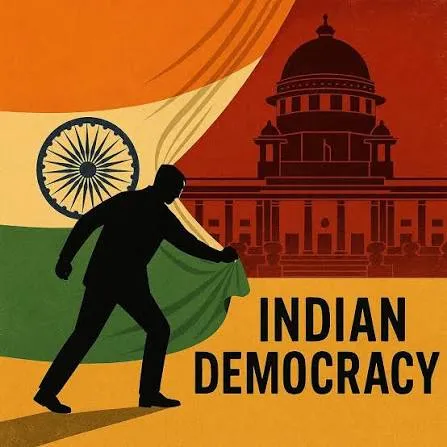


The Republic of Excuses

The CSR Journal Magazine

There is a peculiar new sport sweeping across Indian drawing rooms, WhatsApp groups, and comment sections. It requires no physical fitness, no intellectual preparation, and absolutely no connection to reality. The sport is called “Defending The Obvious”, and its practitioners have reached an almost Olympic level of commitment.

The rules are simple.

Whenever a road collapses, a bridge falls, a child drowns in a waterlogged street, a hospital runs out of oxygen, or a scam surfaces with more zeros than a mathematics textbook, a certain section of the population springs into action. Not to demand answers. Not to hold anyone responsible. But to explain, with great passion and even greater creativity, why actually this is fine. Why actually you are the problem. Why actually asking questions is anti-national, anti-Hindu, anti-development, anti-cow, or simply the work of a foreign-funded cabal that has targeted this particular pothole for geopolitical destabilisation.

Welcome to the psychological condition that no DSM edition has yet named but probably should: Compensatory Civic Servility, with acute symptoms of Whataboutery and chronic Loyalty Blindness.

Let us be very clear about what we are not discussing here. We are not discussing critics of India. We are not discussing those who wish the country ill. We are discussing a very specific, very devoted group of citizens who love India so intensely that they have decided the best way to express that love is to ensure that nobody ever improves it.

The Psychology of the True Believer

In 1951, the longshoreman philosopher Eric Hoffer wrote a book called ‘The True Believer’, which described how mass movements transform ordinary, frustrated individuals into passionate, unthinking loyalists. Hoffer observed that people who feel a deep sense of personal inadequacy, stalled ambition, or social irrelevance are the most enthusiastic recruits for mass movements, not because the movement gives them answers, but because it gives them identity. They stop being Nobody from Nagpur and become Soldier of the Civilisation.

This is not an insult. It is a clinical description of a documented human need. Psychologist Henri Tajfel’s “Social Identity Theory” tells us that people derive a significant part of their self-worth from the groups they belong to. When the group is threatened, even by legitimate criticism, the individual experiences it as a personal attack on their own identity. Criticise the administration’s handling of flood relief, and you are not criticising an administration. You are attacking the person sitting in Pune who spent six months reposting temple consecration videos and now feels personally implicated in the quality of your drains.

This is why the pothole is never just a pothole.

The pothole is a test of loyalty. The bridge that collapsed is a conspiracy. The children who died of encephalitis in a public hospital in 2017, 63 of them in a single month in Gorakhpur, were, according to the internet’s finest constitutional experts, either a fabrication by the opposition press or somehow the fault of the party that had been out of power for years. When the data became undeniable, the explanation shifted: these things happen everywhere, what about what happened before, do you even know what encephalitis is, stop being negative about India.

Psychologists call this “Motivated Reasoning”. You do not evaluate evidence and then form a conclusion. You have a conclusion first, and then you cherry-pick, dismiss, or reconstruct evidence to support it. It is the brain doing what it has evolved to do, protect the tribe, protect the self-image, protect the belief system. The problem is that this evolutionary feature, useful when the threat was a lion, becomes disastrous when the threat is a collapsed sewer.

The Sociology of Manufactured Consent

Italian Marxist Antonio Gramsci, writing from a prison cell nearly a century ago, described how ruling classes maintain power not through brute force alone but through cultural hegemony: the ability to make the values, worldview, and interests of the powerful seem like the natural, common-sense values of everyone. You do not need to threaten people into compliance if they have already internalised the idea that questioning power is itself a form of deviance.

In India today, this machinery runs with remarkable efficiency. A citizen who asks why his state government has not built a functional public hospital in 15 years is not seen as a taxpayer exercising democratic rights. He is seen as someone who hates Hindus. The category substitution is so seamless that most people do not even notice it has happened. Governance accountability has been successfully rebranded as cultural betrayal. And the rebranding was not accidental.

Sociologist Emile Durkheim wrote about how societies create rituals and symbols that generate “collective effervescence”, a shared emotional high that bonds individuals to the group. Modern political rallies, stadium-sized prayer gatherings broadcast on every channel, the theatrical unveiling of large statues, the carefully choreographed emotional moments, these are not merely cultural events. They are social technologies for manufacturing belonging and bypassing the critical faculties. After enough effervescence, it becomes genuinely difficult for the bonded individual to separate affection for civilisation from affection for the people currently running it.

India’s infrastructure crisis is not a secret. The government’s own data documents it. A 2023 report by the National Sample Survey Office found that less than 20% of rural Indian households have piped water that actually functions throughout the year. The Economic Survey 2023-24 acknowledged that India’s public health expenditure, at approximately 1.9% of GDP, remains among the lowest in the world, lower than Sri Lanka, Nepal, and Bangladesh. The Global Hunger Index 2023 placed India at 111th out of 125 countries, a ranking that was greeted with tremendous official outrage at the methodology and zero official curiosity about the children.

In response to these facts, the Pothole Patriots produced a rich body of counter-literature explaining why statistics are a colonial tool, why the researchers are anti-India, and why the real hunger in this country is for national pride, which is available in abundant supply.

What Our Ancestors Actually Said

Here is where things get genuinely painful, because the tradition being invoked to silence dissent is precisely the tradition that mandated dissent most forcefully.

The Vedic intellectual tradition was, at its core, a culture of rigorous questioning. The Upanishads are not hymns of passive devotion. They are records of fierce philosophical debates, between teacher and student, between competing schools, between the individual and the cosmos. Nachiketa, the young boy in the Katha Upanishad, does not meekly accept what he is told. He argues with Yama, the god of death, refusing three alternate gifts until he gets the answer he came for. The tradition celebrated this. It did not cancel Nachiketa for anti-death-god sentiment.

The Nyaya school of Indian philosophy built an entire epistemological system around pramana, or valid means of knowledge, of which pratyaksha (direct perception) was primary. In other words, what you can directly see and verify takes epistemic priority. Not what the authority says. Not what the majority believes. What is actually, verifiably, observably true.

The Lokayata, or Charvaka school, went further. It explicitly rejected the authority of scripture and tradition in matters that could be evaluated empirically. This was considered a valid philosophical position, worthy of serious engagement, not a fringe conspiracy theory to be mass-reported to the platform moderators.

The great debates at Mithila, the philosophical tournaments at ancient universities, the Shastrartha tradition where scholars publicly challenged each other on every question from metaphysics to political governance, this was a civilisation that did not merely tolerate intellectual confrontation. It institutionalised it. It was how it sharpened its thinking and corrected its errors.

The people who claim today to defend this civilisation against its critics have managed the remarkable feat of preserving the rituals while demolishing the epistemology. They have kept the lamps and the mantras and the sacred geography. They have discarded, with suspicious thoroughness, the part that said: question everything, verify everything, do not accept authority without evidence.

The Whatabout Olympics

India’s “Corruption Perception Index” [ranking] has fluctuated between 85th and 100th in the world consistently across the last decade, per Transparency International’s annual data. The 2024 ranking placed India at 93rd out of 180 countries. This is not a stellar performance for a country that has been loudly promising to eradicate corruption at approximately every election since 1947.

But bring this up in any online forum and you will witness the most dazzling display of logical acrobatics this side of a Cirque du Soleil production. What about 1984? What about the Emergency? What about the Commonwealth Games? What about Italy? What about China? What about the British?

Whataboutery is not a debating technique. It is a cognitive escape route. Psychologists call it Tu Quoque, the “you also” fallacy, and it has been documented since the ancient Greeks as a method of deflecting accountability by pointing to someone else’s failures. It is the rhetorical equivalent of explaining that your house is not actually on fire because your neighbour’s house burned down in 2004.

The remarkable innovation of contemporary Indian political discourse is that Whataboutery has been elevated from a logical fallacy to something approaching a patriotic duty. If you are not comparing the current situation to a worse situation from decades ago, you are not being fair. If you are not reminding people that someone else was also bad once, you are being politically motivated. The bar for adequate governance has been set so low that it can only be cleared by pointing backwards.

The Divine Mandate Problem

There is also the matter of God. Or rather, the matter of using God as a governance consultant.

Multiple surveys, including the Pew Research Centre’s 2021 survey on religion in India, confirm that approximately 97% of Indians believe in God. This is a beautiful fact about a spiritually alive civilisation. It becomes a somewhat less beautiful fact when it is converted into a mechanism for immunising political power from evaluation.

When a leader’s authority is framed in civilisational and quasi-divine terms, when temples are inaugurated with a pomp that exceeds the inauguration of hospitals, when political rallies are conducted with the aesthetic grammar of religious gatherings, the effect on the critical mind is predictable and documented.

Solomon Asch’s conformity experiments in the 1950s demonstrated that people will deny the evidence of their own eyes rather than dissent from a confident group consensus. Stanley Milgram’s obedience experiments showed that ordinary people will comply with authority figures even when compliance causes harm, especially when that authority is framed as legitimate and morally elevated.

What happens when the authority figure is not merely legitimate but cosmically endorsed? When dissent is not merely disagreeable but potentially sacrilegious? The compliance is total. The potholes are God’s will. The corruption is a test of faith. The dead children were destined.

A 2022 Lokniti-CSDS survey found that a significant proportion of Indians, over 55% in some categories, trusted the national government to do the right thing “almost always” or “most of the time.” This trust level has remained remarkably stable despite infrastructure failures, economic distress, and declining institutional credibility across multiple indicators. Social psychologists call this “Institutional Halo Effect”. When you deeply believe that the source of authority is fundamentally good, you unconsciously adjust your perception of its specific actions to fit that prior belief.

The government is good. The government built the new airport. The government did the surgery on the economy that was necessary. Therefore, the collapsed bridge was an anomaly, the hospital deaths were exceptional, the unemployment data is fabricated by enemies, and the pothole was dug by the opposition.

The Manufactured Pride Economy

India’s nominal GDP crossed 3.7 trillion dollars in 2024, making it the fifth-largest economy in the world. This is a genuine achievement of Indian enterprise, Indian labour, and Indian resilience across several decades. It is not, however, equally distributed. The Oxfam India Wealth Report 2024 found that the top 1% of Indians hold 40.1% of the nation’s total wealth, while the bottom 50% hold 6.4%. India’s billionaire wealth has more than doubled since the pandemic. Simultaneously, the National Family Health Survey data from 2019-21 shows that 35.5% of Indian children under five are stunted due to malnutrition.

These two facts can coexist. A country can be simultaneously richer and more unequal. An economy can grow while many of its people do not grow with it. These are not contradictions. They are documented patterns of unequal development that economists across the political spectrum have studied and named.

In the current cultural climate, however, mentioning the second fact is treated as a personal attack on the first. You cannot note that children are malnourished without being accused of hating GDP. You cannot observe that 90% of India’s workforce is in the informal sector with no social security without being suspected of wanting the country to fail. Pride in the nation’s achievements has been systematically conflated with blindness to its failures, and anyone who refuses to be blind is labelled an enemy.

This is not pride. Pride that cannot survive the inspection of its object is not pride. It is fragility dressed with hyper-jingoism!

The Way Back

None of this is about which party is in power. Variations of this social pathology have appeared across Indian political history, in different colours, different language, different uniforms. The disease predates the current patient. What is unusual about the present moment is its scale, its digital amplification, and its systematic nature.

What Vedic civilisation understood, at its most rigorous, is that the examined society is the only society worth living in. The Arthashastra, Kautilya’s fourth-century BCE treatise on governance, explicitly states that a king’s dharma includes tolerating the criticism of his subjects, creating systems for hearing public grievance, and measuring his success not by military glory but by the welfare of his people. “In the happiness of his subjects lies the king’s happiness,” Kautilya wrote, “in their welfare, his welfare.”

There is no version of Indian civilisational tradition that says: defend the ruler. Protect the administration from accountability. Silence those who point at the broken road.

That tradition does not come from Nalanda. It does not come from Taxila. It does not come from the Upanishads, the Arthashastra, the Nyaya sutras, or a single darshana of the classical period.

It comes from fear. And fear, as every tradition we claim to honour has noted, is the beginning of the end of wisdom.

The pothole will still be there tomorrow. The question is whether, tomorrow, you will call the corporation and demand it be fixed, or whether you will open your phone and explain why the pothole is actually a symbol of civilisational resilience.

One of those actions is Indian. The other is just exhausting.

Views of the author are personal and do not necessarily represent the website’s views.

Dr. Jaimine Vaishnav is a faculty of geopolitics and world economy and other liberal arts subjects, a researcher with publications in SCI and ABDC journals, and an author of 6 books specializing in informal economies, mass media, and street entrepreneurship. With over a decade of experience as an academic and options trader, he is keen on bridging the grassroots business practices with global economic thought. His work emphasizes resilience, innovation, and human action in everyday human life. He can be contacted on jaiminism@hotmail.co.in for further communication.

Long or Short, get news the way you like. No ads. No redirections. Download Newspin and Stay Alert, The CSR Journal Mobile app, for fast, crisp, clean updates!

App Store – https://apps.apple.com/in/app/newspin/id6746449540

Google Play Store – https://play.google.com/store/apps/details?id=com.inventifweb.newspin&pcampaignid=web_share

Latest News

Popular Videos