


SpaceX Rocket Stage Believed To Have Crashed On Moon Near Einstein Crater
The CSR Journal Magazine

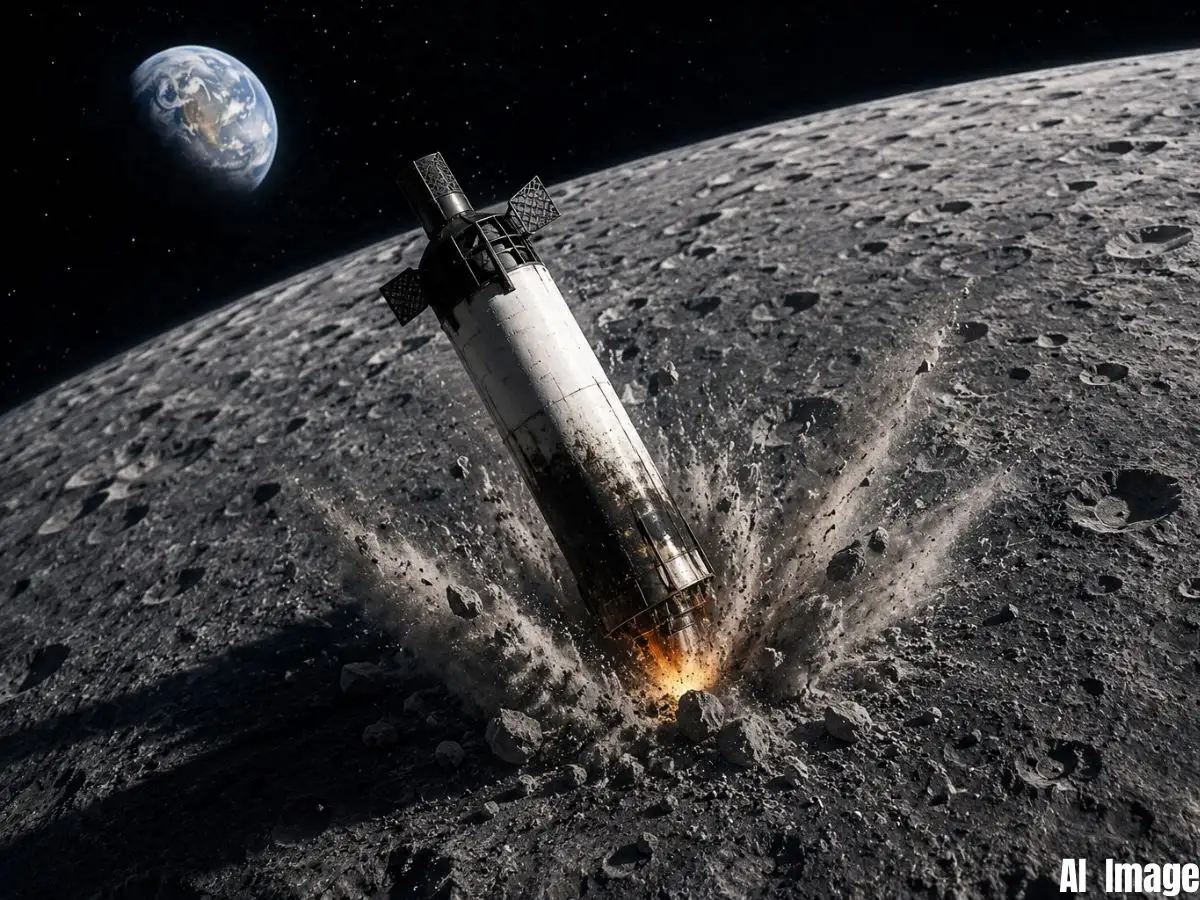
A SpaceX rocket stage that previously launched two lunar landers is thought to have impacted the Moon on Wednesday, having drifted off course for approximately one year. As experts monitor the situation, they anticipate official confirmation of the event may take some time. Observations by space tracking specialists indicate that a crash was unavoidable.

This event highlights the increasing concerns surrounding space debris as lunar exploration activities are expected to intensify in the near future. Experts caution that as countries such as the United States and China advance their plans to send astronauts to the Moon, the issue of debris could escalate even further.

Retired astrophysicist Jonathan McDowell reported that the upper stage of the rocket, weighing about four tons, was confirmed to be on a direct collision course with the Moon during observations made on Tuesday night. The anticipated impact zone is situated near Einstein Crater, on the sunlit hemisphere of the Moon, where visibility is particularly challenging from Earth.

Experts Acknowledge Challenges in Observing the Impact

McDowell expressed certainty that the rocket had broken apart upon impact, stating that it is “now in teeny, little pieces scattered over the Moon near Einstein Crater.” He further explained that even if unforeseen circumstances had redirected the rocket during its approach, the impact would have been in a similar vicinity.

Scientists had foreseen that spotting any resulting dust and rock plume from the ground would be improbable. The potential flash of light generated by the collision was also expected to be difficult to observe. Spacecraft in lunar orbit were noted as the most likely means to capture any visual evidence or imaging of the impact site afterward.

Dutch scientist Marco Langbroek, among those who pointed telescopes towards the Moon at the projected time of impact, unfortunately did not witness any signs of the event. “We knew this would be a long shot,” he commented, echoing the sentiments of McDowell about the certainty of the rocket’s demise.

NASA Awaiting Confirmation From Lunar Reconnaissance Orbiter

Visual validation of the impact will likely occur when NASA’s Lunar Reconnaissance Orbiter conducts a flyover of the site and transmits images back to Earth. NASA has indicated that this imaging is not expected to be available until the following week.

In response to the incident, SpaceX representative Julianna Scheiman articulated that the company is collaborating with NASA to prevent similar occurrences in the future. She clarified that the crash was not a planned event, attributing it instead to an unintentional combination of solar activity and gravitational forces leading to the collision course with the Moon.

The stage was part of a Falcon rocket that launched from Cape Canaveral on January 15, 2025, carrying two lunar landers: Firefly Aerospace’s Blue Ghost and ispace’s Resilience. After successfully deploying the landers, the upper stage was left adrift. While Resilience ultimately crashed, Blue Ghost accomplished a successful landing, marking a milestone as the first private spacecraft to achieve such a feat.

Concerns Over Lunar Debris Intensifying

This incident contributes to growing unease regarding the accumulation of debris on the Moon’s surface. In 2022, a Chinese rocket inadvertently collided with the Moon, with scientists suspecting numerous other rocket remnants may have struck the lunar surface unnoticed over the decades.

The Moon’s status as a target for increasing space missions is evident, with NASA poised to conduct a series of robotic flights aimed at establishing a sustainable lunar presence. Partnerships with SpaceX and Blue Origin are being forged to supply lunar landers for the upcoming Artemis missions, aiming for a crewed lunar landing potentially by 2028.

McDowell emphasised that the frequency of such impacts will likely rise, raising concerns about their ramifications. He noted, “an impact like this on the lunar surface ploughing up huge amounts of dust going for hundreds of miles around is not going to be acceptable.”

Long or Short, get news the way you like. No ads. No redirections. Download Newspin and Stay Alert, The CSR Journal Mobile app, for fast, crisp, clean updates!

App Store –  https://apps.apple.com/in/app/newspin/id6746449540 

Google Play Store – https://play.google.com/store/apps/details?id=com.inventifweb.newspin&pcampaignid=web_share

Latest News

Popular Videos
