


Xi Hosts Putin Days After Trump Visit As China Balances Global Powers
The CSR Journal Magazine

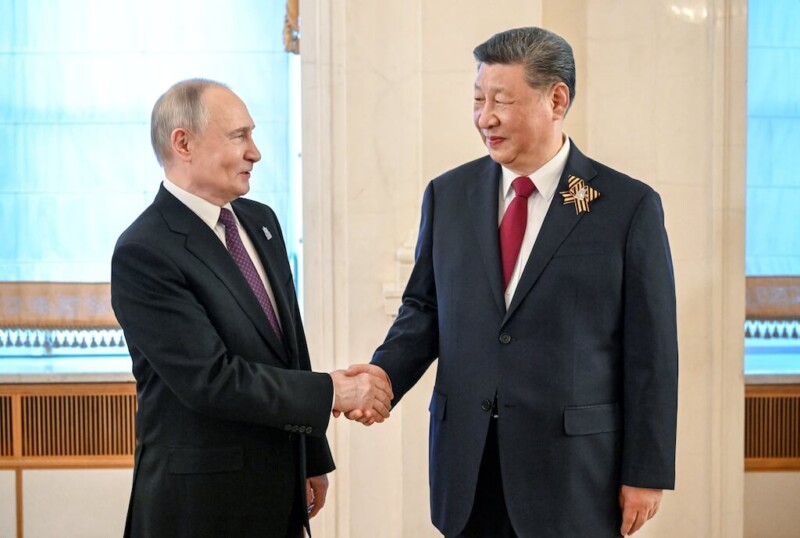
Russian President Vladimir Putin arrived in China on Tuesday for a crucial two-day visit focused on high-level talks with Chinese President Xi Jinping, as Moscow and Beijing continue to strengthen ties against the backdrop of war, sanctions and shifting global alliances.

The visit marks the second face-to-face meeting between the two leaders in less than a year and coincides with the 25th anniversary of the 2001 Treaty of Good-Neighborliness and Friendly Cooperation, the landmark agreement that normalised relations between the two nations after decades of Cold War rivalry and ideological tensions.

Putin’s trip comes shortly after US President Donald Trump concluded his own visit to Beijing, where he also held talks with Xi. Analysts say the close timing of the visits reflects China’s growing effort to position itself as a key power broker in an increasingly fragmented global order.

The discussions between Beijing and Moscow are unfolding amid the ongoing Russia-Ukraine war, rising tensions involving Iran, and disruptions in shipping through the Strait of Hormuz, developments that have intensified concerns over global energy security and geopolitical stability.

China And Russia Draw Closer Amid Western Pressure

Relations between China and Russia have undergone a dramatic transformation over the decades. Once united under communist ideology and opposition to Western influence, the Soviet Union and Maoist China later became bitter rivals, with border tensions during the Cold War pushing both nations close to military confrontation.

Today, however, the same 4,300-kilometre border has evolved into a major corridor for trade, energy cooperation and strategic coordination.

Both Xi and Putin have invested heavily in maintaining personal diplomatic ties, frequently referring to one another as “friends”. Their relationship has deepened considerably since Russia’s invasion of Ukraine in 2022, which pushed Moscow into greater international isolation and accelerated its economic dependence on Beijing.

Ahead of the visit, Putin said Russia and China were “actively developing cooperation in politics, economics, defence, expanding cultural exchanges, and fostering interpersonal interaction”.

He added that the two countries were jointly working to deepen bilateral cooperation and support global development.

Analysts say the unpredictability of Washington’s foreign policy under Trump has also pushed Beijing and Moscow closer together, with both governments seeking to counterbalance US influence while preserving strategic autonomy.

Russia’s Growing Dependence On China

China has become Russia’s most important economic partner since Western sanctions intensified following the Ukraine conflict. Bilateral trade between the two countries more than doubled between 2020 and 2024, reaching approximately USD 237 billion last year.

Beijing has emerged as a crucial buyer of Russian oil and gas exports, particularly after European markets sharply reduced energy imports from Moscow. China’s vast demand has provided Russia with a critical financial lifeline amid continued sanctions.

Moscow has also become increasingly dependent on Chinese technology and manufacturing. Reports indicate that China now supplies the overwhelming majority of Russia’s sanctioned technology imports, including components with military and dual-use applications essential for drone production and defence industries.

However, analysts note that the relationship remains economically unequal. While China is Russia’s largest trading partner, Russia represents only a small share of China’s global trade. Beijing’s significantly larger economy gives it greater leverage in negotiations, allowing China to secure Russian energy supplies at discounted prices while expanding its influence over Moscow’s economic future.

Energy Security And Strategic Cooperation

Despite the imbalance, China also derives major strategic benefits from the partnership. Russia provides Beijing with secure overland access to energy resources at a time when maritime trade routes are increasingly vulnerable.

The conflict surrounding Iran and disruptions in the Strait of Hormuz have heightened Chinese concerns over energy security, given its heavy reliance on imported oil and gas transported through contested sea lanes.

This has renewed focus on the long-delayed Power of Siberia 2 pipeline project, expected to feature prominently in the Putin-Xi discussions. The proposed pipeline would transport 50 billion cubic metres of Russian gas annually to China through Mongolia, significantly increasing energy connectivity between the two nations.

Beyond economics, Russia remains a key geopolitical partner for China. Both countries frequently coordinate positions at the United Nations Security Council and share opposition to several US-led international policies.

While China has avoided entering a formal military alliance with Moscow, the two nations have steadily expanded defence cooperation through joint military exercises and naval drills. Recent exercises in the Sea of Japan focused on submarine rescue, missile defence, anti-submarine warfare and maritime combat operations, signalling growing strategic coordination without a binding defence pact.

Experts say the durability of the China-Russia partnership lies in its flexibility. Rather than being driven solely by ideology, the relationship is increasingly rooted in shared economic interests, energy security concerns and strategic calculations in response to an evolving global power balance.

Long or Short, get news the way you like. No ads. No redirections. Download Newspin and Stay Alert, The CSR Journal Mobile app, for fast, crisp, clean updates!

App Store –  https://apps.apple.com/in/app/newspin/id6746449540 

Google Play Store – https://play.google.com/store/apps/details?id=com.inventifweb.newspin&pcampaignid=web_share

Latest News

Popular Videos
