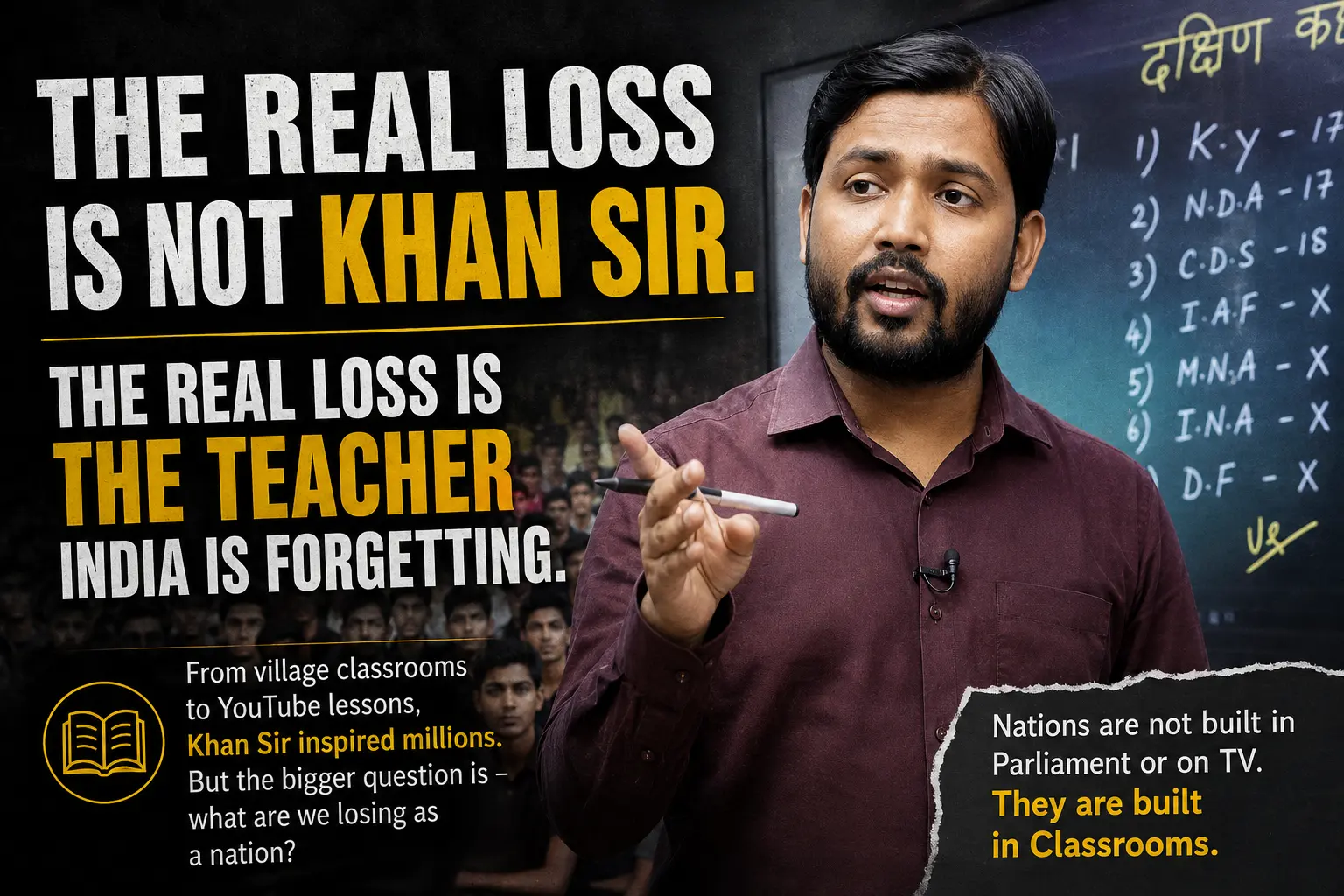
The debate around Khan Sir is no longer just about one teacher. It is about what India expects from its educators and what happens when a teacher becomes bigger than the classroom.
For generations, India’s greatest nation-builders were not politicians, celebrities, or industrialists. They were teachers. The village schoolmaster, the dedicated professor, the mentor who stayed back after class to help a struggling student—these were the people who quietly shaped the India we know today.
Khan Sir became popular because millions of students saw in him what they rarely find anymore: a teacher who understood their struggles, spoke their language, and made education accessible. His success was not just his own; it reflected the hunger of India’s youth for good teachers but there is a lesson here for all educators. In the age of social media, teachers are increasingly becoming influencers. And influencers are often rewarded for controversy, attention, and viral moments rather than education. The danger is that the classroom slowly takes a back seat to public debates, politics, and personal opinions.
The recent controversy surrounding Khan Sir’s academy may also be a consequence of success itself. When an educator teaches a few hundred students, the focus remains entirely on learning. But when that educator reaches millions, every statement, classroom remark, or opinion is scrutinized, amplified, and often interpreted through political, social, or ideological lenses. Social media, intense public attention, rising expectations, and the commercialization that often accompanies rapid growth can create an environment where controversy overshadows education. What may once have remained a classroom discussion can quickly become a national debate.
The mainstream media has largely missed this deeper story. The issue is not whether Khan Sir is right or wrong. The real issue is whether India can afford to lose teachers to the distractions of fame and controversy. A teacher’s greatest strength is not influence—it is trust. Students come from different religions, backgrounds, and beliefs, but they all enter a classroom hoping to learn and build a better future.
Today, when India faces challenges ranging from unemployment to social divisions, the country needs teachers who inspire curiosity, discipline, and character. Teachers who create scientists instead of social media warriors, innovators instead of followers, and responsible citizens instead of angry crowds.
The true measure of a teacher is not the number of followers they have. It is the number of lives they transform. Long after controversies fade and headlines disappear, what remains are the students. And that is why India needs teachers like Khan Sir—teachers who can ignite young minds—but it also needs them to remain focused on their highest calling: teaching. Nations are not built first in Parliament or on television screens, they are built in classrooms.