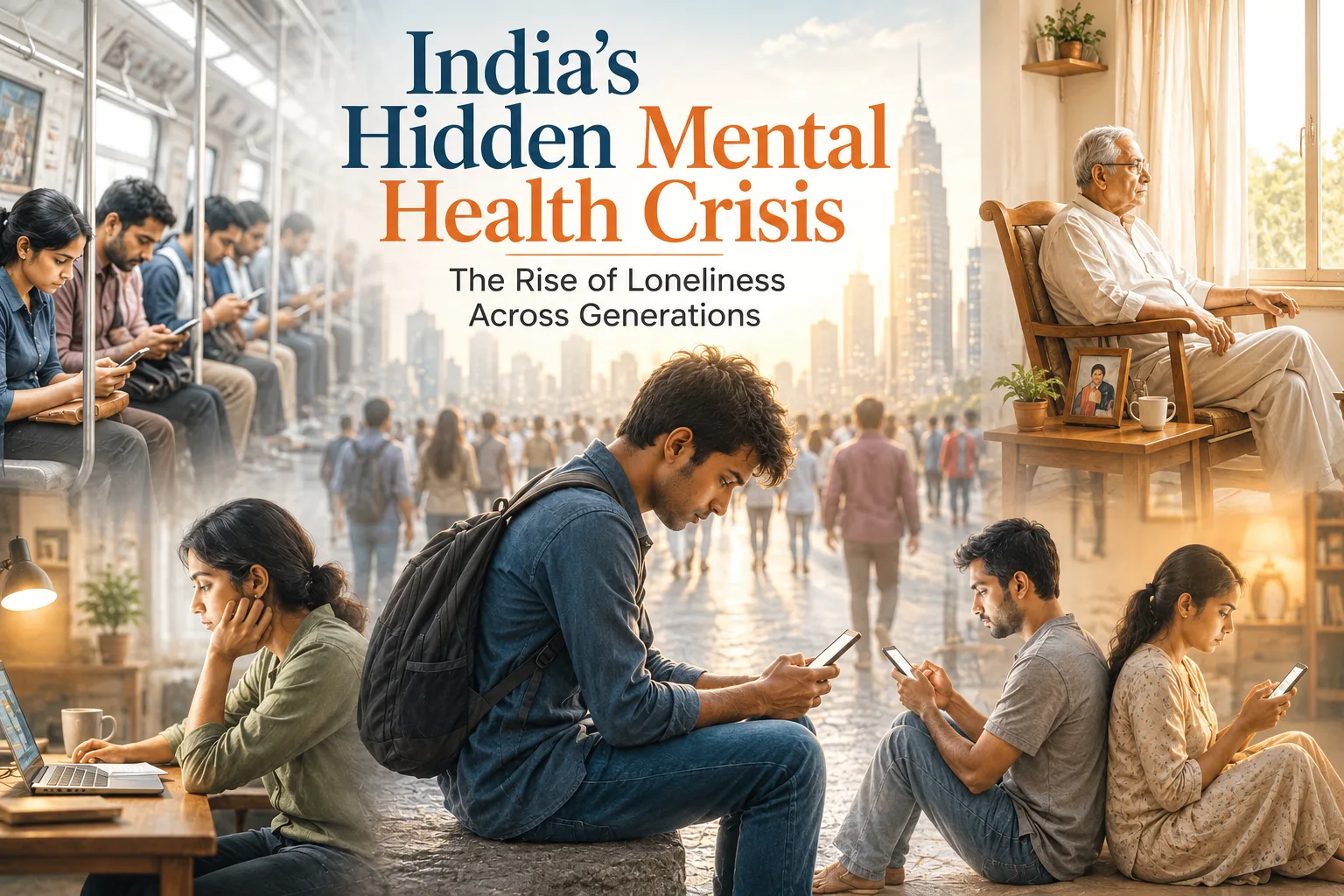
India has never been more connected. There are more smartphones than ever before. Social media notifications never stop. Video calls can connect families across continents in seconds. A person sitting in Mumbai can instantly speak to someone in New York, London or Sydney. Yet, beneath this hyper-connected world, a silent crisis is unfolding.
Millions of Indians are lonely. Not because they are physically alone, but because they feel emotionally disconnected. It is perhaps one of the greatest paradoxes of modern India. At a time when technology has made communication effortless, meaningful human connection seems harder to find than ever.
Walk into any cafe, metro station, airport or restaurant. Families sit together staring at separate screens. Friends gather but spend more time posting photos than talking to each other. Couples share homes but often struggle to share conversations. We are communicating constantly, yet connecting less.
For India’s youth, the problem is becoming particularly severe. An entire generation has grown up comparing their real lives to carefully curated social media feeds. Every scroll presents another person’s success, holiday, promotion, luxury purchase or perfect relationship. The result is a growing feeling of inadequacy and isolation. Many young Indians have hundreds of online connections but very few people they can genuinely call when life falls apart. Behind smiling selfies are often battles with anxiety, self-doubt and loneliness that remain invisible to the outside world.
The migration story that has powered India’s economic rise has also contributed to this loneliness epidemic. Every year, millions leave their hometowns in search of education and employment. Young professionals move from small towns to big cities. Students leave their families to build careers hundreds or thousands of kilometres away. The opportunities are real and so is the loneliness.
In crowded cities, people often find themselves surrounded by millions yet known by no one. Neighbours remain strangers. Friendships become transactional. Work consumes most waking hours. Weekends disappear in recovery from exhausting schedules. Many discover that success can sometimes be surprisingly lonely. Perhaps nowhere is this crisis more heartbreaking than among India’s elderly.
Across the country, countless parents spend their final decades waiting for phone calls from children who now live in different cities or countries. They proudly celebrate their children’s achievements while quietly dealing with empty homes and silent evenings. The joint family system that once provided emotional security has steadily weakened. Nuclear families have become the norm. Economic progress has improved living standards, but in many cases it has also increased emotional distance.
Many elderly Indians are not asking for financial support, they are asking for time, a conversation, a visit a feeling that they still matter. The tragedy is that loneliness does not discriminate. It affects the young professional chasing promotions, the student living away from home, the elderly parent waiting for a call, the homemaker whose sacrifices go unnoticed and even successful individuals who appear to have everything.
Loneliness often hides behind achievement, it hides behind busy schedules, it hides behind smiling photographs and because it remains invisible, society frequently ignores it. India has rightly focused on economic growth, infrastructure development and technological advancement but perhaps it is time to acknowledge that emotional well-being is also a national issue.
A nation cannot become truly strong if millions of its citizens feel disconnected from one another. The solution does not lie in abandoning technology. It lies in rediscovering humanity, it lies in conversations without distractions, it lies in checking on friends without needing a reason, it lies in visiting parents more often, it lies in creating communities where people feel seen, heard and valued. It lies in understanding that sometimes the most important message is not the one we post online, but the one we speak face-to-face.
India’s loneliness epidemic may not dominate television debates or election speeches. It may not appear in economic reports or corporate presentations but it is real and it is growing. In a country of more than 1.4 billion people, perhaps the saddest reality is this: Never before have so many people been surrounded by so many others, and yet felt so alone.