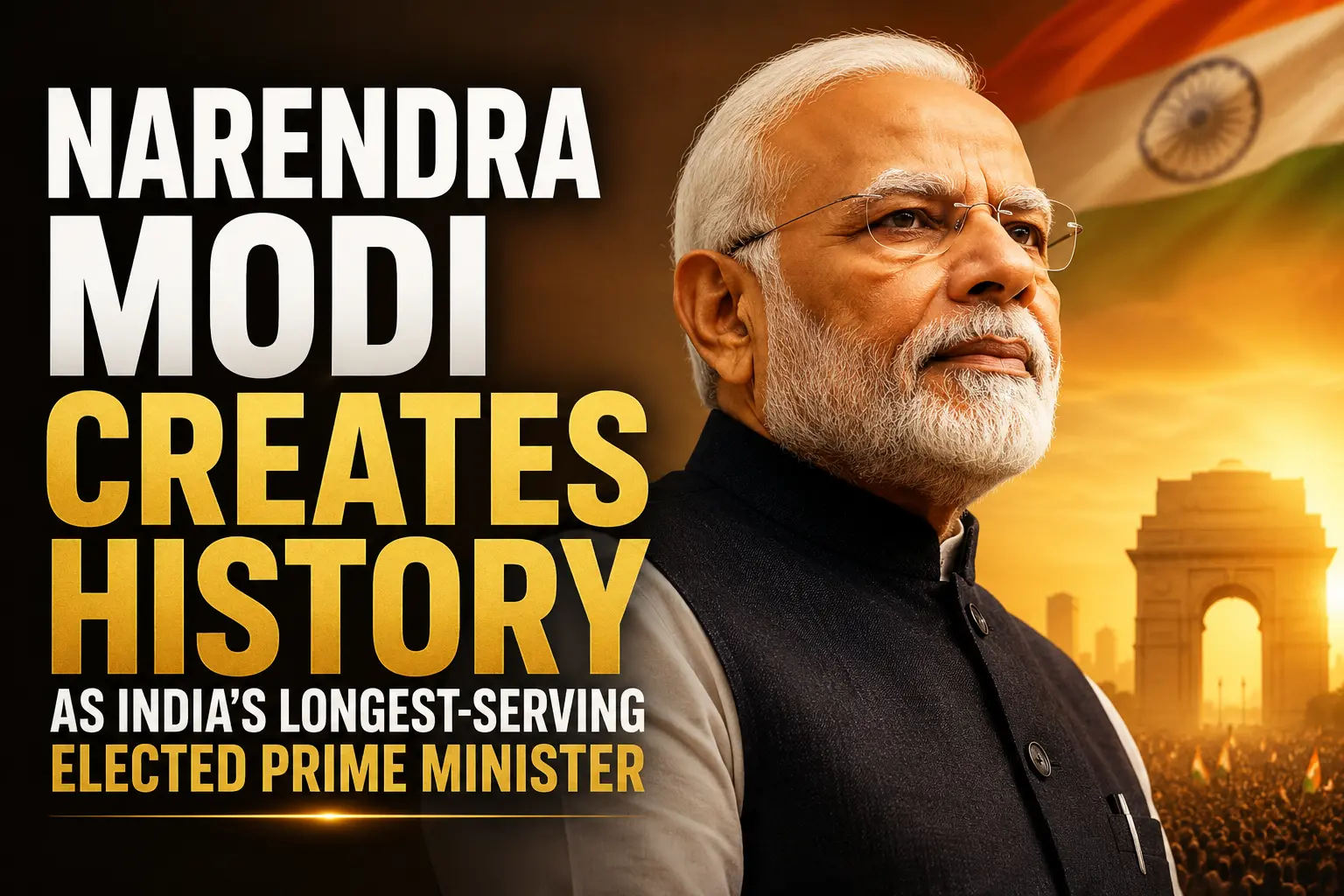
There are moments in a nation’s history that transcend politics. Moments that force a country to pause, look back, and reflect on how far it has travelled.Today is one such moment. As Prime Minister Narendra Modi completes the longest continuous tenure ever served by an elected Prime Minister of India, the milestone is about far more than a record. It is about a journey that began in obscurity and ended in history.
In a nation of 1.4 billion people, where political fortunes rise and fall with breathtaking speed, where governments are routinely tested by public anger, economic pressures, social upheavals, and relentless scrutiny, surviving is difficult. Dominating for more than a decade is extraordinary but rewriting the record books of Indian democracy is something else entirely.
For millions of Indians, Narendra Modi’s story is not merely the story of a politician. It is the story of possibility. A boy born into a modest family. A child who knew struggle before he knew power. A young man who had no political surname, no family empire, no inherited constituency, and no guarantee that history would ever remember his name. Yet today, that same man stands as the longest-serving elected Prime Minister in the history of the Republic of India.
Few journeys capture the imagination of ordinary Indians more powerfully than that. because deep down, India has always loved stories of people who rise against the odds and few odds were greater. For over a decade, Narendra Modi has remained at the centre of India’s hopes, ambitions, debates, victories, frustrations, and aspirations. An entire generation has grown up knowing only one national leader at the helm.
Children who entered primary school when he first became Prime Minister are now preparing for college. Young adults who voted for him in 2014 are now raising families of their own. For them, the Modi era is not a chapter in a history book. It is their lived experience.
These years have witnessed some of the most transformative and turbulent moments in modern India. Economic reforms, technological revolutions, welfare expansion, geopolitical shifts, a global pandemic, international conflicts, and an unprecedented reimagining of India’s place in the world.
Through it all, one figure remained constant – Narendra Modi.
Love him or oppose him, support him or criticise him, few can deny the sheer scale of his impact on India’s political landscape. That is why this moment matters because history is rarely written by those who simply hold office. History remembers those who define an era.
The truth is that records do not survive for decades by accident. They survive because democracy is unforgiving. Every election is a referendum, every victory must be earned again, every day in office is borrowed from the people and in a country as diverse, emotional, argumentative, and politically vibrant as India, retaining the trust of voters for such an extraordinary length of time is a feat few leaders anywhere in the democratic world have achieved. Perhaps the most emotional aspect of this story is not found in statistics or political analysis. It is found in the countless ordinary Indians who saw a reflection of themselves in Narendra Modi’s rise.
The small businessman who believed hard work still mattered. The student from a small town who dared to dream bigger. The first-generation entrepreneur who refused to accept limitations. The poor family that wanted their children to have a better future. For many, Modi’s journey became symbolic of India’s own journey—a nation once underestimated, now determined to command attention on the world stage.
Today, as India marks this historic milestone, the significance extends beyond one individual. It is a reminder of the extraordinary unpredictability of democracy. Who could have imagined decades ago that the longest chapter of leadership in the world’s largest democracy would be written by a man with no political dynasty behind him? Who could have predicted that he would surpass a record set by Jawaharlal Nehru, one of the founding architects of modern India?
History often surprises us and sometimes it humbles us because no matter where one stands politically, some moments demand acknowledgment. This is one of them. Years from now, when future generations study the story of 21st-century India, they will debate policies, question decisions, celebrate achievements, and analyse controversies.
But one fact will remain unchanged. Narendra Modi did not merely serve as Prime Minister. He became one of the defining figures of modern India. He became the leader who occupied the office longer than any elected Prime Minister before him and in doing so, he etched his name into the permanent memory of the Republic. Long after today’s headlines disappear, long after political battles fade, and long after contemporary debates give way to new ones, this moment will endure because records are eventually broken , governments eventually change, political movements eventually evolve but every nation remembers the leaders who leave an imprint large enough to shape an era.
And whether viewed through admiration, criticism, or history’s impartial lens, Narendra Modi’s chapter has become impossible to ignore.
It is now written permanently into the story of India.