


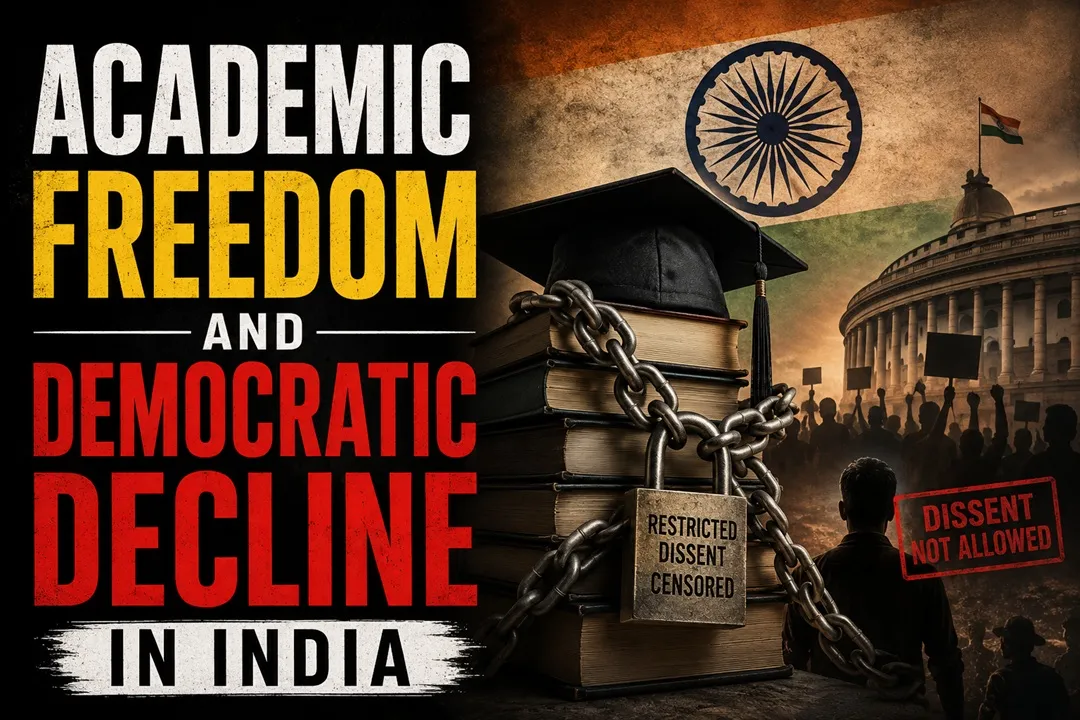


If India is a “democracy”, why are professionals calculating the risk before they speak

The CSR Journal Magazine

There is a particular kind of silence that settles over a dinner table when someone almost says something political. You can feel it. The slight pause before a sentence, the quick scan of who is listening, the pivot to something safer, something about the weather, or cricket, or the price of onions. In India today, that silence has migrated from the dinner table into the university seminar room, into the corporate town hall, into the teacher’s lounge. And the most unsettling part is that many people no longer notice it. They have made their peace with not speaking.

This is not a small thing. This is a civilisational surrender.

The Price of Having a View

A professor of history at a central university, someone who has spent twenty years studying communal violence in colonial India, decides one morning to post a three-line comment on social media about the naming of a public building. By evening, a complaint has been filed with the university administration. By the next morning, a local news channel is running a chyron describing the professor as “anti-national.” By the end of the week, the professor is being asked to appear before a committee. The research, the twenty years, the institutional credibility, none of it matters. What matters is the three lines.

Now ask yourself: what does the professor do next time they want to say something?

They don’t. They learn the lesson. And in learning the lesson, they become a slightly smaller version of the person they set out to be.

This is how intellectual cultures collapse, not through dramatic bonfires of books, but through the slow, deliberate shrinking of people.

There is a tendency to frame this problem in purely moral terms, as a question of courage versus cowardice. That framing is both lazy and unfair. When we talk about a schoolteacher in a government-aided institution in a small town in Uttar Pradesh who chooses not to tell her students what she actually thinks about the Citizenship Amendment Act, we are not talking about a failure of backbone. We are talking about a person doing a rational economic calculation.

She has a family. She has a provident fund that vests in three years. She has a mother whose medical expenses she manages. Her salary is the only income in the household. Now weigh that against the hypothetical value of expressing a political opinion. What exactly does she gain? A moment of intellectual honesty, perhaps. What does she risk? Everything.

Economists call this a chilling effect. It is the phenomenon where, even in the absence of a direct law prohibiting speech, the credible threat of punishment produces the same outcome as prohibition. Nobody bans the teacher from speaking. She bans herself. And the state achieves its preferred outcome without having to get its hands dirty.

What makes India’s version of this particularly vicious is the asymmetry of exposure. The threat is not distributed equally. A senior professor at a well-funded private university in Bangalore, with international publications and a foreign collaborator, has considerable protection. She can afford to speak. Her counterpart at a state-funded college in Muzaffarnagar cannot. The chilling effect is most severe exactly where it is most disabling, at the bottom of institutional hierarchies, among the people with the least cushion.

This is a regressive tax on speech. The poor pay more of it.

If the academy has been intimidated into silence, Indian corporate culture was never particularly committed to speech in the first place. It was already structured around hierarchy, deference, and the relentless management of optics.

But something has shifted in the last decade. The stakes of corporate speech have risen. The government is a major customer, regulator, licensor, and partner for largest Indian businesses. A publicly listed company whose senior employee posts a critical opinion about government policy on LinkedIn is now calculating not just the HR optics, but the regulatory implications. Licences can be delayed. Inspections can happen. Tenders can be quietly deprioritised. The infrastructure of state power touches corporate life at enough points that the cost-benefit of employee dissent looks very different from how it looked in 2013.

This is not speculation. There is a well-documented pattern, across media companies, technology firms, and conglomerates, of internal communications asking employees to avoid commentary on politically sensitive subjects. Some companies have explicit social media policies that prohibit “reputationally sensitive” content. Others rely on informal culture, the ambient understanding that visible dissent is a career-limiting move.

The result is a professional class that has outsourced its political conscience to the privacy of its own skull. In public, on LinkedIn, at industry events, they are relentlessly positive, aggressively non-controversial, and spiritually vacant. They will post about leadership lessons from the Bhagavad Gita. They will not post about farmers sitting in the cold at Singhu.

When Your Identity Is the Problem

For minorities, including Muslims, Christians, Sikhs in certain regions, and Dalits navigating institutional structures that were never built for them, the calculation is not just economic. It is existential.

Consider what it means for a Muslim professor at a public institution in the current climate to express a view on, say, the demolition of a mosque, or the curriculum changes in NCERT textbooks, or the violence in Manipur. The political view is inseparable from the religious identity. The professional becomes the symbol. The symbol becomes the target.

A Hindu professor expressing the same view might be labelled a “liberal” or a “leftist,” categories that carry professional risk but not usually physical risk. A Muslim professor expressing the same view is potentially described as a “jihadi sympathiser.” The category carries a different kind of threat, one that extends beyond the campus, beyond the HR department, into the street.

How free is a democracy in which certain citizens pay a systematically higher price for the act of speaking? What do we call a system that formally guarantees rights to all its citizens but structurally ensures that those rights are unaffordably expensive for some of them to exercise?

This is not secularism. This is the ghost of secularism, the word still on the letterhead while the practice has vacated the building.

What Happens to Women Who Speak

The gendered dimension of this silence deserves its own reckoning.

When women in professional settings, particularly in education, express political views, they are subject to a two-axis attack. First, the political attack, the same one any dissenter faces. Second, a specifically gendered attack that questions their character, their sexuality, their mental stability, or their fitness as mothers and wives. Social media makes this devastatingly efficient. A female academic who posts a critical thread about the UGC’s new regulations can expect responses about her appearance. A woman corporate executive who shares a critical op-ed about government economic policy might find her phone number being circulated in WhatsApp groups.

This is not incidental. It is strategic. The gendered harassment is designed to make the cost of speech higher for women than for men, to ensure that women who consider entering public intellectual life are warned, in the most intimate and violating ways possible, about what awaits them.

The outcome is a public intellectual landscape that is increasingly male, increasingly upper-caste, increasingly willing to perform the dominant cultural consensus. Women who remain in that landscape have often made calculated decisions about what they will and will not say. They are not less intelligent or less brave than the women who have gone silent. They are simply more practiced at managing exposure.

The Constitution Is a Beautiful Document That Lives in a Glass Case

Article 19 of the Indian Constitution guarantees freedom of speech and expression. It is one of the more robustly worded free speech protections in any democratic constitution. It lives in Devanagari script in a nitrogen-filled glass enclosure in Constitution Hall in New Delhi. It is treated with tremendous physical reverence. It is not treated with particularly tremendous operational reverence.

The mechanisms of suppression do not usually need to work against Article 19 directly. They work around it. Sedition law, though recently put in abeyance, was deployed for decades against journalists, students, and professors who criticised government. The UAPA, the Unlawful Activities Prevention Act, requires no charge sheet within the kind of timeframe that would make it a deterrent rather than a punishment. IT Act provisions on “offensive” content are vague enough to be applied selectively. And beyond all formal law, there is the informal apparatus, the FIR that may not result in a conviction but still requires you to show up at a police station and hire a lawyer and take a day off work, repeated enough times to communicate the message clearly.

When an instrument of the state can make your life expensive and frightening simply by initiating a process against you, regardless of its eventual outcome, then the formal protection of rights begins to look like scenery on a stage where something else is being performed.

There is a body of social psychology, going back to Solomon Asch’s conformity experiments and extending through Zimbardo and Milgram, that tells us something uncomfortable: people do not need physical coercion to conform. They need only the perception of observation and the credible belief that deviance will be noticed. In the age of social media and Aadhaar-linked digital footprints, that perception is total.

What we are observing in India is not just political suppression. It is a large-scale behavioural experiment in what happens to a population when the cost of non-conformity feels permanently elevated. The result, as psychology would predict, is not just external compliance but internal revision. People do not just stop saying things they believe. After long enough, they begin to rearrange what they believe to match what is safe to say. The mind, remarkably adaptable, begins to find ways to agree with power. The discomfort of cognitive dissonance is resolved, not by speaking truth, but by adjusting truth to avoid the discomfort.

This is the most profound damage. It is invisible. It shows up not in any crime statistic or university report, but in the texture of intellectual life, in the quality of public debate, in the narrowing range of ideas that feel thinkable in a given moment. A society that has spent a decade suppressing dissent does not just have fewer dissenters. It has worse ideas.

The Mythology of the Sensitive Majority

One of the most effective tools in the suppression of speech in India has been the constant invocation of hurt sentiments. The argument runs like this: your words have offended the religious feelings of a community, and since that community is the majority, the offence constitutes a social harm that justifies restriction.

This argument is circular in the most cynical way. It posits that the majority’s emotional response to criticism is a legitimate constraint on speech, while never asking what happens to the minority’s emotional experience of living in a society that increasingly does not include them in its conception of itself. The Muslim student who sits in a classroom where the textbook has been revised to minimise the Mughal period does not get to invoke her hurt sentiments as a constraint on curriculum design. The Dalit professional who watches his caste being mobilised as an electoral instrument does not get a hearing for his emotional response to dehumanisation. Hurt sentiments, it turns out, are a selective political tool, not a principled limitation on expression.

Are We a Democracy, or Have We Just Been Using the Word Wrong?

Democracy is not voting. Voting is a condition of democracy, not its definition. A democracy requires, at minimum, a free press, an independent judiciary, freedom of political organisation, and the meaningful ability of citizens to express dissent without state reprisal. Strip away the procedural elements and what you have is a nation that conducts elections. Elections in which the information environment has been shaped by media capture, in which the judiciary takes the longest possible time adjudicating bail petitions for journalists and professors, in which the political opposition is repeatedly subject to investigation by central agencies, and in which ordinary professionals have learned to ration their public thoughts.

What do you call that?

You can call it many things. But intellectual honesty demands that we not call it a fully functioning democracy without immediately asking: functioning for whom?

The Small Acts of Courage That Remain

None of this is to say that India is a country without dissent. It is not. The student who chalks her views on a university wall knowing the risk, the journalist who covers the story that the editors would prefer to leave alone, the teacher who tells her class what the textbook has left out, the Muslim professional who posts the opinion and waits for the notifications with her hands steady, these people exist. They are not romanticised heroes. They are ordinary people doing ordinary things at ordinary cost, and the fact that we treat it as heroism is itself the measure of how far we have fallen.

What a society needs is not heroic dissenters. It needs conditions in which dissent is unremarkable. It needs a normal, functioning intellectual culture where a professor can have a view about government policy and express it without calculating whether she will still have a job next month. It needs corporate boardrooms where someone can say an uncomfortable thing about the direction of the country without everyone in the room going very quiet and looking at their laptops.

That is not asking for chaos. It is asking for the baseline condition of a healthy republic. It is asking for the quiet ordinary freedom that the Constitution promised and that, for too many people, has become a luxury they cannot afford.

The silence in the seminar room is not peace. It is the sound of a democracy eating itself.

Views of the author are personal and do not necessarily represent the website’s views.

Dr. Jaimine Vaishnav is a faculty of geopolitics and world economy and other liberal arts subjects, a researcher with publications in SCI and ABDC journals, and an author of 6 books specializing in informal economies, mass media, and street entrepreneurship. With over a decade of experience as an academic and options trader, he is keen on bridging the grassroots business practices with global economic thought. His work emphasizes resilience, innovation, and human action in everyday human life. He can be contacted on jaiminism@hotmail.co.in for further communication.

Long or Short, get news the way you like. No ads. No redirections. Download Newspin and Stay Alert, The CSR Journal Mobile app, for fast, crisp, clean updates!

App Store – https://apps.apple.com/in/app/newspin/id6746449540

Google Play Store – https://play.google.com/store/apps/details?id=com.inventifweb.newspin&pcampaignid=web_share

Latest News

Popular Videos