


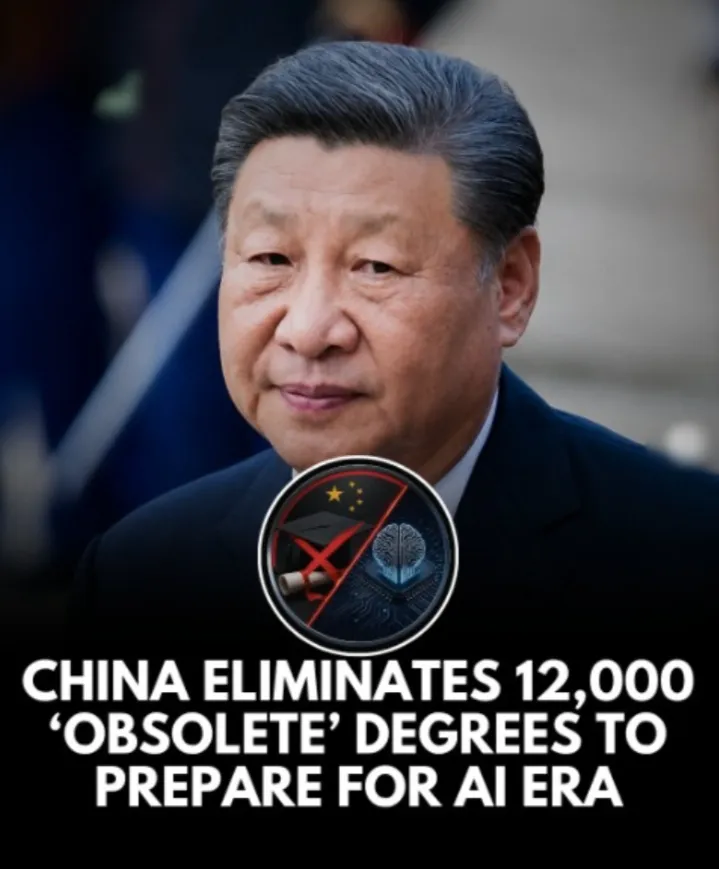
China Eliminates 12,000 College Degrees to Promote AI Courses
The CSR Journal Magazine

The recent move by China to eliminate a significant number of college degrees is part of a broader strategy to align its educational system with the rapid rise of artificial intelligence (AI) and other emerging technologies. This decision reflects not only the changing dynamics in the job market but also the need for graduates to acquire skills that are in demand. As more industries automate their operations, students are reassessing the value of traditional degrees that may soon have diminished relevance.

Universities in China are reportedly overhauling their academic offerings by discontinuing courses that are perceived as outdated. The shift is largely driven by the increasing need for skilled workers in fields such as AI, robotics, and advanced manufacturing. Consequently, subjects that fall under arts, humanities, and management are facing cuts as institutions adjust their programs to better align with national economic goals.

This transformation is considered necessary in light of China’s high youth unemployment rates, which remain above 16 per cent. With more graduates entering the job market each year, the competition for relevant employment has intensified, prompting a reconsideration of academic paths that lead to viable employment opportunities.

Introduction of New Courses Targeting Technological Advancement

In tandem with the phasing out of certain degrees, Chinese universities are concurrently introducing courses that focus on areas crucial for the country’s industrial ambitions. One notable example is the emergence of new degree programs in embodied intelligence, a field that merges AI with physical automation, such as robotics. At least nine universities have launched majors in this area, underscoring the government’s push to incorporate AI technologies into the economy.

According to data from the Ministry of Education, between 2021 and 2025, universities in China have reportedly revoked or suspended approximately 12,200 undergraduate programs while simultaneously adding around 10,200 new ones. This rapid alteration in academic structures indicates that more than 30 per cent of university programs have gone through significant modifications within a four-year timeframe, reaffirming the urgency for educational reform.

However, experts are expressing concerns that merely replacing old programs with new ones may not suffice to address the underlying issues in higher education. Many current courses were introduced recently, and their effectiveness has yet to be fully evaluated. Rather than a continuous cycle of additions and eliminations, experts advocate for a more stable and flexible educational structure that is adaptable to ongoing technological changes in industry needs.

Call for Structural Reforms in Higher Education

The ongoing adjustments in China’s higher education landscape have garnered attention, prompting discussions on the necessity for deeper reforms beyond superficial changes. Experts emphasise the importance of a robust framework that allows students to select courses in line with evolving market demands. They highlight the significance of equipping students with skills that will remain relevant despite the rapid pace of technological transformation.

The recurring trend of cutting and replacing academic programmes may dilute the educational experience, according to advocates for reform. By fostering a more dynamic educational environment that prioritises adaptability, universities can better prepare graduates for the future workforce. This approach would ideally lead to enhanced employability and a more aligned educational ethos with national and global economic trends.

As China continues on its path to becoming a leader in AI and advanced manufacturing, the implications of these educational reforms will be closely monitored. The substantial changes in the higher education sector aim to not only respond to current economic needs but also ensure that future generations of students are equipped to navigate an increasingly complex job market.

Long or Short, get news the way you like. No ads. No redirections. Download Newspin and Stay Alert, The CSR Journal Mobile app, for fast, crisp, clean updates!

App Store –  https://apps.apple.com/in/app/newspin/id6746449540 

Google Play Store – https://play.google.com/store/apps/details?id=com.inventifweb.newspin&pcampaignid=web_share

Latest News

Popular Videos
