


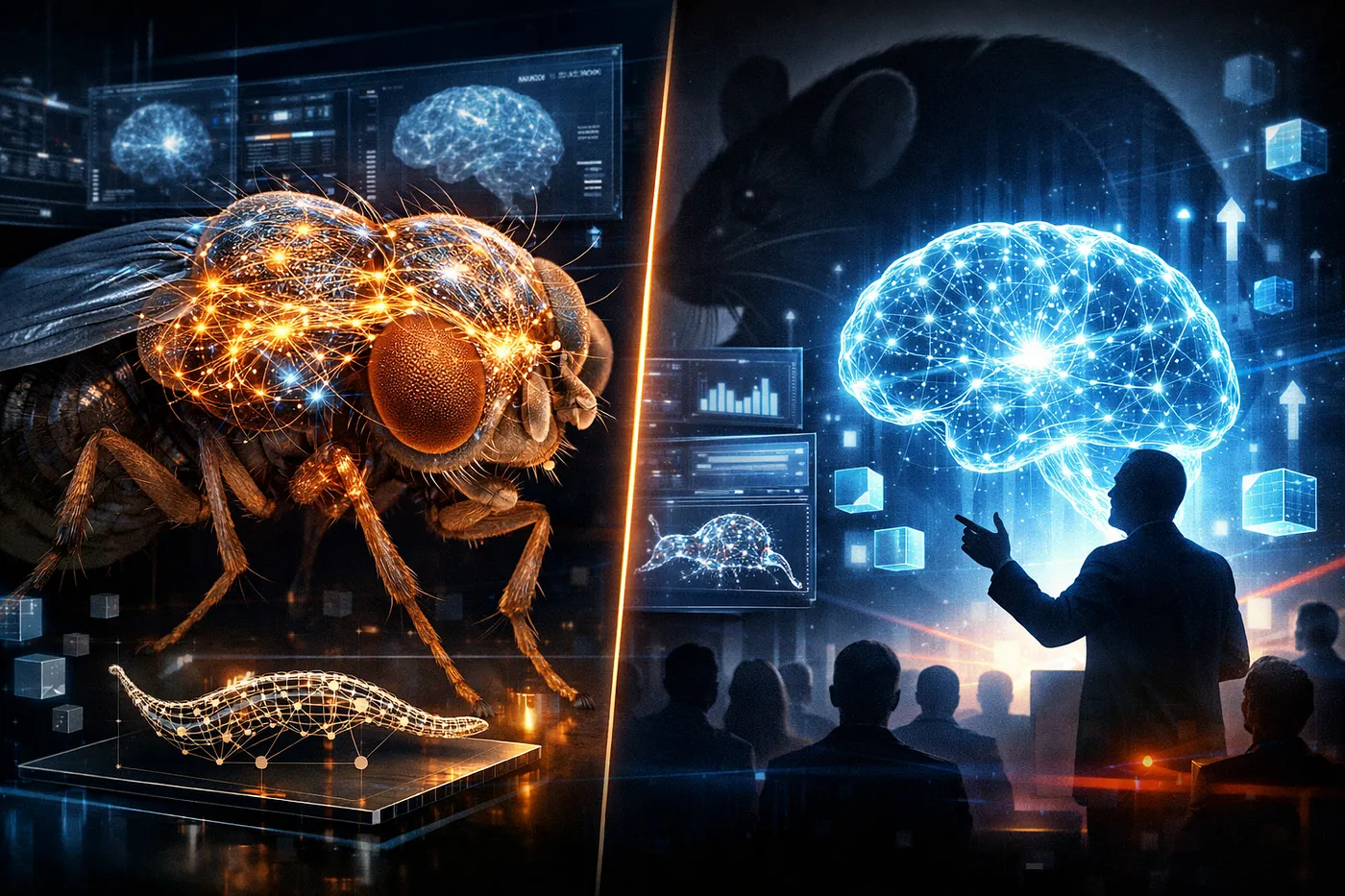

Scientists Successfully Simulate Fruit Fly Brain with AI Technology

The CSR Journal Magazine

Recent advancements in artificial intelligence have led to significant breakthroughs, with researchers now exploring the potential to simulate entire brains. A notable achievement has come from a technology company named Eon Systems, which has reportedly created a simulation of a fruit fly’s brain capable of generating complex behaviours. This development suggests that the methods used could be a stepping stone toward more sophisticated brain simulations, including those of humans.

The company showcased a virtual representation of a fruit fly navigating a simulated environment, exhibiting behaviours such as cleaning its antennae and consuming virtual banana slices. The ability of this virtual fly to mimic the actions of a real fruit fly has garnered considerable interest, highlighting the possibilities inherent in AI-driven simulations.

Eon Systems’ simulation operates with an impressive accuracy rate of 95 per cent, achieved by closely analysing the workings of a fruit fly’s brain with electron microscopy. Data gathered from this analysis was paired with an AI algorithm to precisely control the neurons in the virtual fly’s brain, mirroring the biophysical processes that occur in a living fruit fly.
Implications of Mind Uploading Research

This project by Eon is seen as an exploratory step towards the concept of mind uploading. Eon’s co-founder, Wissner-Gross, believes this initial experiment could eventually pave the way for simulating more complex brains. Although he acknowledges that there are limitations and issues to address, he expresses optimism about achieving technical accuracy in modelling not just the brain of a fly, but potentially other organisms and eventually humans.

If successful in replicating the human brain, the simulation might raise questions about consciousness and identity. Eon posits that if every neural signal could be digitised accurately, the virtual representation could embody the memories, feelings, and experiences unique to an individual. This notion challenges current understandings of consciousness within artificial intelligence frameworks.

Experts in neuroscience have expressed both intrigue and caution regarding this technology. Some, such as Karl Friston from University College London, argue against the assumption that simulating a conscious brain guarantees the presence of authentic experiences or emotions within that simulation. This caution highlights the complex relationship between biological consciousness and artificial replicative efforts.

Future Directions and Considerations

The implications of successful brain simulation extend well beyond mere technological advancements; they could redefine the landscape of artificial intelligence. If Eon Systems achieves a reliable simulation of the human brain, it might propel AI into new realms, potentially enabling it to interact in ways that mirror human behaviour and thought processes.

However, there are various ethical concerns surrounding such achievements. Perspectives like that of neuroscientist Anil Seth emphasise that creating a digital copy of experiences—akin to simulating a rainstorm on a computer—does not yield true emotional awareness or physical sensations. The debate highlights the essential difference between artificial replication and genuine consciousness.

As research continues, further exploration will be necessary to navigate the ethical, philosophical, and technical challenges posed by brain simulations. While the prospect of successfully simulating human consciousness remains distant, developments like those from Eon Systems may contribute to the foundational knowledge needed for future breakthroughs in this ambitious field.

Long or Short, get news the way you like. No ads. No redirections. Download Newspin and Stay Alert, The CSR Journal Mobile app, for fast, crisp, clean updates!

App Store –  https://apps.apple.com/in/app/newspin/id6746449540 

Google Play Store – https://play.google.com/store/apps/details?id=com.inventifweb.newspin&pcampaignid=web_share

Latest News

Popular Videos