


Satellite Imagery Indicates Strong Western Disturbance Approaching India
The CSR Journal Magazine

The headline highlights that satellite imagery shows a significant western disturbance on its way to India. Currently, vast regions of the country are grappling with extreme heatwave conditions, resulting in persistently high temperatures day and night.

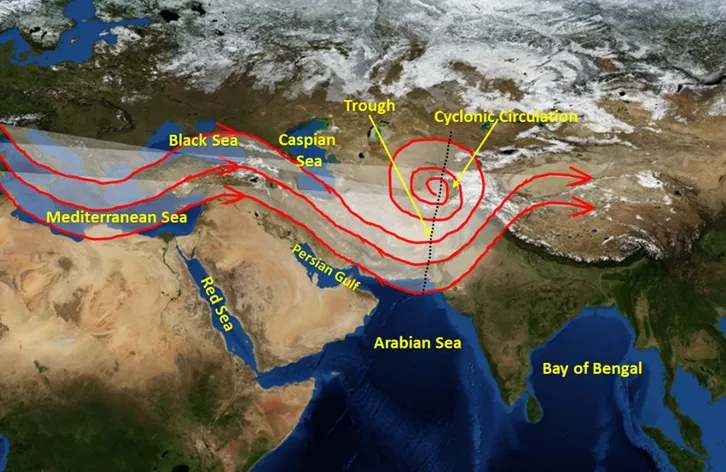
Recent thermal infrared imagery from the India Meteorological Department (IMD) shows a substantial cloud mass and cyclonic circulation extending over Afghanistan, Pakistan, and parts of northwest India. This system, observable as dense white cloud bands, is heading east towards the Himalayan region and northern plains, intensifying hope for upcoming rainfall.

Since the beginning of May, northwestern and central India have faced intense heat. Cities in Delhi, Rajasthan, Haryana, and Uttar Pradesh, along with specific areas in Madhya Pradesh, have reported daytime temperatures soaring above 45 degrees Celsius. Nighttime temperatures have also remained high, affecting recovery for residents after daylight hours.

Specifics of the Western Disturbance

The satellite imagery points to an extensive moisture incursion over the Arabian Sea, with significant cloud formation observed across northeast India and the Bay of Bengal. Meteorological experts believe that this incoming western disturbance may engage with the existing moisture, potentially leading to thunderstorms, gusty winds, lightning, and scattered rainfall in various regions.

Notably, the most vigorous cloud activity detected is concentrated over northern Pakistan and Jammu & Kashmir, signifying strong atmospheric instability linked with the system’s arrival. Additional convective cloud clusters are evident over northeast India, suggesting the presence of pre-monsoon thunderstorms already developing in the eastern part of the nation.

Meteorologists anticipate that the western disturbance could result in rainfall across Jammu & Kashmir, Himachal Pradesh, Uttarakhand, Punjab, Haryana, Delhi, and western Uttar Pradesh in the coming days, though the exact intensity of the rainfall remains uncertain. Furthermore, there is a likelihood of dust storms and isolated hailstorms in certain areas as well.

Potential Impact of Weather Changes

While the projected rainfall may not entirely alleviate the heatwave gripping northern India, it could provide a significant dip in temperatures, particularly by reducing excessively high nighttime temperatures. The current satellite observations also indicate a burgeoning activity in the Arabian Sea and southern Bay of Bengal, where cloud clusters are beginning to organise as conditions for the monsoon gradually enhance.

For many individuals enduring uncomfortable, sleepless nights due to the heat, the imminent weather system may deliver sought-after temporary relief. Nonetheless, meteorologists caution that with climate change amplifying extreme weather patterns, India faces the prospect of prolonged and increasingly severe heatwaves that are becoming more unpredictable over time.

In summary, as the western disturbance makes its approach, the weather dynamics across India are expected to evolve, offering the possibility of rainfall and a potential respite from the current heatwave. These changes hold significant relevance for millions impacted by the ongoing high temperatures and associated conditions.

Long or Short, get news the way you like. No ads. No redirections. Download Newspin and Stay Alert, The CSR Journal Mobile app, for fast, crisp, clean updates!

App Store –  https://apps.apple.com/in/app/newspin/id6746449540 

Google Play Store – https://play.google.com/store/apps/details?id=com.inventifweb.newspin&pcampaignid=web_share

Latest News

Popular Videos
