


India’s Monsoon Faces Significant Challenges With 42% Rainfall Deficit
The CSR Journal Magazine

India’s southwest monsoon is currently undergoing a prolonged slowdown, resulting in a substantial rainfall deficit. According to data from the India Meteorological Department (IMD), the all-India rainfall deficit stood at 42% between June 4 and June 18. The country recorded only 42.1 mm of rain as compared to the normal 72.2 mm during this timeframe.

The insufficient rainfall indicates a severe challenge for the current monsoon season, which just began a fortnight ago. Large regions of the country are experiencing significantly below-normal precipitation. A district-wise rainfall analysis reveals a concerning trend, with many areas in central, eastern, and peninsular India classified under deficient or large deficient categories.

Only a few isolated areas in northwest India and segments of the western Himalayan region have reported excess rainfall. The overall situation suggests that rain distribution is highly uneven across the nation, with many states facing alarming dry spells. The ongoing drought-like conditions have raised concerns about agricultural impacts and water supply.

Satellite Imagery and Atmospheric Conditions

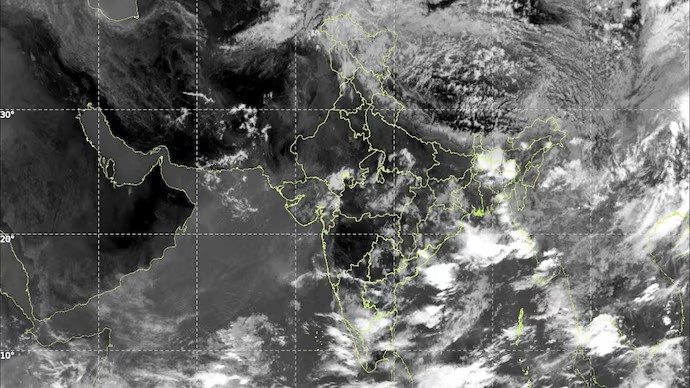
Satellite imagery from INSAT-3DS dated June 18 illustrates the complexity of the situation. The imagery reveals that the densest cloud formation is primarily concentrated over the western Himalayas and adjacent northern regions, attributed to an active western disturbance. Conversely, large portions of central India, including Maharashtra and Gujarat, remain significantly cloud-free, affecting rainfall distribution.

Current conditions indicate that the Arabian Sea branch of the monsoon appears weak, with minimal deep convection occurring along the western coast. Similarly, the Bay of Bengal branch is only generating scattered thunderstorm clusters in eastern and northeastern India. Meteorologists note that the monsoon circulation is still struggling to establish itself effectively throughout the country.

The stagnation in monsoon activity has persisted for several days, primarily due to upper-level atmospheric conditions that are inhibiting its northward movement. Continuous disruptions from western disturbances have further hampered traditional monsoon flows, limiting the advancement of moisture-laden winds into critical regions.

Ground-Level Impact and Future Prospects

The impact of the rainfall shortfall is becoming increasingly evident on the ground. States like Maharashtra are reporting severe deficits, with Mumbai experiencing one of its driest Junes in over a decade. As a measure to address water scarcity, local authorities have resorted to imposing water restrictions. Parts of central India, particularly in Vidarbha and Madhya Pradesh, are also bracing for a meaningful revival of the monsoon.

As we move deeper into June, timing is crucial for the monsoon’s recovery. The season necessitates a robust surge in rainfall from both the Arabian Sea and the Bay of Bengal to mitigate the existing deficit. However, current satellite observations suggest that a widespread revitalisation is not imminent.

Unless a significant low-pressure system can develop and moisture transport strengthens substantially within the upcoming week, the rainfall deficit is likely to persist into late June. This could complicate efforts for a full recovery of the monsoon, underscoring the urgency for favourable weather conditions to avoid long-term ramifications.

Long or Short, get news the way you like. No ads. No redirections. Download Newspin and Stay Alert, The CSR Journal Mobile app, for fast, crisp, clean updates!

App Store –  https://apps.apple.com/in/app/newspin/id6746449540 

Google Play Store – https://play.google.com/store/apps/details?id=com.inventifweb.newspin&pcampaignid=web_share

Latest News

Popular Videos
