



Pakistan was built on one idea. Religion would hold together a country that geography, language and ethnicity never agreed to hold together.
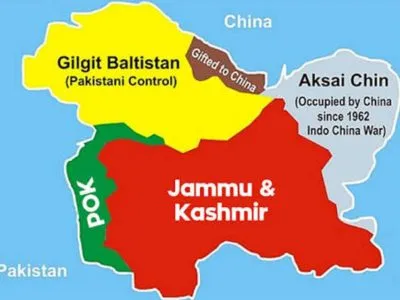
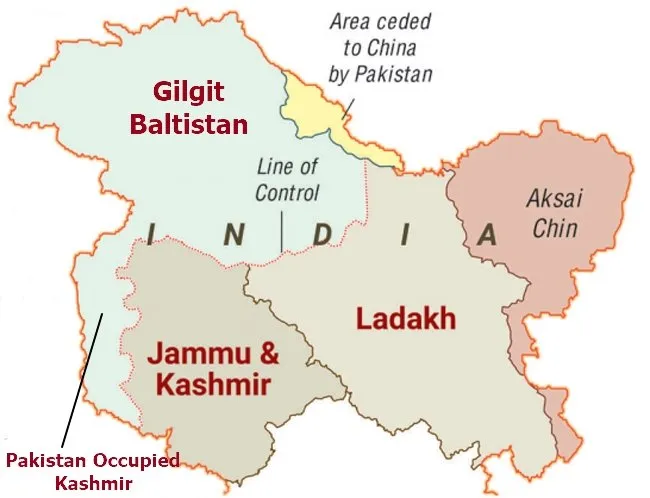
79 years later, that idea is cracking in the 2 places Islamabad talks about the least in polite company: Balochistan and Pakistan-occupied-Kashmir, including Gilgit Baltistan. Both regions are done pretending the federation works for them. The signal is no longer subtle. It is bodies, blockades and burnt patience.
This is not a call for war cries or map fantasies. It is a plain reading of numbers, patterns and incentives.
And the conclusion is simple.
A vacuum is opening on India’s western border: If New Delhi does not fill it with quiet, sustained statecraft, Beijing or Tehran will fill it instead, on terms far less comfortable for India.
Balochistan: A Province Treated Like a Colony
Balochistan is Pakistan’s largest province by land, about 44% of the country’s territory, and its smallest by population share. It sits on gas, copper, gold and a coastline that opens straight onto the Arabian Sea and the mouth of the Strait of Hormuz. It should be Pakistan’s richest region. Instead it is its poorest, and the reason is not an accident of geology. It is policy.
Look at the resource math first.
The Reko Diq copper gold deposit in Chagai district is one of the largest undeveloped mineral finds on earth. Pakistan and Balochistan’s provincial government together hold a 50% stake, with Barrick Gold holding the other half, and the project has drawn 3.5 billion dollars in international financing from the Asian Development Bank, the US Export-Import Bank and other lenders in late 2025.
Officials project the mine will generate something in the range of 75 billion dollars over roughly 35 years, with between 7,500 and 13,500 jobs at full production. That sounds generous until you remember whose land this is and who has historically been shut out of its returns. A 1993 deal handed 75% of Reko Diq’s shares to an Australian company, sparking outrage in a province where most people live below the poverty line, and the fight over who profits from Baloch soil has run for 3 decades since.
Then there is the China Pakistan Economic Corridor (CPEC).
Nationally, CPEC has pulled in 25.9 billion dollars in investment and created more than 261,000 jobs since it began, with the wider corridor valued at roughly 60 billion dollars. Gwadar port, sitting inside Balochistan, is the crown jewel of this plan, marketed as the future gateway between China and the Gulf. But energy projects make up 60% of announced CPEC funding within Balochistan itself, largely built to enable mining and extraction rather than to develop the province’s own economy. The people living on top of this wealth still face some of the worst human development indicators in South Asia. Roads exist to move ore and gas out, not to connect Baloch towns to hospitals or universities.
This is the oldest colonial trick in the book, dressed up as a national development project. Extract the resource, ship the profit to the capital and to a foreign patron, and leave the local population with dust, checkpoints and a military garrison.
Now look at what the Pakistani state does to anyone who objects.
The numbers on enforced disappearances in Balochistan are not whispered activist rumors anymore. They are monthly, documented, and rising.
Paank, the human rights wing of the Baloch National Movement, recorded 1,355 enforced disappearances in 2025 and 225 extrajudicial killings, with the pattern continuing into 2026 at 82 disappearances in January and 109 in February. A separate monitor put the February 2026 figure even higher, at 234 enforced disappearances including a woman and 9 teenagers, alongside 87 killings that month, with students the single largest group of victims and the Frontier Corps identified as the main perpetrator.
March brought 65 more disappearances and 50 killings, again concentrated among students, with 14 of the dead having previously been reported missing before being found killed in custody.
April added 124 further disappearances, including 8 women and 5 teenagers, and 53 killings, with the Frontier Corps again named as the primary force behind the abductions.
Read that pattern again. Students. Teenagers. Women. Health workers. People picked up from hostels, buses and their own homes, some released after weeks of torture, many never seen again, others returned only as bodies. In just two weeks in January 2026, the Baloch Yakjehti Committee documented 18 people forcibly disappeared in raids across Kech and Gwadar districts alone. This is not counter-insurgency. This is collective punishment of an entire ethnic population for the actions of an armed few.
And the armed few are not going away. In one of the bloodiest stretches on record, Baloch guerrillas, mainly the Baloch Liberation Army, killed at least 42 Pakistani security personnel in 4 days starting July 5, 2026, prompting a major new army operation that claimed 102 Baloch fighters killed in response.
On January 31, 2026, the BLA carried out coordinated attacks across more than a dozen cities in Balochistan simultaneously, including the provincial capital Quetta itself. This is not a fringe insurgency hiding in the hills anymore. It is a movement with the reach to strike the seat of provincial government on a single day, in multiple cities at once.
A Pakistani army spokesman was once asked directly about the missing. His answer, on record, was that the state does not “wish that anyone should be missing”. That is the entire official position, offered with a straight face while the bodies keep turning up in ditches.
 Dr. Jaimine Vaishnav is a faculty of geopolitics and world economy and other liberal arts subjects, a researcher with publications in SCI and ABDC journals, and an author of 6 books specializing in informal economies, mass media, and street entrepreneurship. With over a decade of experience as an academic and options trader, he is keen on bridging the grassroots business practices with global economic thought. His work emphasizes resilience, innovation, and human action in everyday human life. He can be contacted on jaiminism@hotmail.co.in for further communication.