


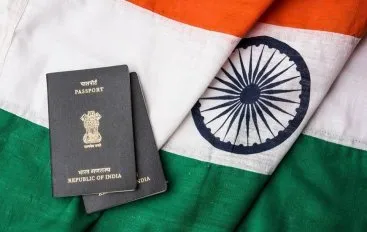

For a country that likes to describe itself as a rising power, India’s passport tells a strange story. In 2006, the Indian passport stood at 71st position on the Henley Passport Index. By 2025, it had slid to 85th.
In early 2026, after 2 rounds of upward revision, it climbed back to somewhere between 75th and 78th, depending on which quarterly update you read. Indian passport holders can now travel visa free, or with visa on arrival, to 55 or 56 countries. Singapore’s passport, ranked first, offers its citizens access to 192 or more destinations. Japan and South Korea are close behind.
The recent uptick is worth noting honestly, since good data journalism does not cherry pick only the bad news. But an uptick of a few places after two decades of overall decline is not a recovery. It is a correction inside a longer story of stagnation.
The real question an Indian citizen should ask is simple: Why does a passport from the world’s fifth largest economy, a nuclear power, a country that sends astronauts to space and runs one of the largest software export industries on earth, still sit below Rwanda, Namibia, and several small Pacific island nations on a list of travel freedom?
The answer is not one single villain.
It is a mix of diplomacy, economics, and something less discussed in polite policy circles: the daily conduct of Indian citizens themselves once they land in another country.
This piece tries to look at both honestly, without shouting and without excusing anyone, including ourselves.
How the Index Actually Works
The Henley Passport Index is built on reciprocity data supplied by the International Air Transport Association. It counts, for each passport, how many of 227 destinations a holder can enter without a visa arranged in advance. This includes visa free entry, visa on arrival, and electronic travel authorisation.
The important word here is reciprocity. No country grants visa free access out of goodwill alone. It grants it because it expects the same treatment for its own citizens, and because it trusts that visitors from that country will follow the rules, leave when their visa expires, and not become a burden on its immigration and law enforcement systems. A passport ranking, in other words, is a trust score. It measures how much the rest of the world is willing to take your word for it that you will behave.
This is why India’s low ranking cannot be blamed only on foreign ministries or old colonial hierarchies, tempting as that explanation is. Trust has to be earned continuously, and it can be eroded by things a government cannot fully control.
Well,
There are real structural reasons why India’s passport underperforms relative to its economic size.
First, visa policy is negotiated bilaterally and regionally, and it moves slowly. Countries that liberalised early, such as the Schengen bloc among themselves, built decades of institutional trust through free movement treaties. India has no equivalent regional club. Its neighbourhood, from Pakistan to Myanmar to Afghanistan, is one of the least visa friendly regions in the world, and that regional reputation spills over.
Second, per capita income still matters more to visa officers than aggregate GDP. India’s GDP is large because its population is large. Its per capita income remains modest by global standards. Visa officers in wealthier countries use income, employment history, and property ownership as informal predictors of whether a traveller will overstay. A large population with a wide income spread means a higher statistical chance, in the eyes of foreign immigration departments, that some travellers will look for informal work or simply not go home.
Third, and this is measurable, overstay rates matter enormously. The United States Department of Homeland Security publishes an annual overstay report. India has consistently featured among the countries with a meaningfully high number of overstays in absolute terms, even though the percentage rate is not the worst in the world. Absolute numbers matter to policy makers because they translate into enforcement cost. When lakhs of visa holders are involved, even a small percentage overstaying becomes a real administrative headache for the host country, and that headache gets remembered the next time a visa waiver negotiation comes up.
Fourth, India’s outbound tourist numbers have grown extremely fast, crossing 27 million in 2024 alone, and are expected to keep rising. Rapid growth without matching improvement in traveller conduct or documentation systems puts pressure on host countries to tighten rather than loosen entry rules. A country granting visa free access is making a bet on future behaviour based on past behaviour. When the numbers of travellers rise faster than the trust built with each one, the bet gets harder to make.
None of this means India’s diplomats are not working. Reciprocal arrangements have expanded with several African, Pacific, and Caribbean nations, and this is exactly why the index recovered to the mid-seventies in 2026 after touching 85.
But look closely at which countries actually grant India visa free access. It is overwhelmingly small economies in Africa, the Caribbean, and Oceania. It is not Europe, not North America, not most of wealthy East Asia. That pattern tells its own story about where global trust in Indian travel conduct currently sits.
The Part We Do Not Like to Discuss
Governments negotiate visa policy, but individual travellers write the reputation that governments then have to negotiate with. And on this front, the last two years have not been kind to India’s image.
Consider the episode in May 2026 when a group of Indian tourists performed garba, complete with a portable speaker, in a circle right next to a parked aircraft on the tarmac of a Vietnamese airport. A tarmac is not a public square. It is an active operational zone with fuel trucks, ground equipment, and safety protocols that exist because aircraft fuel and moving vehicles are genuinely dangerous. The same group reportedly repeated similar performances at a train street and a theme park during the same trip. Some commentators called it cultural pride. Fair enough, culture deserves celebration. But celebrating culture in a hazardous restricted zone, ignoring the safety staff standing right there, is not pride. It is a failure of basic situational awareness, dressed up as pride so that criticism can be waved away as prejudice.
This was not an isolated case. A similar video from the top of the Burj Khalifa showed a matching-outfit group dancing to loud film music on a public viewing deck shared by tourists of every nationality, prompting even sympathetic Indian commentators online to ask whether the same behaviour would be acceptable at the Taj Mahal or India Gate.
In Bali, visitors were filmed climbing on statues at temple sites considered sacred by local Hindus, purely for a better camera angle, an act that led local authorities to consider restricting group entries from certain Indian travel agencies. In a separate incident at a Bali resort, hotel staff reportedly recovered towels, a hair dryer, cutlery, and a bathrobe from the luggage of departing Indian guests.
On a Singapore Airlines flight in 2026, a dispute over cabin baggage space between Indian passengers went viral and nearly delayed departure, feeding yet another round of stereotyping in international comment sections.
Then there is the pattern that Indian women travellers, and foreign women visiting India, have both separately complained about for years: men who ask for photographs and then linger, film without consent, or make remarks that cross clearly from admiration into harassment. Reports from Goa describe local police having to act against domestic tourists harassing foreign visitors, women in particular, for photographs. This is not a new problem invented by social media outrage. It has simply become harder to hide now that everyone carries a camera.
None of this justifies blanket stereotyping of over a billion people based on a handful of viral clips, and honest commentary should say so clearly. Most Indian travellers abroad are polite, curious, and behave exactly as any responsible visitor should.
But the uncomfortable truth is that a small percentage of loud, careless, or entitled behaviour, once filmed and shared, does more damage to national reputation in a week than a decade of quiet diplomatic effort can repair. Visa officers and airline staff do not read academic papers on statistical outliers. They watch the same viral clips as everyone else, and they remember.
Two Questions Worth Sitting With
-
Why do we, as Indian travellers, so often treat a foreign public space, whether a tarmac, a heritage site, or a hotel room, as an extension of a private family function, entitled to music, dancing, and souvenirs on our own terms?
-
And why do some of us confuse being watched with being disrespected, when a request for a photograph or a raised phone camera is met with either aggressive harassment of the woman being photographed, or outrage when the same men are called out for it?
 Dr. Jaimine Vaishnav is a faculty of geopolitics and world economy and other liberal arts subjects, a researcher with publications in SCI and ABDC journals, and an author of 6 books specializing in informal economies, mass media, and street entrepreneurship. With over a decade of experience as an academic and options trader, he is keen on bridging the grassroots business practices with global economic thought. His work emphasizes resilience, innovation, and human action in everyday human life. He can be contacted on jaiminism@hotmail.co.in for further communication.