


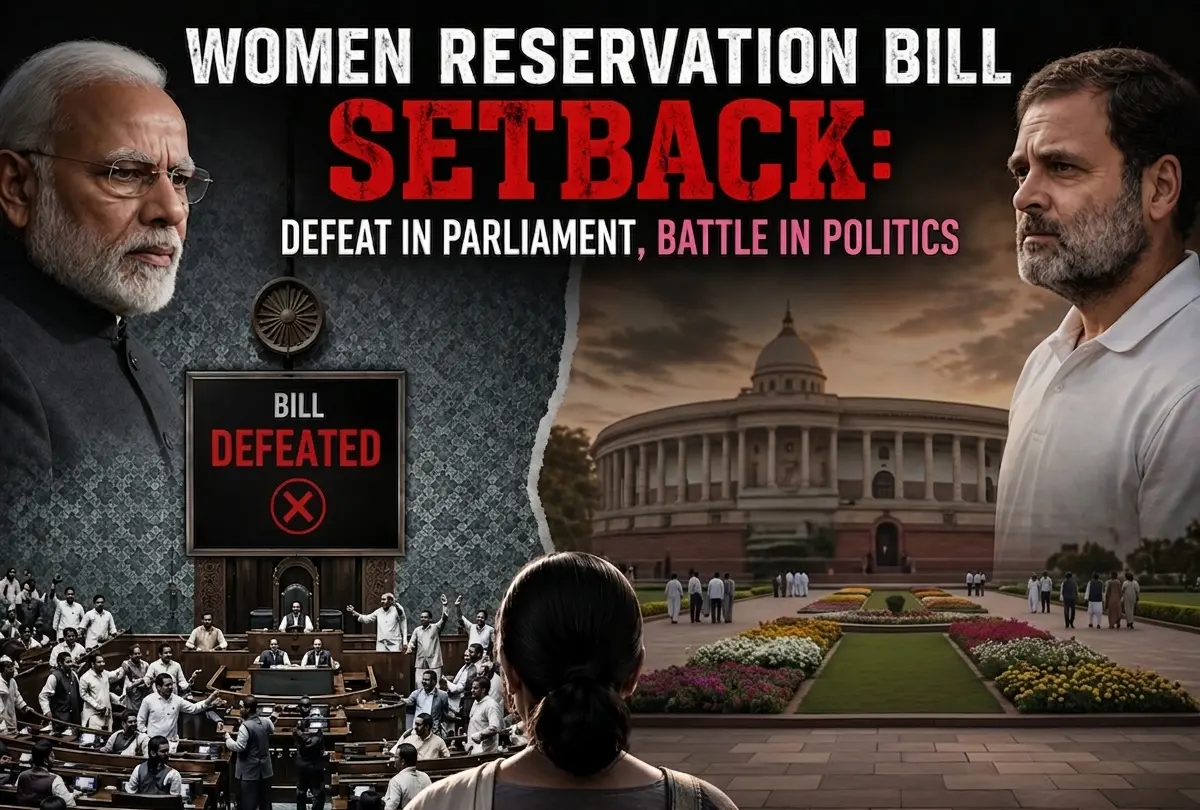
Women Reservation Bill Setback: Defeat in Parliament, Battle in politics
The CSR Journal Magazine

One of the most significant political discussions in recent memory has been sparked by the failure of a crucial constitutional change related to the implementation of women’s reservation. A rare parliamentary setback for the ruling Bharatiya Janata Party (BJP) occurred when the motion, which sought to operationalize the long-promised 33% reservation for women in Parliament and state assemblies, failed to secure the necessary two-thirds majority.

However, the episode has developed into a wider struggle over political intent, narrative control, and electoral strategy that goes beyond the numbers in Parliament, raising concerns about whether the BJP’s loss in the House could still result in an advantage among voters.

What Exactly Failed—and Why It Matters

There is a crucial distinction at the core of the problem. There has long been widespread political agreement on the idea of women’s reservations. The framework’s earlier passage, often referred to as the Nari Shakti Vandan Adhiniyam, was hailed as a significant milestone.

However, the 2026 constitutional amendment linked this reserve to proposed Lok Sabha seat increase and delimitation, or redrawing of constituencies, in an attempt to activate it. This connection turned out to be controversial and ultimately caused the bill to fail.

The amendment essentially merged two significant fundamental changes:

1) Political representation based on gender

2) Election power redistribution among states

This combination turned a popular change into a contentious political initiative.

The Strategic Logic Behind BJP’s Move

Political Analysts contend that far than being a mistake, the BJP’s choice to push the amendment—despite not having guaranteed numbers—was a calculated risk.

Setting the agenda seems to have been one of the main goals. The BJP put itself in a strong moral position by introducing a law that focused on women’s representation. Opposition parties found it challenging to openly oppose the law without running the danger of facing public reaction due to the wording.

It is anticipated that the party’s messaging would center on a straightforward story:

“The opposition prevented us from bringing women’s reservations.”

Politically, this simplification is effective. Even when the actual debate covers intricate topics like federal balance and delimitation, it is more difficult to convey these subtleties to a large number of voters.

Women Voters as a निर्णायक Factor

A larger electoral trend—the increasing significance of female voters—is also reflected in the BJP’s approach. Women have become a powerful voting bloc during the last 10 years, frequently exhibiting higher turnout and strong support for the ruling party in a number of states.

The BJP upholds its reputation as a party dedicated to women’s emancipation by emphasizing the reservation issue. Even though the amendment was unsuccessful, the party can still assert leadership and intent on the matter by just offering it.

Symbolism and perception are frequently just as important in electoral politics as actual policy accomplishments. As a result, the bill might serve more as a political signal than as a legislative tool.

Opposition’s Position: Support with Reservations

The Indian National Congress and other opposition parties have criticized the BJP’s narrative, claiming that their resistance was to the system of women’s reservations rather than the reservation itself.

Three main issues were the focus of their worries:

1) They contend that the connection with delimitation may change the distribution of political representation among states.

2) The implementation was delayed since the reservation wouldn’t go into force until after further census and delimitation procedures.

3) The lack of clauses that address internal diversity, including sub-quota requirements.

However, there is a communication problem with this role. In contrast to the BJP’s more straightforward framing, it is more difficult to communicate in electoral messaging even while it represents policy nuance.

Delimitation and the Federal Question

Delimitation is arguably the debate’s most important underlying problem. India’s federal structure will be significantly impacted by the procedure, which redraws constituency borders based on population.

Particularly in the South, states have voiced worry that population growth-based delimitation could:

1) Increase the number of northern states with faster population growth.

2) Diminish the relative impact of states that have effectively managed population growth.

The amendment successfully combined gender justice with a delicate issue of regional power balance by tying women’s reservation to delimitation.

A second level of political friction has emerged as a result, one that touches on regional interests and transcends party boundaries. Opposition to the law became as much about defending state interests as it was about challenging its design for a number of regional parties.

Narrative vs Reality: Where Elections Are Decided

Which story wins over voters will ultimately determine the political ramifications of the bill’s demise.

The BJP may be able to turn the loss into an electoral gain if it is successful in portraying the incident as an example of change thwarted by the opposition. The party has a powerful platform because to the emotional appeal of women’s representation and clear messaging.

However, the BJP’s claim to moral superiority may be contested if the opposition is able to refocus attention on the bill’s framework, claiming that it was a conditional or delayed change linked to political considerations.

In political communication, this leads to a traditional struggle between simplicity and complexity:

1) The BJP’s message is straightforward, poignant, and simple to understand.

2) The message of the opposition is complex, conditional, and more difficult to scale.

Historically, simpler narratives tend to resonate more widely, especially in large and diverse electorates.

Short, Medium, and Long-Term Implications

The BJP seems to be in a stronger position to gain in the near future. Its ability to communicate effectively and the issue’s symbolic importance may aid in building support, especially among female voters.

By highlighting issues with federal balance and implementation delays, particularly in areas vulnerable to delimitation, the opposition may be able to reclaim ground in the medium term.

The matter can eventually turn into a credibility test. There may be a perception gap between aim and delivery if significant reforms are frequently announced but never carried out. This may have an impact on how people evaluate the larger governing strategy as well as this particular policy.

A Broader Shift in Political Strategy

The incident also illustrates a broader shift in Indian politics, as laws are increasingly used for two purposes:

1) As a tool for policy

2) As a means of communicating politically

In this instance, the modification expanded the discussion on women’s representation, putting opposing parties in a challenging political situation, developed a campaign narrative regardless of the outcome of legislation.

This implies that legislative results are no longer the exclusive indicator of political success. Rather, the capacity to influence public opinion has become just as important.

Conclusion: A Defeat That May Not Be One

On paper, the Bharatiya Janata Party has suffered a loss with the failure of the women’s reservation-linked amendment. However, if the party is able to turn it into an engaging story, it might still serve as a tactical benefit in the context of electoral politics.

The opposition’s task is to go beyond defensive justifications and offer a distinct alternative vision that addresses issues of federal balance and implementation while promoting women’s representation.

In the end, voters’ interpretations of this story will determine its relevance rather than just what transpired in Parliament. In this regard, the actual decision about the measure has not yet been made—not in the parliamentary chambers, but at the polls.

Latest News

Popular Videos
