


Twenty-One Out Of Twenty-Five Most Polluted Cities Worldwide Reside In India
The CSR Journal Magazine

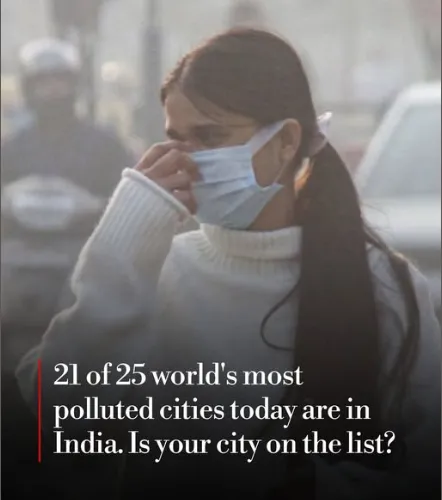
The current situation in India is marked by a severe heatwave, which simultaneously coincides with alarming air quality levels. Recently released rankings by AQI.in, at 12:50 pm IST on Sunday, reveal that India is home to twenty-one of the world’s twenty-five most polluted cities. These findings highlight the urgent need for interventions as air quality deteriorates across vast regions, particularly in northern and eastern India.

Air Quality Index Rankings

At the top of the list is Begusarai in Bihar, recording an alarming Air Quality Index (AQI) of 549, categorised as hazardous. Such levels of pollution can have significant health repercussions, even on those without pre-existing conditions, while representing a severe risk to individuals with respiratory or cardiovascular issues. Following closely are Patna and Bhagalpur, both exceeding an AQI of 150, labelled as unhealthy. Other cities such as Buxar, Jaisalmer, Haldia, Saharsa, Saharanpur, Gorakhpur, Moradabad, and Kolkata have also been identified as having critically poor air quality.

Interestingly, only four cities outside of India made it to the top twenty-five list, including Dhaka in Bangladesh, and Kathmandu and Lalitpur in Nepal, along with another entry for Kathmandu from a different monitoring zone. This stark contrast raises considerable concerns regarding the air quality challenges faced by Indian cities.

Experts point to several factors exacerbating the situation. Meteorological data suggests that extreme heat has a detrimental effect on air quality, stemming from stagnant atmospheric conditions, dust transport, and photochemical reactions that are intensified by bright sunlight. In particular, particulate matter known as PM2.5, which measures less than 2.5 micrometres, poses significant health risks as it can infiltrate deep into the lungs and bloodstream, leading to various serious health issues over prolonged exposure.

Factors Contributing To Pollution

Research shows that heatwaves substantially enhance PM2.5 levels. The dry conditions prevalent during these temperatures allow dust particles to linger longer in the air, compounded by weak winds that inhibit the dispersion of pollutants. As temperatures in several northern Indian cities approach or exceed 45°C, health experts warn of a “double environmental assault” due to the simultaneous impacts of extreme heat and high pollution levels.

Bihar has emerged as a particularly affected state, with various cities, including Begusarai, Patna, Bhagalpur, Saharsa, Gaya, Muzaffarpur, and Aurangabad, featuring prominently in the global pollution rankings. This situation underscores that air pollution issues in India are not confined to the winter months or specific seasonal events, such as post-Diwali smog or crop burning. Instead, these air quality challenges have transformed into a year-round crisis driven by urban growth, industrial emissions, and an increasing frequency of dust storms.

Climate change further compounds these issues, elevating average temperatures and worsening air pollution across urban centres in India. As the developments unfold, the latest rankings serve as a stark reminder that many cities are not only heating up but becoming increasingly unbreathable for their inhabitants.

Long or Short, get news the way you like. No ads. No redirections. Download Newspin and Stay Alert, The CSR Journal Mobile app, for fast, crisp, clean updates!

App Store –  https://apps.apple.com/in/app/newspin/id6746449540 

Google Play Store – https://play.google.com/store/apps/details?id=com.inventifweb.newspin&pcampaignid=web_share

Latest News

Popular Videos
