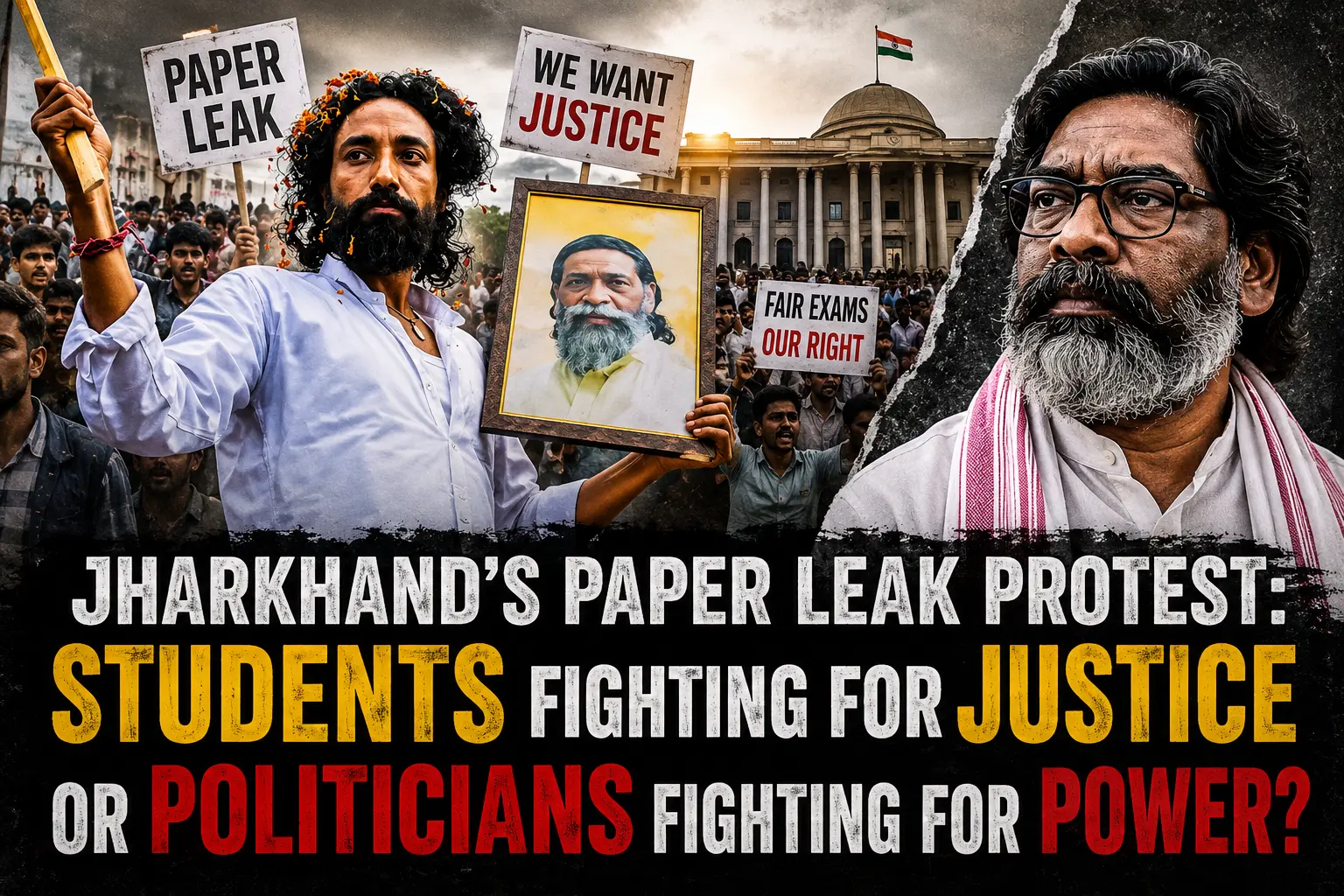
Behind the anger on the streets lies a bigger question: Is this purely a youth movement against recruitment failures, or has Jharkhand’s political rivalry entered the battlefield?
Ranchi is witnessing a dangerous collision between unemployment, examination distrust and politics. Thousands of young aspirants have marched towards the Jharkhand Assembly, demanding action over alleged irregularities in JPSC and JSSC recruitment examinations. Police used water cannons, tear gas and batons as the protest escalated on August 10. The agitation began on July 25 and has now become one of the most significant youth protests in the state in recent years but beneath the slogans, barricades and political accusations lies a question that deserves far more serious examination: Who exactly is driving this movement—and what does each stakeholder stand to gain from it? Because this is no longer merely a story about an examination, It is a battle over trust, jobs, political credibility and power.
First, let us not insult the students by calling their anger political
The easiest—and most dangerous—way to dismiss a student movement is to label it “politically sponsored.” That would be profoundly unfair. For thousands of young people in Jharkhand, government recruitment is not an abstract political issue. It is a question of survival. That anger is real. The current protesters are demanding cancellation of certain examinations, reforms in JPSC and JSSC and an independent investigation, including a CBI probe or an inquiry by retired High Court judges from outside the state.
So the first conclusion must be clear: There is a genuine student grievance here. Anyone who attempts to erase that fact by simply shouting “BJP-sponsored protest” or “political conspiracy” is avoiding the real issue. But then comes the uncomfortable question: Who is benefiting from the anger? This is where the story becomes politically explosive. Jharkhand is governed by the JMM-led alliance under Chief Minister Hemant Soren. The principal opposition force, the BJP, has seized upon the recruitment controversy and demanded accountability, a CBI investigation and even the Chief Minister’s resignation. BJP MPs have already protested in Parliament over the alleged JPSC paper leak.
On August 10, BJP Leader of Opposition Babulal Marandi and other BJP leaders were detained during protests linked to the recruitment controversy. That tells us something important: The student movement may be genuine—but the political ecosystem surrounding it is unquestionably real. And that distinction matters. A protest can begin organically and still become politically useful. A student can protest because his career is being destroyed, while a political party sees an opportunity to weaken the government.Both things can be true simultaneously.
One of the most visible faces of the agitation is JLKM leader Devendra Nath Mahto. Mahto went on hunger strike and later joined the Assembly march after reportedly losing significant weight. His involvement has given the agitation a recognisable political face. That does not automatically make the student movement political. But it makes one thing unavoidable: The protest is no longer operating in a political vacuum. There are now political leaders, opposition parties and pressure groups attempting to associate themselves with the anger of the students.
The BJP has its own political calculation. JLKM has its own political space to expand. The ruling JMM-Congress alliance has an obvious interest in containing the damage. And the students have their own very different objective: They want their examinations and careers protected. These interests overlap—but they are not identical.
The BJP’s calculation is obvious—but that does not make its questions illegitimate
The BJP has every political reason to attack the Hemant Soren government. Recruitment examinations are an extremely powerful political weapon because they connect directly with unemployment. If the opposition can successfully establish that the government has failed to protect recruitment examinations, it can convert a technical administrative controversy into a much larger political narrative: “The government has failed Jharkhand’s youth.” That is politically devastating.
But there is a trap here. If BJP leaders turn every student demand into an anti-Soren campaign, they risk destroying the credibility of the very movement they claim to support. The moment students become merely political ammunition, their cause becomes secondary. The question should not be: “Can this protest damage Hemant Soren?” The question should be: “Can this protest force an examination system that no government can manipulate?”
And the JMM-Congress response raises another uncomfortable question
The government says it has accepted approximately 98% of the protesters’ demands.The students strongly dispute that claim. According to reports, the protesters argue that only three of the 13 examinations they sought to have cancelled were actually scrapped.This is where communication has failed spectacularly. If the government says 98%, and students say “not even close,” then somebody needs to put the entire demand list on the table.
No political speeches, No slogans, No press conferences, No competing narratives, Just a document.
Demand number 1 — Government response.
Demand number 2 — Government response.
Demand number 3 — Government response.
And so on. Because when a government says 98% and protesters say the opposite, the public deserves to know who is telling the truth.
The biggest issue may not actually be the latest alleged leak
This is where the story becomes much deeper. Jharkhand’s recruitment system has been facing controversy for years. The Jharkhand High Court dealt with allegations surrounding the JSSC CGL examination and noted that the investigation had found evidence of candidates being allegedly extorted in the name of supplying question papers, but the investigation cited in the judgment did not find evidence of an organised leak of the original 150-question paper.
That is an extremely important fact because there is a massive difference between: “There was an organised paper leak.” and “Candidates were allegedly cheated or extorted by people falsely claiming to possess leaked papers.”The distinction matters legally. It also matters journalistically. And it matters politically. A protest should not be built upon an allegation being treated as a proven fact before an independent investigation establishes what actually happened. But equally, the absence of proof in one investigation should not be used to dismiss every concern about the recruitment system. The real crisis is bigger than one FIR. It is the collapse of confidence.
This is the real crime: destroying trust
Imagine preparing for an examination for two years. Then imagine hearing that someone may have obtained the paper beforehand. Even if the allegation ultimately proves false, what happens to your confidence? You begin asking:Was the examination fair? Was the centre secure? Was the agency competent? Were insiders involved? Was the result manipulated? Why was the examination cancelled? Why was it delayed? Why isn’t there an independent investigation?That is how institutional trust dies. And once trust dies, a government cannot repair it with a press release. It needs transparency, independent investigation and accountability.
But is political rivalry now turning this into a battlefield?
Very possibly—but that must be investigated, not assumed. There are clear signs of political appropriation. BJP leaders are openly demanding the Chief Minister’s resignation. JLKM’s Devendra Nath Mahto has become a prominent face of the agitation. Other political and pressure groups have also extended support. CJP founder Abhijeet Dipke has publicly backed the students and described his organisation as a pressure group.That means the movement has developed multiple political stakeholders.
But here’s the crucial distinction: Political support does not automatically mean political conspiracy. A political party supporting a genuine public movement is normal democracy. The problem begins when politicians attempt to manufacture the grievance, control the protesters, dictate their demands or use students merely as weapons against their rivals.
So the correct question is not: “Is BJP behind the protest?” The more intelligent question is: “How much of the protest existed independently of political parties, and how much has subsequently been appropriated by them?” That is the question we as journalists should investigate.
Could this be an equal-score game between political parties?
Yes, that possibility deserves serious scrutiny. Indian politics has a familiar pattern. When Party A is in power, Party B attacks it over unemployment, recruitment scandals and examination failures. When Party B comes to power, Party A suddenly discovers the same issues.
The students remain the same, Their unemployment remains the same, Their lost years remain the same, Only the political slogans change. That is why Jharkhand’s students should ask every political party a brutally simple question: “What did you do when you were in power?”
And then: “What exactly will you do if you come to power? Not promises, Not speeches, Not hashtags, A written recruitment reform plan with deadlines.
If the BJP is serious, let it publish its roadmap
If the BJP believes the JMM-led government has failed Jharkhand’s youth, it should go beyond demanding Hemant Soren’s resignation. Publish a blueprint. How will examinations be conducted? Who will conduct them? How will printing and transportation be secured? How will digital access be monitored? What punishment will paper-leak criminals face? How quickly will investigations be completed? What compensation will candidates receive when an examination is cancelled because of administrative failure? What will happen to officials responsible for negligence? And most importantly: Will the BJP guarantee a fixed annual recruitment calendar if it comes to power? That would turn political opposition into public accountability.
And the same test must be applied to JMM-Congress
The ruling alliance cannot hide behind the argument that “most demands have been accepted.” Young people do not need percentages. They need certainty. When will the examination happen? When will the investigation finish? Who will be held responsible? Which examinations will be cancelled? When will the new examinations be conducted? When will appointments be made?Give the students dates. Give them names. Give them procedures.Give them legally enforceable accountability.
The Assembly march is therefore bigger than a paper leak
What we are witnessing in Ranchi is not simply a fight between students and police. It is a fight between citizens and an increasingly distrusted recruitment system. It is also becoming a fight between the ruling alliance and the opposition for political ownership of youth anger. And somewhere between these two battles are thousands of young people who cannot afford to become anybody’s political weapon.
The government has a responsibility. The opposition has a responsibility. Political organisations have a responsibility. And the media has an even greater responsibility. Do not turn students into political props. Investigate the allegations. Investigate the investigation. Investigate the recruitment agencies. Investigate the political connections. Investigate the money trail, if any. Investigate the people accused of selling fake papers. Investigate whether genuine leaks occurred. Investigate whether rumours were deliberately manufactured. Investigate whether political actors are exploiting the movement. And investigate whether government institutions failed through corruption, negligence or incompetence.
The ultimate test: Follow the evidence, not the flag
There is a very simple way to determine whether this is a genuine youth movement or a political operation. Remove every political party from the equation. Remove BJP flags. Remove JMM flags.Remove Congress flags. Remove JLKM flags. Remove every political speech. Then ask the students five questions:
Do you want transparent examinations? Do you want an independent investigation? Do you want accountability? Do you want a fixed recruitment calendar? Do you want examinations conducted without political or bureaucratic interference? If the answer remains yes, then the movement has a legitimate democratic foundation. If political parties subsequently join it, that is politics.But the grievance remains real.
Jharkhand’s youth cannot be asked to choose between two political stories
One side says: “This is a BJP-sponsored conspiracy.” The other says: “This government has destroyed the future of Jharkhand’s youth.” Both slogans may serve political interests. Neither is enough. The truth must be established independently because the biggest victim is not BJP, It is not JMM, It is not Congress, It is not JLKM. It is the student who spent three years preparing for a government job and now doesn’t know whether the examination itself can be trusted. That student does not care who wins the next election. He wants to know whether his hard work will be worth anything.
The final question is therefore not “Who is behind the protest?”
The real question is: “Who will stand behind the students when the political cameras leave?”If there was a genuine paper leak, expose the network. If there was administrative negligence, punish those responsible.If there was a fake-leak racket, expose that. If political parties manufactured parts of the agitation, expose that too. And if the government is genuinely confident that the recruitment system is clean, then it should have nothing to fear from an independent investigation.
A transparent investigation does not weaken a government. It protects an honest government. Jharkhand’s youth deserve nothing less. Because a paper leak does not merely steal an examination. It steals time. It steals money. It steals opportunity. And worst of all— it steals a young person’s belief that merit still matters. That is why this protest must not be allowed to become merely another chapter in Jharkhand’s political score-settling. The students’ future is too valuable to become somebody else’s election strategy.
Investigate everything. Protect the students. Follow the evidence. And let neither the government nor the opposition escape accountability.