


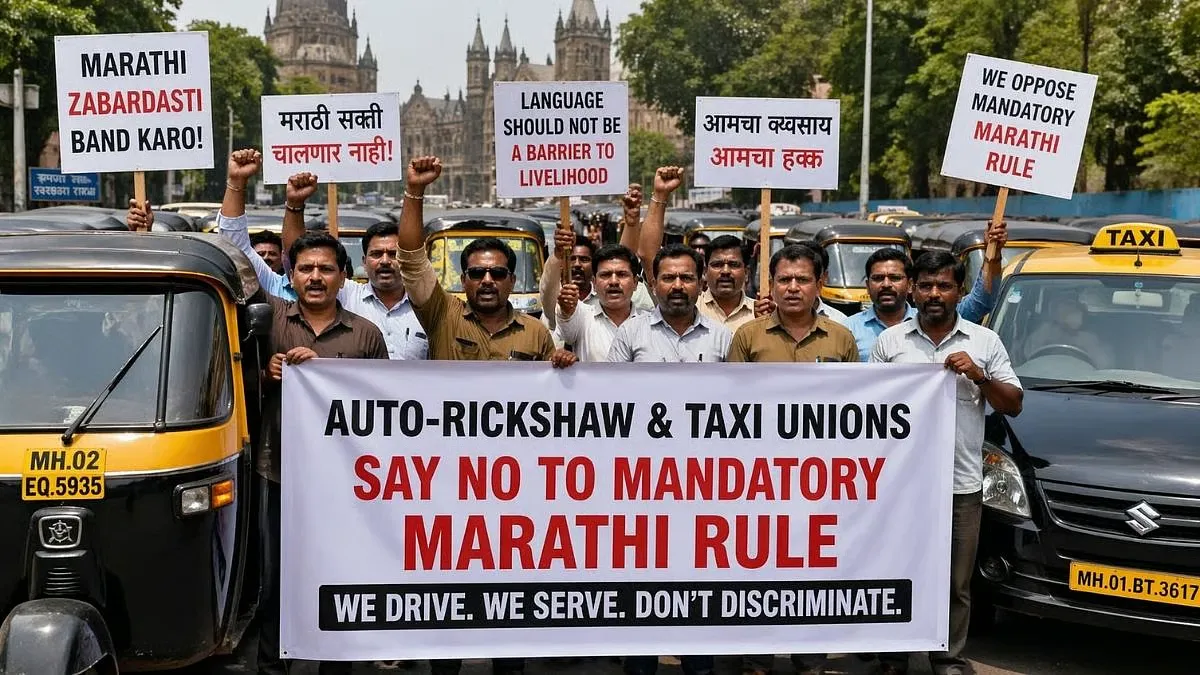
Protests Erupt Over Marathi Language Requirement for Drivers in Maharashtra
The CSR Journal Magazine

The recent announcement by Maharashtra’s Transport Minister Pratap Sarnaik regarding a new language requirement for drivers has sparked significant protests. From May 1, all auto and taxi drivers in the state will be expected to demonstrate proficiency in reading and writing Marathi. This requirement targets licensed drivers working in Maharashtra, but it has particularly affected migrants from other states. The response from driver unions has been strong, labelling the initiative as an attack on migrant workers’ rights and initiating plans for widespread protests should the tests be enforced.

The government asserts that the rule being implemented is not new but an enforcement of existing provisions. Nevertheless, this move has reignited a long-standing debate about language politics and migrant rights. Concerns have been raised by various transport worker organisations, who argue that this requirement may create unnecessary barriers to employment.

Legal Context of the Language Requirement

The foundation of the current language mandate can be traced back to the Motor Vehicles Act, 1988, which governs driving licence eligibility across India. According to the Central Motor Vehicles Rules, all candidates for a transport vehicle licence must at least possess a Class 8 pass certificate. Transport vehicles comprise various public service vehicles, including auto-rickshaws and taxis.

While the central law defines broad criteria for eligibility, it allows state governments to establish additional rules provided they do not contradict national provisions. For instance, Section 28 of the Motor Vehicles Act grants states the authority to create specific rules regarding driver badges aimed at transport vehicle operators. This delegation granted to states has led to the development of Rule 24 under the Maharashtra Motor Vehicles Rules, which links language proficiency to the issuing of badges for public transport vehicle drivers.

Under Rule 24, applicants must demonstrate both topographical knowledge of their operational area and a working knowledge of Marathi, along with one other commonly spoken language. Failure to meet this language requirement permits transport authorities to either deny or revoke a driver’s badge.

Potential Legal Challenges Ahead

A crucial legal challenge to the Maharashtra government’s mandate lies in a 2017 ruling by the Bombay High Court. In the case of Shivpujan Kumar vs State of Maharashtra, the court examined the language stipulations applied to auto-rickshaw and taxi permits. The judgement clarified that auto-rickshaws are classified as “motor cabs” within the Motor Vehicles Act framework, which exempts them from the stipulations of Rule 24. Consequently, the court concluded that the application of a language requirement for auto-rickshaw drivers was not valid.

The implications of this ruling present a significant obstacle for the state government, particularly as it seeks to implement the language test beginning May 1. Current moves to amend the rules seek to formalise Marathi language proficiency as compulsory for public service vehicle drivers, which, if passed, would give licensing authorities the authority to assess language skills during the application process.

Additionally, public consultations for any proposed rule changes would follow, yet until any amendments are officially adopted, enforcement initiatives related to the requirement might face imminent legal challenges.

Broader Implications for Language Policy in India

The announcement of this Marathi language proficiency requirement has triggered comparable demands in neighbouring Karnataka. Political groups such as the Karnataka Congress and the Karnataka Rakshana Vedike are calling for local language requirements for driver badge issuance within their jurisdiction. Currently, local language proficiency is only mandated for conductors of public service vehicles in Karnataka, not for drivers.

Legal experts have voiced concerns regarding the lack of explicit authority under the Motor Vehicles Act for states to impose language requirements related to driving licences. While Maharashtra’s justification for the rule may hinge on enhancing communication for passengers, the intersection of local identity politics and employment is evident in this discourse. The developments surrounding this issue warrant close monitoring as the debate on language rights continues to evolve in India.

Long or Short, get news the way you like. No ads. No redirections. Download Newspin and Stay Alert, The CSR Journal Mobile app, for fast, crisp, clean updates!

App Store –  https://apps.apple.com/in/app/newspin/id6746449540 

Google Play Store – https://play.google.com/store/apps/details?id=com.inventifweb.newspin&pcampaignid=web_share

Latest News

Popular Videos
