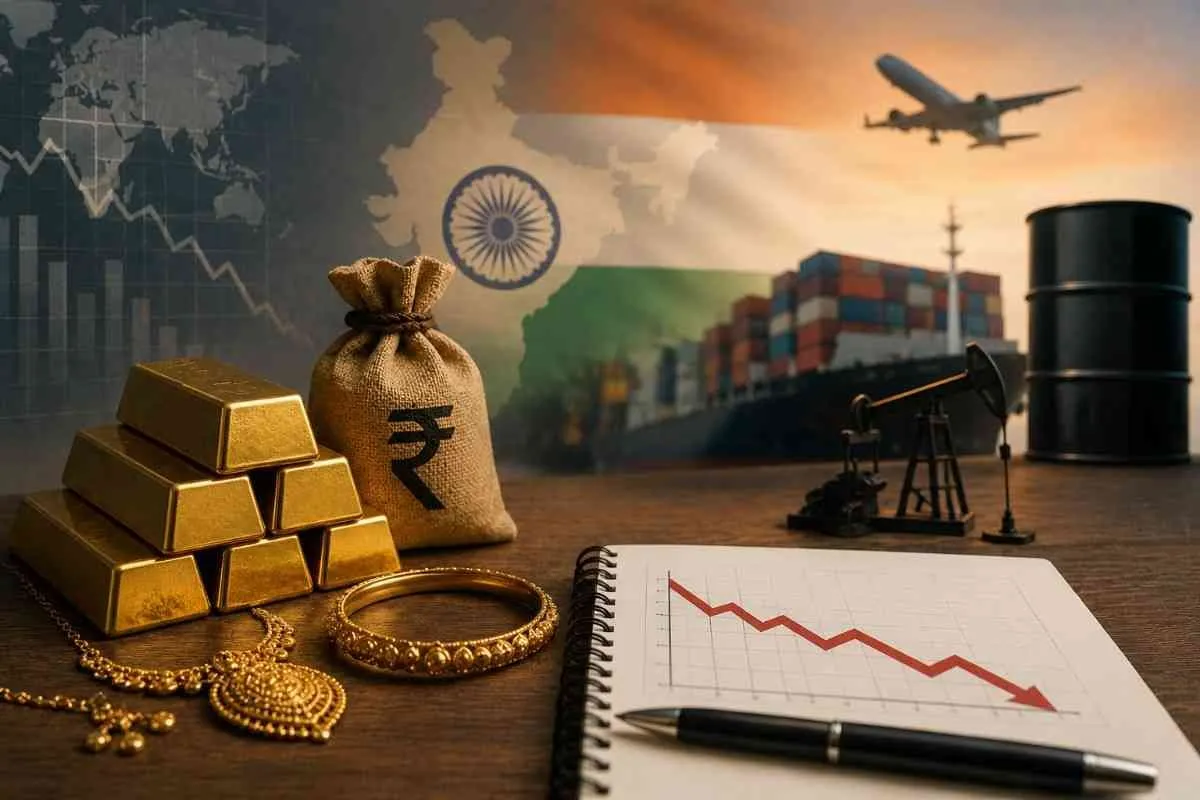
India’s economy today is living two realities at the same time.
The first is the official narrative: India is the world’s fastest-growing major economy, global investors are bullish, infrastructure is expanding rapidly, digital payments are transforming commerce, and the country is steadily positioning itself as the next global growth engine.
The second reality is quieter, more emotional, and visible in the everyday decisions Indians are making with their money. People are buying more gold despite record prices. Fuel prices have become politically sensitive economic instruments. Travel spending is exploding even as financial insecurity quietly rises beneath the surface.
None of these trends are accidental. Together, they reveal something important about modern India: the country is optimistic about its future but increasingly uncertain about its present. That contradiction is becoming one of the most important economic stories in the country.
Gold has always held cultural significance in India, but what is happening now goes beyond tradition or weddings. Indians are buying gold not merely as jewellery but as psychological protection. In uncertain economies, households move toward assets they trust emotionally, and few assets command more trust in India than gold.
This matters because gold demand often rises when confidence in financial stability weakens. When families fear inflation, currency weakness, unstable employment, geopolitical tensions, or future economic shocks, gold becomes a defensive decision. It is the middle-class insurance policy that does not require trust in institutions.
For the government, this creates a difficult balancing act. India wants household savings to move into productive investments — equities, manufacturing, startups, infrastructure, entrepreneurship. But when citizens quietly move back towards gold, it suggests that risk appetite is shrinking beneath the optimism being publicly projected. The concern is not just psychological. India imports massive amounts of gold, putting pressure on the trade deficit and the rupee. In simple terms, every surge in gold imports reflects money flowing outward rather than being deployed inside the domestic economy. Yet policymakers cannot openly discourage gold buying too aggressively because they know something fundamental: millions of Indians still trust gold more than systems.
Fuel tells a similarly uncomfortable story. In most economies, fuel prices move visibly with global crude oil trends. In India, however, fuel pricing has increasingly become part economics and part political management. Prices often remain surprisingly stable even during periods of global volatility, not because the pressure disappears, but because it is temporarily absorbed somewhere else in the system.
This creates the appearance of inflation control and economic stability. It helps governments politically, especially during sensitive electoral periods, because fuel impacts everything — transportation, food prices, household budgets, logistics, and consumer sentiment. But delayed economic pressure does not disappear forever. Someone eventually carries the burden: oil marketing companies, fiscal balances, taxpayers, or future consumers facing later corrections. India’s inflation management strategy often looks less like market-driven stability and more like controlled postponement.
That becomes especially dangerous because India remains heavily dependent on imported crude oil. Despite the push towards electric vehicles, renewables, and energy diversification, the country is still deeply exposed to geopolitical disruptions, OPEC decisions, shipping instability, and global commodity shocks. This is the hidden vulnerability beneath the superpower narrative.
India may become a manufacturing giant, a digital powerhouse, and a geopolitical heavyweight — but as long as imported energy remains a core dependency, economic confidence will always carry an invisible layer of fragility.
Then comes the most misunderstood signal of all: travel. At first glance, India’s travel boom looks like a spectacular success story. Airports are crowded, international tourism spending is surging, luxury hotels are thriving, and young Indians are spending aggressively on experiences. Aviation companies and hospitality brands celebrate this as evidence of rising disposable incomes and a confident aspirational middle class. And part of that interpretation is absolutely true. But another reality exists underneath it.
A growing number of young Indians are spending on experiences because they no longer feel confident about long-term affordability itself. Housing prices in major cities are increasingly unreachable. Work-life balance is deteriorating. Job insecurity is rising in white-collar sectors. AI disruption fears are beginning to reshape professional psychology. Burnout has become normalized. In that environment, travel becomes more than leisure. It becomes emotional compensation.
People are increasingly prioritizing experiences because traditional economic milestones — buying homes, building stable wealth, achieving predictable financial security — feel delayed or uncertain. Previous generations converted rising income into long-term assets. Today’s urban consumers are often converting rising income into temporary relief. That shift has enormous implications.
In the short term, it boosts consumption and supports sectors like aviation, tourism, luxury retail, fintech, and hospitality. But in the long term, it may reveal weakening confidence in future financial stability. Economies can survive periods of pessimism. What they struggle to survive is silent behavioral change. And behavioral change is exactly what India is witnessing right now.
None of this means India’s rise is fake. Far from it. The country still possesses extraordinary structural advantages: a young population, expanding digital infrastructure, rising geopolitical relevance, manufacturing opportunities, growing domestic consumption, and one of the world’s most dynamic entrepreneurial ecosystems.
India’s infrastructure transformation is real. The highway networks, airports, logistics corridors, digital payment systems, and manufacturing incentives are fundamentally changing the country’s economic capacity. Global companies increasingly view India as an alternative supply chain destination in a fragmented world economy. The optimism surrounding India is not manufactured. It is justified.
But what makes this moment dangerous is the widening gap between macroeconomic messaging and household psychology. Governments everywhere depend on confidence to sustain growth. But when official optimism grows louder while citizens quietly become more defensive with money, trust gaps begin to emerge. Gold buying increases , Fuel sensitivity deepens , Emotional spending rises , Long-term financial caution quietly expands.
These are not isolated consumer trends. They are economic warning signals hiding in plain sight. Today, India is not a collapsing economy, it is not even a weak economy but it is becoming an emotionally divided economy — one where people believe in the nation’s future while simultaneously worrying about their own financial resilience. That contradiction may define the next phase of India’s economic story more than any GDP number ever will. Because ultimately, economies do not run only on growth statistics. They run on belief.
And the moment citizens begin protecting themselves emotionally, financially, and behaviorally at the same time, policymakers should pay attention — even when the headline numbers still look strong.