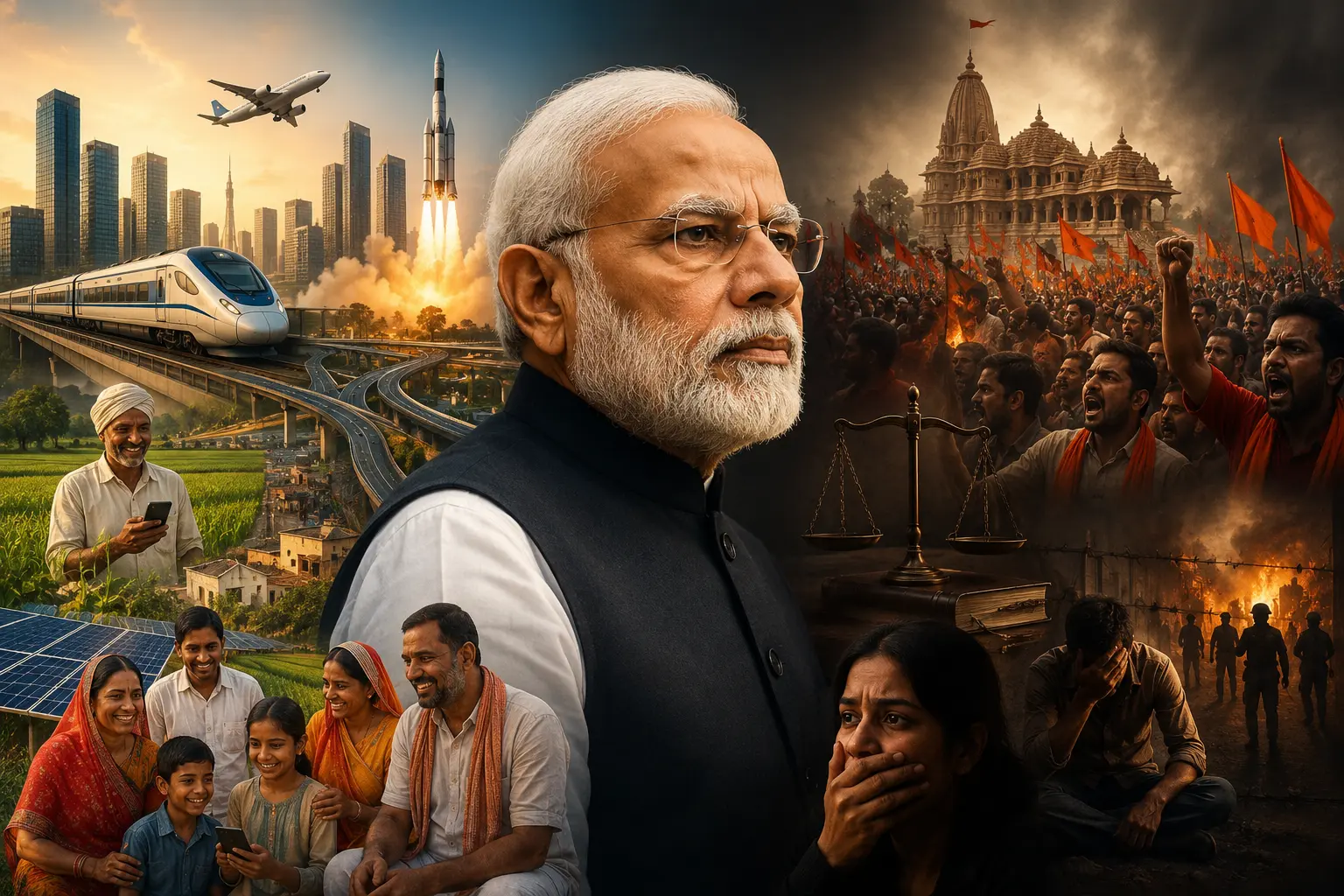
India under Prime Minister Narendra Modi and the ruling Bharatiya Janata Party has become one of the most politically charged democracies in the world. Over the last decade, the country has witnessed extraordinary transformation — soaring infrastructure projects, rising global influence, rapid digitization, stronger welfare delivery systems, and an aggressive projection of national pride. To millions of Indians, Modi is the leader who changed the image of India from a slow-moving democracy into a confident global power.
But beneath the development narrative lies another reality that many Indians discuss only in private. A growing section of citizens, journalists, activists, and opposition supporters believe India is slowly becoming a place where criticizing the government carries social, professional, and sometimes even legal risks. The central question shaping modern India is no longer simply whether Modi is popular. It is whether people are supporting the BJP entirely out of belief — or whether fear has quietly entered the political atmosphere.
For supporters, the answer is simple. They argue Modi earned his popularity through visible results. Roads, airports, digital payment systems, welfare schemes, stronger military responses, and India’s rising international status are constantly highlighted as proof that the BJP government delivers where previous governments failed. Millions of middle-class families, first-time voters, and rural beneficiaries genuinely believe their lives improved under BJP rule. Direct bank transfers, subsidized housing, free ration schemes, and infrastructure expansion created a powerful emotional connection between the government and ordinary citizens.
To BJP supporters, criticism of Modi often appears exaggerated, politically motivated, or disconnected from the realities of everyday India. They believe India finally has a leader who projects strength globally and decisiveness domestically. The construction of the Ram Mandir, the removal of Article 370 in Kashmir, and a more assertive national security policy are seen by supporters as historic corrections rather than controversial decisions. Many also believe the BJP gave voice to a Hindu majority that felt politically ignored for decades.
Critics argue this same political model has created an environment where dissent is increasingly uncomfortable. Across universities, media organizations, and social media platforms, there is a growing perception that openly criticizing the government can attract harassment, trolling, investigations, or legal pressure. Journalists critical of the government often face massive online abuse campaigns. Opposition leaders have repeatedly accused central agencies of selectively targeting political rivals through raids and investigations. Activists and student leaders have been arrested under stringent laws, raising concerns among civil rights groups about the shrinking space for democratic protest.
The fear, critics say, is not always direct censorship. It is psychological pressure. Many Indians privately admit they avoid political conversations publicly because debates quickly turn hostile, communal, or deeply personal. Social media has intensified this atmosphere dramatically. Online political ecosystems are now dominated by hyper-aggressive narratives where disagreement is often framed as betrayal. Critics claim that questioning the government is increasingly portrayed as being “anti-national,” making nuanced political debate nearly impossible.
Religious polarization has become another major fault line in Modi’s India. Supporters argue the BJP simply embraces Hindu civilizational identity with confidence after years of what they call minority appeasement politics. Critics, however, believe this approach has deepened divisions between communities. Mob lynching incidents linked to cow vigilantism, hate speech controversies during elections, communal tensions, and “bulldozer politics” against alleged rioters have all fueled concerns that minorities, particularly Muslims, increasingly feel politically vulnerable and socially isolated.
The media landscape has also become deeply divided. Critics argue several major television channels now behave more like nationalist political platforms than independent news organizations. Prime-time debates are often accused of promoting sensationalism, attacking opposition figures, and avoiding difficult questions for the government. International press freedom rankings and surveillance controversies like the Pegasus allegations have further intensified criticism against the BJP government. Supporters reject these accusations entirely, claiming India’s media and intellectual spaces were historically dominated by anti-BJP bias and that social media merely disrupted elite control over public narratives.
Still, despite intense criticism, Modi remains one of the most powerful and popular political figures India has ever seen. Even many critics acknowledge that no opposition leader currently matches his mass appeal, communication skills, or political machinery. This is where India’s political contradiction becomes impossible to ignore. Millions genuinely admire Modi and trust his leadership. Millions also worry about the direction of democratic freedoms, institutional independence, and religious harmony. Both realities exist at the same time.
Today, India is not a silent nation. It is an emotionally polarized nation. Some people support Modi out of genuine faith, some stay silent out of fear of backlash while others feel both admiration and concern simultaneously. That uncomfortable coexistence may ultimately define the legacy of modern India more than any election result ever could.