


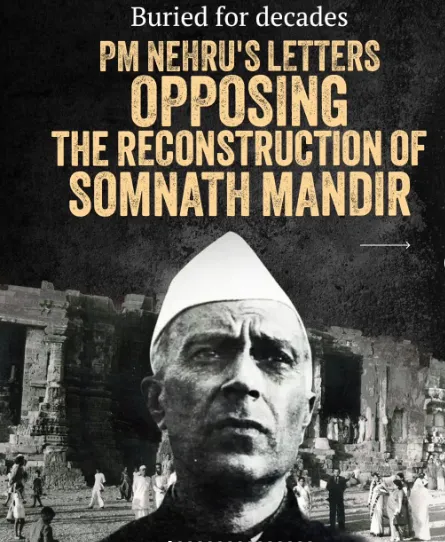

Nehru’s Alleged Unease Over Somnath Temple Reconstruction Revealed in Letters

The CSR Journal Magazine

During the Somnath Amrut Mahotsav held in Gujarat, commemorating 75 years since the Somnath Temple’s restoration, Prime Minister Narendra Modi discussed the challenges faced in rebuilding the temple following India’s Independence. He noted that Sardar Vallabhbhai Patel and India’s first President, Dr Rajendra Prasad, encountered substantial opposition from Jawaharlal Nehru, the then Prime Minister. Modi emphasised that no force could compel India to submit to pressures.

The Prime Minister’s commentary highlighted a series of letters authored by Nehru between 1950 and 1951 concerning the temple’s reconstruction and its consecration. These letters, sent to various political figures and officials, underscore Nehru’s apprehensions regarding the state’s involvement in the religious project.

The correspondence involved key individuals such as K M Munshi, who was then the Minister of Food and the chief organiser of the temple project, as well as Rajendra Prasad, the Jam Saheb of Nawanagar, and Mridula Sarabhai. Nehru expressed his disquiet in numerous letters, stating that government association with the temple ceremony was “most unfortunate.”

Nehru’s Concerns Over Government Involvement

In a letter to K M Munshi dated July 20, 1950, Nehru articulated his concerns, stating that the Indian government should not engage in the construction of any religious edifices. He argued that if the government commenced such endeavours, it could potentially face pressures from various religious groups. He also pointed out the ongoing economic challenges in the country, highlighting that large-scale temple building seemed inappropriate under the circumstances.

Moreover, Nehru expressed apprehension regarding former President Rajendra Prasad’s participation in the temple’s consecration ceremony, although Prasad intended to attend in a personal capacity. He warned that the inauguration could imply government endorsement, leading to misinterpretations.

In correspondence dated March 11, 1951, to C Rajagopalachari, Nehru reiterated his reservations, indicating that while Prasad’s visit to the temple was unobjectionable, the significance of the inauguration was a concern. He preferred that Prasad not associate himself with the event.

International Implications and Secular Concerns

Nehru’s concerns extended to potential implications for India’s international image as a secular nation. He noted with dismay the reported collection requests to Indian embassies for sacred waters and soil for rituals connected to the ceremony. In a letter to K M Panikkar on April 17, 1951, he described the situation as “fantastic” and “embarrassing,” warning against any association that could lead foreign nations to perceive India as a religious state.

Further elaborating on these concerns, Nehru mentioned in a letter dated April 24, 1951, to Mridula Sarabhai that he had previously expressed his views to Prasad. He stated that he did not want to hinder Prasad’s personal inclination towards the project but remained troubled by its implications. Nehru also clarified that he was investigating claims about the Saurashtra government’s financial contributions to the ceremony.

In summary, despite Nehru’s persistent objections, Rajendra Prasad attended the temple’s installation ceremony on May 11, 1951. Meanwhile, K M Munshi played an instrumental role in the reconstruction, asserting that public contributions facilitated the temple’s rebuilding efforts.

Long or Short, get news the way you like. No ads. No redirections. Download Newspin and Stay Alert, The CSR Journal Mobile app, for fast, crisp, clean updates!

App Store –  https://apps.apple.com/in/app/newspin/id6746449540 

Google Play Store – https://play.google.com/store/apps/details?id=com.inventifweb.newspin&pcampaignid=web_share

Latest News

Popular Videos