


India Rejects Pakistan’s Claims at UN, Connects Indus Treaty to Terrorism
The CSR Journal Magazine

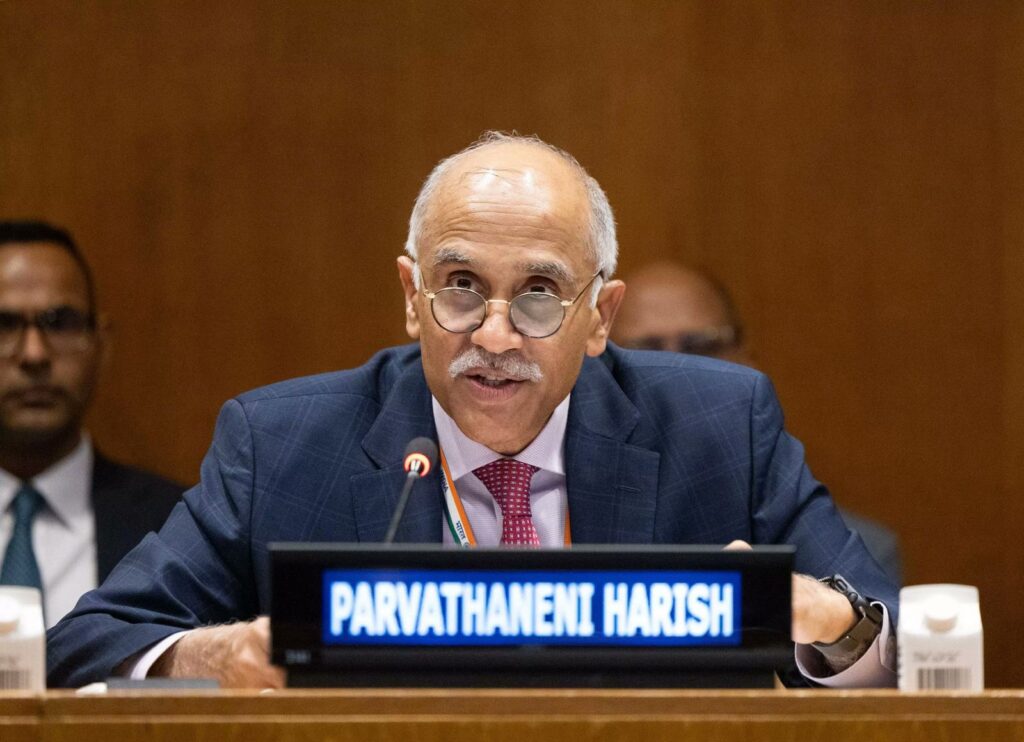
India has firmly rebutted remarks made by Pakistan at the United Nations regarding the Indus Waters Treaty, emphasising that cooperation under this agreement is untenable due to ongoing cross-border terrorism. The assertion was made by Ambassador Parvathaneni Harish, India’s Permanent Representative to the UN, during a high-level open debate on natural resource management held by the UN Security Council.

Ambassador Harish stated that India’s position on the Indus Waters Treaty remains consistent, noting that mutual trust is essential for cooperation. He argued that trust cannot be maintained while terrorism continues to be employed as a tool of state policy. The ambassador’s comments marked a direct response to what he described as Pakistan’s manipulation of discussions to promote a misleading narrative.

Pakistan’s Accusations and India’s Response

Pakistan’s Permanent Representative to the UN, Asim Iftikhar Ahmad, accused India of “weaponising water” and claimed that the suspension of the Indus Waters Treaty was unlawful. He asserted that this decision poses a significant threat to the livelihoods of over 240 million people in Pakistan. In his remarks, he urged the international community to take notice of what he portrayed as India’s hazardous approach to water resources.

In a detailed reply, Ambassador Harish not only addressed the accusations regarding the Indus Waters Treaty but also reiterated India’s position on Jammu and Kashmir. He declared that Jammu and Kashmir is an integral part of India and highlighted that Pakistan’s continuous claims ignore relevant constitutional and legal realities. He denounced Pakistan’s stance as an ongoing illegitimate occupation of Indian territory.

In this context, Harish urged Pakistan to focus on its internal issues rather than critiquing India, reiterating that the only substantial concern surrounding Jammu and Kashmir is Pakistan’s alleged aggression and occupation of Indian territory.

Governance of Natural Resources and International Cooperation

During the UN debate, India’s ambassador also raised concerns about the illegal exploitation and trafficking of natural resources, which can sometimes fund armed groups and exacerbate conflicts. He stressed the necessity for natural resources to contribute positively to the development and prosperity of sovereign nations, indicating the importance of responsible governance in this area.

Harish highlighted the primary responsibility for natural resource management lies with sovereign states and called for governance mechanisms that are transparent, accountable, and nationally owned. He argued that strengthening international cooperation is equally pivotal to prevent illicit exploitation and ensure that natural resources serve developmental goals.

In conclusion, India’s comprehensive rebuttal at the UN aimed to clarify its views on the Indus Waters Treaty, Jammu and Kashmir, and the governance of natural resources. The Indian delegation firmly rejected Pakistan’s statements, adhering to its stance that natural resources should be managed transparently and equitably by sovereign nations.

Long or Short, get news the way you like. No ads. No redirections. Download Newspin and Stay Alert, The CSR Journal Mobile app, for fast, crisp, clean updates!

App Store –  https://apps.apple.com/in/app/newspin/id6746449540 

Google Play Store – https://play.google.com/store/apps/details?id=com.inventifweb.newspin&pcampaignid=web_share

Latest News

Popular Videos
