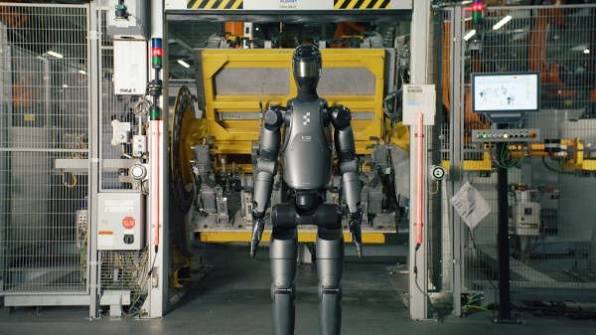
Humanoid robots functioning in a factory setting may seem like a concept from a science fiction narrative, yet in 2026, this has become a reality. German automotive manufacturer BMW has recently demonstrated a series of humanoid robots sourced from Figure AI, showcasing their capabilities to perform tasks traditionally undertaken by humans.
A recent video released by BMW and Figure AI displays four Figure 03 humanoid robots actively working within the BMW plant located in Spartanburg, United States. The footage illustrates one robot advancing, retrieving a trolley, and manoeuvring it back, mimicking human motion. Following that, it sorts various components from disorganised containers and organises them into the trolley.
Upon completing the task, the Figure 03 robot returns to its designated charging station. Figure AI maintains that this operation unfolds autonomously, facilitated by their proprietary system, Helix 02, which synchronises the robot’s arms, hands, torso, and feet. This system enables the robot to manipulate parts while stepping and adjusting its posture, such as pulling a heavy cart effortlessly.
Previous Success with Figure 02 Robots
This initiative marks not BMW’s first collaboration with Figure AI; the company revealed that the earlier model, Figure 02, contributed to the assembly of approximately 30,000 BMW X3 vehicles within ten months in 2025. The Figure 02 robots executed tasks with remarkable speed and precision, such as inserting sheet-metal components for welding in the body shop.
According to Figure AI, the capabilities of the Figure 03 robots extend beyond basic tasks like picking and placing sheet metal. The humanoids are designed to switch between accurately picking and placing delicate parts, facilitating whole-body coordination required in complex manoeuvres, such as pulling a large metal cart along the assembly line.
The robotics company points out that programming fixed sequences of motions is insufficient due to variability in the positioning of carts, bins, and parts. This unpredictability mandates the robots to identify and interact with items that may be located differently on each occasion, presenting challenges that differentiate the tasks handled by Figure 02 from those expected of Figure 03.
Figure AI and the Industry Landscape
Figure AI has recently gained attention for its innovative approach, exemplified by a widely publicised competition between a Figure 03 robot and an intern in an eight-hour “Man vs Machine” sorting challenge. The startup reportedly claims to have a greater number of robots compared to human employees in its workforce.
A variety of other organisations are also venturing into the realm of humanoid robotics. For instance, Tesla, led by entrepreneur Elon Musk, is in the process of developing the Optimus robot, with plans for commercial launch anticipated soon. Additionally, Chinese companies such as Unitree and Agibot are rapidly advancing their own projects in this field.
As the use of humanoid robots continues to evolve, companies like BMW are at the forefront, actively integrating advanced technology into their production processes. This trend suggests a potential shift in how manufacturing operations will be conducted in the future, highlighting the capacity of robots to perform complex tasks traditionally reserved for human workers.
Long or Short, get news the way you like. No ads. No redirections. Download Newspin and Stay Alert, The CSR Journal Mobile app, for fast, crisp, clean updates!
Legendary cricketer Sachin Tendulkar and students from the College of Engineering of Anna University, launched ‘SKILL NEXT»’, a technical skilling initiative. Together, they assembled...