


A Powerful Monsoon System Brings Record Rainfall to Ahmedabad
The CSR Journal Magazine

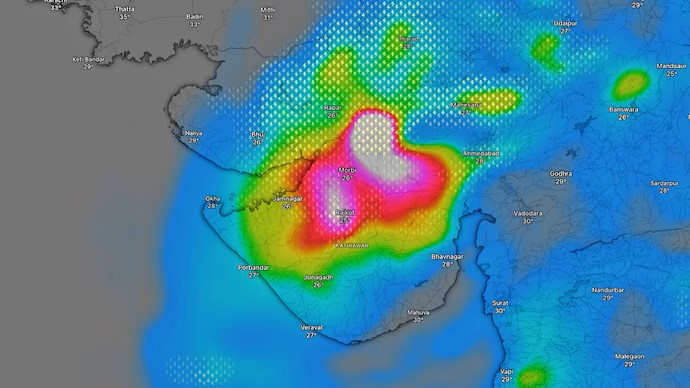
Ahmedabad has recorded one of the most significant rainfall events in July this century, driven by a potent monsoon system. The city faced severe downpours that led to extensive flooding, disrupted transportation, and submerged several areas. The India Meteorological Department (IMD) reported a staggering 294.6 mm of rainfall within a 24-hour period, concluding at 8:30 am on Friday. This figure marks the highest daily rainfall for July in Ahmedabad since the start of the 21st century and ranks as the fourth-highest recorded over any 24-hour timeframe in the city’s history.

The overall rainfall across the district has been even more extraordinary, with various localities documenting between 300 mm and 600 mm of rain. While light showers persisted through the morning hours, meteorologists have indicated that moderate to heavy rainfall is anticipated to persist throughout the day.

Reasons Behind the Intense Rainfall in Gujarat

Forecasters attribute the heavy rainfall to a combination of converging weather systems that have created favourable conditions for prolonged downpours. A well-marked cyclonic circulation over both western and central India has remained nearly stationary in its westward movement, enabling rain-bearing clouds to form repeatedly over Gujarat. This slow progression has allowed for sustained precipitation in specific regions.

Additionally, moisture-rich southwesterly winds from the Arabian Sea have been continuously supplying substantial volumes of water vapour to the atmosphere. Satellite imagery from INSAT-3DS showcases persistent dense convective cloud clusters over Gujarat and adjoining regions of Rajasthan, indicating active thunderstorm development. Meteorologists refer to this phenomenon as a “training effect,” where consecutive thunderstorms move over the same area, resulting in exceptionally high rainfall totals within a short duration.

The monsoon trough’s active position across western India has further amplified atmospheric instability, contributing to intensified thunderstorms. Elevated sea-surface temperatures in the Arabian Sea have also been instrumental, acting as an additional source of moisture that has supported the continuation of heavy rain across the state.

Continued Flood Risks for Residents

The IMD’s most recent district-specific warning map highlights large portions of Gujarat under red and orange alerts, signalling the potential for extremely heavy rainfall and considerable flooding. Authorities have cautioned residents in low-lying areas to stay vigilant, as rivers, lakes, and urban drainage systems face extreme pressure following the unprecedented rainfall. Reports of waterlogging, traffic obstructions, and flash flooding are being observed in numerous districts.

Although the rainfall is expected to gradually decrease as the weather system transitions westward, forecasters advise that the immediate future remains critical. With the ground already saturated and additional rain forecasted, even light showers could exacerbate flooding conditions in Ahmedabad and nearby districts before a return to normalcy is achieved.

Authorities continue to monitor the situation closely, urging residents to remain informed about weather updates and to take necessary precautions to ensure their safety in the coming days.

Long or Short, get news the way you like. No ads. No redirections. Download Newspin and Stay Alert, The CSR Journal Mobile app, for fast, crisp, clean updates!

App Store –  https://apps.apple.com/in/app/newspin/id6746449540 

Google Play Store – https://play.google.com/store/apps/details?id=com.inventifweb.newspin&pcampaignid=web_share

Latest News

Popular Videos
