Total Solar Eclipse Occurs Today

The CSR Journal Magazine

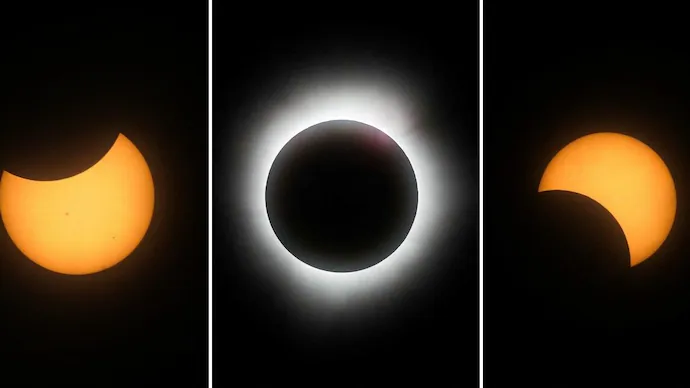
The first total solar eclipse of the year will take place today, marked by the Moon completely covering the Sun along a narrow path in the Northern Hemisphere. Although the Moon is significantly smaller than the Sun, its proximity to Earth allows it to appear almost the same size in the sky. This celestial alignment results in the Moon obstructing sunlight, casting a shadow that sweeps across the Earth.

Timing of the Eclipse in Indian Standard Time

The event will commence with the partial phase beginning at 9:04:15 pm IST on August 12. Following this, the first location to experience totality will witness the full eclipse starting at 10:28:09 pm IST. The peak of the eclipse, noted as the maximum eclipse, will occur at 11:16:06 pm IST, when the shadow of the Moon reaches its greatest depth over the Earth.

The period of totality will conclude with the last location observing the full eclipse at 12:04:07 am IST on August 13. Subsequently, the entire partial eclipse is set to finish at 1:27:57 am IST. However, it is important to note that viewers in India will not have the ability to witness the eclipse, as this astronomical event will take place while the Sun is situated below the horizon.

Skywatchers across India can instead opt for live online coverage of the total solar eclipse. As this event gains traction, updated broadcasts will provide insights into its progress for interested observers.

Visibility of the Eclipse

This total solar eclipse will be observable from specific locations, including a narrow corridor that traverses Greenland, Iceland, and regions of Spain and Portugal. In contrast, a partial eclipse will be visible across a larger expanse, covering much of Europe and portions of North America and Africa.

In India, the eclipse remains unviewable due to the country lying outside the visibility zone of the event. While local observers will not experience the eclipse directly, live streams will offer them a chance to engage with the celestial phenomenon occurring elsewhere.

The significance of this event lies in its ability to temporarily transform daytime skies along the path of totality, thus revealing features of the Sun’s normally obscured outer atmosphere, known as the corona, against the dark backdrop of the Moon. This rare occurrence draws notable interest from astronomers and enthusiasts alike.

Future Solar Eclipses in India

As observers focus on this total solar eclipse, attention may turn towards future astronomical events, including the next total solar eclipse set to occur in 2026. Timelines and details regarding upcoming eclipses will likely provide valuable information for those eager to witness such events in coming years.

As of now, individuals in India can follow the developments of this total solar eclipse through various online platforms. The anticipation surrounding the phenomenon highlights the public’s interest in celestial occurrences and astronomical studies.

Long or Short, get news the way you like. No ads. No redirections. Download Newspin and Stay Alert, The CSR Journal Mobile app, for fast, crisp, clean updates!

App Store –  https://apps.apple.com/in/app/newspin/id6746449540 

Google Play Store – https://play.google.com/store/apps/details?id=com.inventifweb.newspin&pcampaignid=web_share

Latest News

Popular Videos