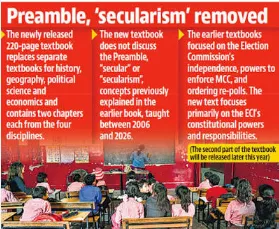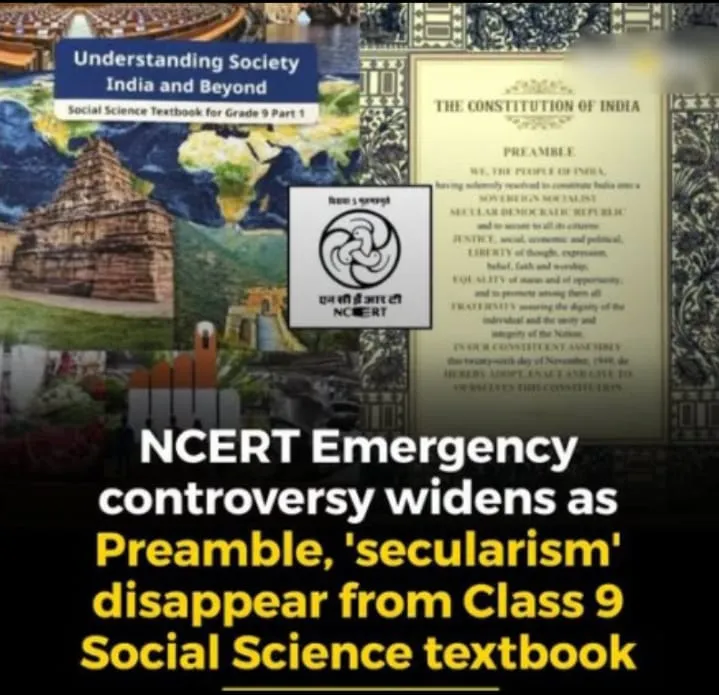

The National Council of Educational Research and Training (NCERT) has revised its Class 9 Social Science textbook as part of a broader educational reform under the National Education Policy (NEP) 2020. This updated curriculum brings several significant alterations, particularly the removal of the Preamble along with references to “secular” and “secularism” from the central text.
The new textbook consolidates subjects such as History, Geography, Political Science, and Economics, creating a unified volume that diverges from earlier editions. This integration is intended to align the curriculum with the developmental goals outlined in the NEP 2020.
Among the significant changes are alterations to chapters regarding the Constitution and the Election Commission. These revisions aim to present a modernised framework that reflects contemporary educational methodologies and priorities.
Introduction of Emergency Chapter
A notable addition in the revised textbook is a dedicated chapter on the 1975–77 Emergency, marking a significant moment in India’s democratic history. This chapter covers critical themes, including the suspension of civil liberties, censorship of the press, and the detention of political figures.
By incorporating this period into the syllabus, NCERT aims to provide students with a comprehensive understanding of democratic processes and the importance of civil rights. The introduction of this chapter has received mixed reactions; some educators appreciate its inclusion as historically essential, while others question how it is portrayed.
The chapter’s focus seeks to engage students in discussions about the implications of governmental authority and the restoration of democracy, fostering a sense of civic responsibility.