


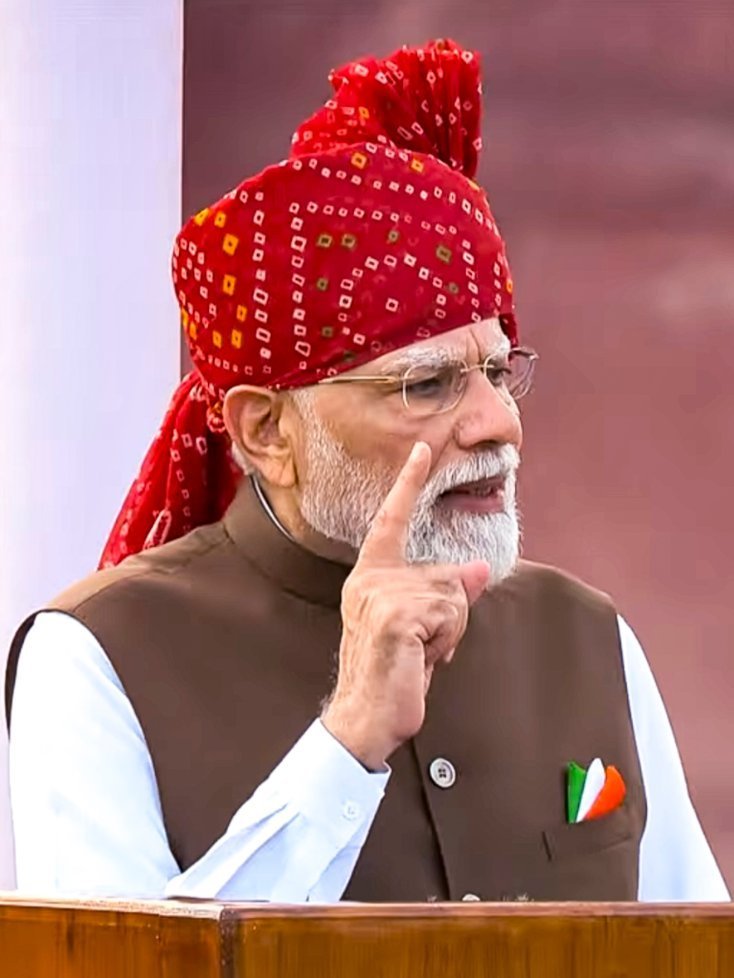
PM Modi Showcases Bandhani Safa, Highlighting Ancient Craftsmanship
The CSR Journal Magazine

Prime Minister Narendra Modi’s choice of a maroon Bandhani safa with a distinctive yellow-and-white dotted pattern during his address at the Red Fort on India’s 80th Independence Day has attracted significant attention. This piece of headgear is part of a broader tradition wherein the Prime Minister utilises various regional textiles to promote Indian culture during his annual addresses. The Bandhani craft is far from new and bears a rich history.

The Artistry Behind Bandhani

The visual appeal of Bandhani lies in its unique dotted design, achieved through a meticulous resist-dyeing technique. Artisans tie small portions of the fabric with thread before immersing it in dye. This process ensures that the tied sections remain undyed, resulting in the characteristic patterns that define Bandhani textiles. The technique might seem straightforward at first, yet it requires a considerable amount of skill and precision to create intricate designs.

Historically, Bandhani, known as Bandhej in Gujarat and Bandhani in Rajasthan and Madhya Pradesh, emerges from a long-standing heritage of resist-dyeing practices in India. The term derives from the Sanskrit word ‘bandh’, meaning to tie or bind, which aptly describes the artisan’s method of preparing the fabric. Each piece undergoes a complex process, with thousands of bindings contributing to the final design.

Craft sources affiliated with the Indian government trace the origins of Bandhani back to the Indus Valley civilisation, estimating its beginnings around 4000 BC. It is a craft that showcases India’s deep-rooted textile traditions, as seen in ancient artworks and historical references. Although the assertion that Bandhani has been continuously practised for 5,000 years may be overly simplistic, it can be confidently stated that the art of tie-dyeing in India has profound historical significance.

Regional Development of Bandhani

Two regions, Gujarat and Rajasthan, are central to the evolution of Bandhani. In Gujarat, the Khatri community has played a pivotal role in formalising and disseminating the craft. Historical accounts indicate that the Khatris introduced Bandhani to the Kutch region during the 12th century, transforming it into an essential craft with considerable export potential. Jamnagar and Kutch continue to be key centres of Bandhani production, with Jamnagari Bandhani holding a Geographical Indication (GI) registration.

The raw materials for Bandhani can vary, encompassing cotton, silk, and other textiles. Traditionally, natural dyes were employed before the advent of synthetic alternatives. The craft allows for diverse patterns, including floral, geometric, and intricate motifs, demonstrating the artisan’s creativity. Additionally, Rajasthan has its own tie-dye traditions, such as Leheriya, which features flowing, wave-like designs.

Bandhani’s versatility is noteworthy, as it extends beyond sarees to encompass odhnis, ghagras, and headgear like turbans. This aspect reflects its historical significance in the royal attire of western India, where Bandhani textiles were frequently favoured. For instance, Maharani Gayatri Devi of Jaipur, a symbol of elegance and trendsetting, was often photographed in elaborate Bandhani garments, establishing a legacy of cultural significance in fashion.

Cultural Symbolism of Bandhani in Contemporary India

PM Modi’s choice of a Bandhani safa not only represents a visually striking accessory but also encapsulates an entire textile tradition rich in cultural meaning. The confluence of colours, patterns, and fabric serves as a reminder of the deep-rooted heritage that resonates within India’s diverse communities. As he addressed the nation from the Red Fort, the safa’s cultural implications highlighted the enduring relevance of traditional crafts in India’s modern identity.

Long or Short, get news the way you like. No ads. No redirections. Download Newspin and Stay Alert, The CSR Journal Mobile app, for fast, crisp, clean updates!

App Store –  https://apps.apple.com/in/app/newspin/id6746449540 

Google Play Store – https://play.google.com/store/apps/details?id=com.inventifweb.newspin&pcampaignid=web_share

Latest News

Popular Videos
