


India’s Chandrayaan-3 Receives Prestigious Global Award for Historic Moon Landing
The CSR Journal Magazine

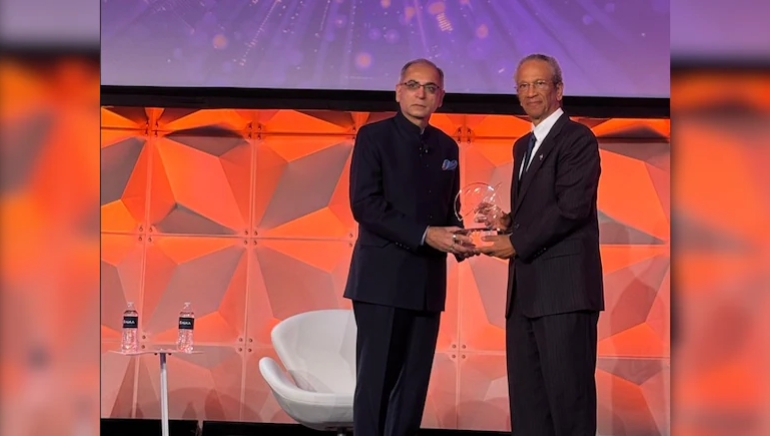
India’s Chandrayaan-3 mission has been honoured with the esteemed 2026 Goddard Astronautics Award by the American Institute of Aeronautics and Astronautics (AIAA) for its landmark achievement in lunar exploration. This accolade specifically recognises the successful soft landing of the mission near the Moon’s south pole, marking a significant accomplishment as it is the first time such a feat has been achieved in history.

The award positions India’s lunar programme alongside notable global space achievements and highlights contributions to future Moon exploration and deep space initiatives. This recognition underscores the increasing prominence of India in the field of space science.

Details of the Mission

Launched by the Indian Space Research Organisation (ISRO) in July 2023, the Chandrayaan-3 mission made history with the Vikram lander successfully touching down on the lunar surface on August 23, 2023. This event positioned India as the fourth nation globally to perform a soft landing on the Moon, following the United States, Russia, and China, while also achieving the distinction of being the first to target the largely unexplored south pole region.

Former ISRO chairman S. Somanath expressed his pride in the recognition, praising the commitment and innovation of the Indian space community. He acknowledged the vision of the Indian Prime Minister to engage the nation meaningfully in space exploration through numerous future missions, not only to the Moon but also targeting other planetary bodies.

Somanath emphasised that advancements in space research and capabilities are as significant as the economic aspects, reflecting India’s strategic focus on merging scientific research with commercial prospects in the expanding global space sector.

Robust Engineering and Research Contributions

The Chandrayaan-3 mission was perceived as a vital redeployment following the setbacks faced by the Chandrayaan-2 lander, which experienced a crash in 2019. ISRO engineers undertook significant redesigns of essential systems, optimised landing algorithms, and fortified safety mechanisms to assure the mission’s success.

The Vikram lander and the Pragyan rover were tasked with performing various experiments on the Moon’s surface, contributing valuable data on temperature variations, seismic activity, and the chemical composition of lunar soil. The mission’s findings are expected to facilitate future crewed and robotic explorations aimed at the Moon’s south pole, a region believed to contain substantial water ice deposits.

This recognition by the AIAA arrives at a pivotal time, as India intensifies its ambitions within the realm of space exploration. The nation is planning several forthcoming initiatives, including the Gaganyaan human spaceflight mission, the establishment of the Bharatiya Antariksh Station (BAS), and exploratory missions targeting Venus and Mars.

Long or Short, get news the way you like. No ads. No redirections. Download Newspin and Stay Alert, The CSR Journal Mobile app, for fast, crisp, clean updates!

App Store –  https://apps.apple.com/in/app/newspin/id6746449540 

Google Play Store – https://play.google.com/store/apps/details?id=com.inventifweb.newspin&pcampaignid=web_share

Latest News

Popular Videos
