


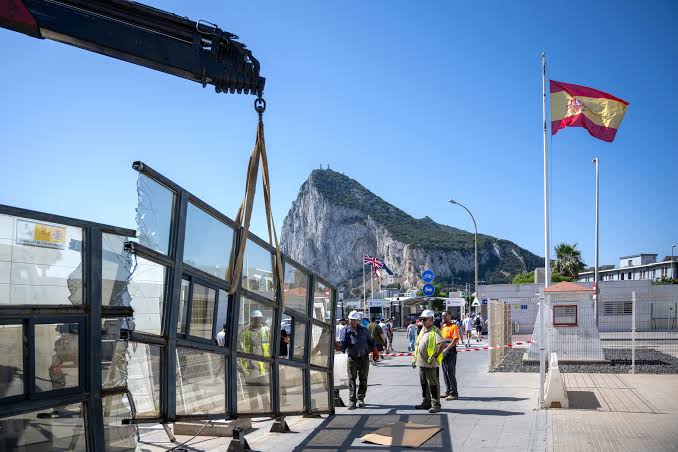
Gibraltar Border Fence Removed Following EU-UK Treaty for Post-Brexit Travel
The CSR Journal Magazine

Thousands of people commuting daily between southern Spain and Gibraltar will no longer have to cross a physical border after the removal of the frontier fence at midnight on Wednesday, following the signing of a European Union-UK treaty aimed at resolving post-Brexit border arrangements.

The agreement is expected to simplify travel for Gibraltar’s 38,000 residents and around 15,000 Spanish workers who cross the border each day, while helping safeguard the British Overseas Territory’s economy and improving movement for families, workers and visitors.

Treaty Ends Years Of Post-Brexit Negotiations

Gibraltar’s relationship with the European Union remained unresolved after Britain left the bloc in 2020, leading to years of negotiations over the movement of people and goods across the border.

In 2025, the United Kingdom and the European Union announced an agreement on border arrangements. The treaty was formally signed on Tuesday by representatives of both sides along with the Gibraltar government.

UK Foreign Office Minister Stephen Doughty said the agreement secured Gibraltar’s long-term economic future and protected its interests.

European Union trade representative Maros Sefcovic welcomed the agreement, saying, “It has taken four years of patient, complex negotiation, but the outcome speaks for itself. It is a very special feeling to see a fence come down.”

Without the agreement, Gibraltar faced the prospect of a hard land border with full passport checks, which could have disrupted trade, commuting and tourism.

Daily Travel To Become Easier

Gibraltar Chief Minister Fabian Picardo said the agreement would make everyday journeys significantly easier for residents on both sides of the border.

“People who are visiting family in Spain, or whose Spanish family is visiting them in Gibraltar. Children who are going to football matches and extracurricular activities, either in Spain or in Gibraltar. They will be able to do that without having to worry about frontier queues,” he told The Associated Press.

Around 15,000 people cross the border each day for work, accounting for nearly half of Gibraltar’s workforce.

Gibraltar Joins Schengen Travel Area

Under the agreement, Gibraltar will effectively become part of the European Union’s Schengen free travel area.

Border checks at Gibraltar’s airport and port will be conducted jointly by UK and Spanish officials under a system similar to that used at Eurostar terminals in London and Paris.

Travellers arriving in Gibraltar from outside the Schengen area will also undergo checks under the EU’s Entry-Exit System, introduced in April, which replaces passport stamps with biometric verification using photographs and digital fingerprints.

Digital Security Replaces Physical Border

Following the removal of the border fence, Gibraltar has introduced live facial recognition cameras at entry points and across the territory.

Picardo said the territory had significantly expanded its CCTV network and strengthened police, customs and Coast Guard resources.

“The fortress has become a digital fortress now,” he said.

Sovereignty Dispute Remains Unresolved

In the 2016 Brexit referendum, 96 per cent of Gibraltar’s voters backed remaining in the European Union.

Gibraltar, often referred to as “the Rock”, was ceded to Britain in 1713, although Spain continues to claim sovereignty over the territory.

While the new treaty removes the physical border and eases cross-border movement, it does not address the long-standing dispute over Gibraltar’s sovereignty.

Long or Short, get news the way you like. No ads. No redirections. Download Newspin and Stay Alert, The CSR Journal Mobile app, for fast, crisp, clean updates!

App Store –  https://apps.apple.com/in/app/newspin/id6746449540 

Google Play Store – https://play.google.com/store/apps/details?id=com.inventifweb.newspin&pcampaignid=web_share

Latest News

Popular Videos
