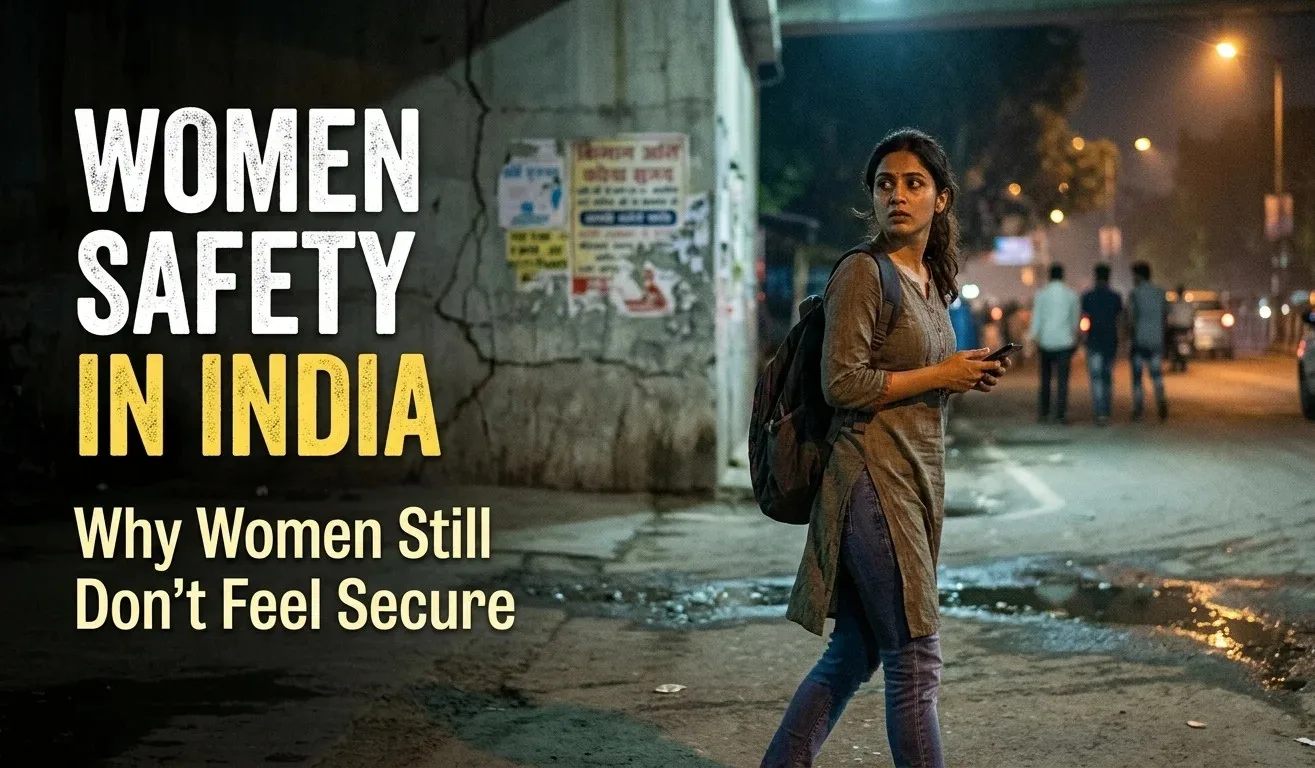
India has spent more than a decade tightening its legal net around crimes against women. In the aftermath of the 2012 Delhi gang rape case, laws were strengthened, fast-track courts introduced, and funds earmarked to make cities safer. On paper, the system looks formidable but on the ground, women still walk faster after dark.
A System That Exists—But Doesn’t Reassure
Every 16 minutes, a woman in India reports a rape, according to National Crime Records Bureau trends. Every few minutes, a case of cruelty by a husband or relative is registered. These are only the reported numbers. Behind them lies a quieter statistic silence.
Studies and surveys repeatedly show that a large share of women do not report harassment or assault at all—either because they fear retaliation, social stigma, or simply don’t believe anything will change. The result is a country where legal protections expand, but confidence in them does not.
A 2025 safety assessment found that roughly 4 in 10 women still feel unsafe in their own cities, with fear intensifying sharply at night. In some urban safety audits, over 80% of women reported feeling unsafe in public spaces after dark. This is not a failure of legislation. It is a failure of lived experience.
What makes this crisis harder to accept is not that the government has been absent—but that it has been present, repeatedly, through announcements, schemes, and reforms that rarely translate into felt safety. From emergency helplines to “safe city” projects, the intent is visible on paper, budget sheets, and press briefings. Yet for many women, these measures dissolve at the exact moment they are needed most—on an unlit street, inside an empty coach, or in a workplace where reporting feels riskier than silence. The result is a widening emotional distance between policy and protection: a state that promises security in speeches, while women continue to negotiate insecurity in real time.
Streets, Trains, Offices: Fear Has No Single Address
The threat is not confined to one place—it follows women across their day. On the streets, harassment is so routine it is often dismissed as background noise: staring, comments, being followed. Surveys suggest younger women report nearly double the rate of such harassment compared to older groups, normalizing fear early.
Public transport compresses that fear into tight, unavoidable spaces. In major cities, studies have identified buses and trains as some of the most common sites of harassment. For millions of women, the commute is not just exhausting—it is risky.
Many adapt quietly: changing routes, avoiding late shifts, carrying improvised weapons, or abandoning opportunities altogether. Research indicates that rising local crime can significantly reduce women’s participation in the workforce, turning safety into an economic barrier.
At work, the contradiction deepens. India’s legal framework on workplace harassment is considered robust, yet reporting remains low. In 2025, just a few hundred formal complaints were filed through official government channels—numbers widely seen as a fraction of reality. The reason is simple: reporting comes with consequences. Careers stall. Reputations suffer. Systems meant to protect can feel like they expose.
The Most Dangerous Place Isn’t the Street
Public fear often focuses on strangers. Data tells a different story. More than 90% of rape survivors in India know their attackers—they are family members, neighbors, acquaintances. Violence is not always a sudden घटना in a dark alley; it is often embedded in everyday relationships.
Globally aligned estimates suggest that nearly 1 in 3 women experience intimate partner violence in their lifetime. In India, many of these cases never reach the police. These are crimes that laws struggle to penetrate—not because they are rare, but because they are hidden behind doors, traditions, and dependence.
The Cost of Constant Vigilance
For many women, safety is not a state—it is a strategy.It is the message sent before entering a cab , the fake phone call while walking alone, the decision to skip a job, a class, a night out. This constant calculation extracts a psychological toll that data cannot fully capture. It also carries a national cost. When women limit mobility or opt out of opportunities, economic growth, urban life, and social equity all suffer.
India is not short on rules. It is short on reassurance. The uncomfortable truth is this: safety cannot be legislated into existence if it is not enforced, trusted, and felt. Until a woman can step out without mapping escape routes in her head, the gap between law and reality will remain wide—and deeply personal.
Because the real measure of safety isn’t how many laws exist. It’s how many women believe they work.