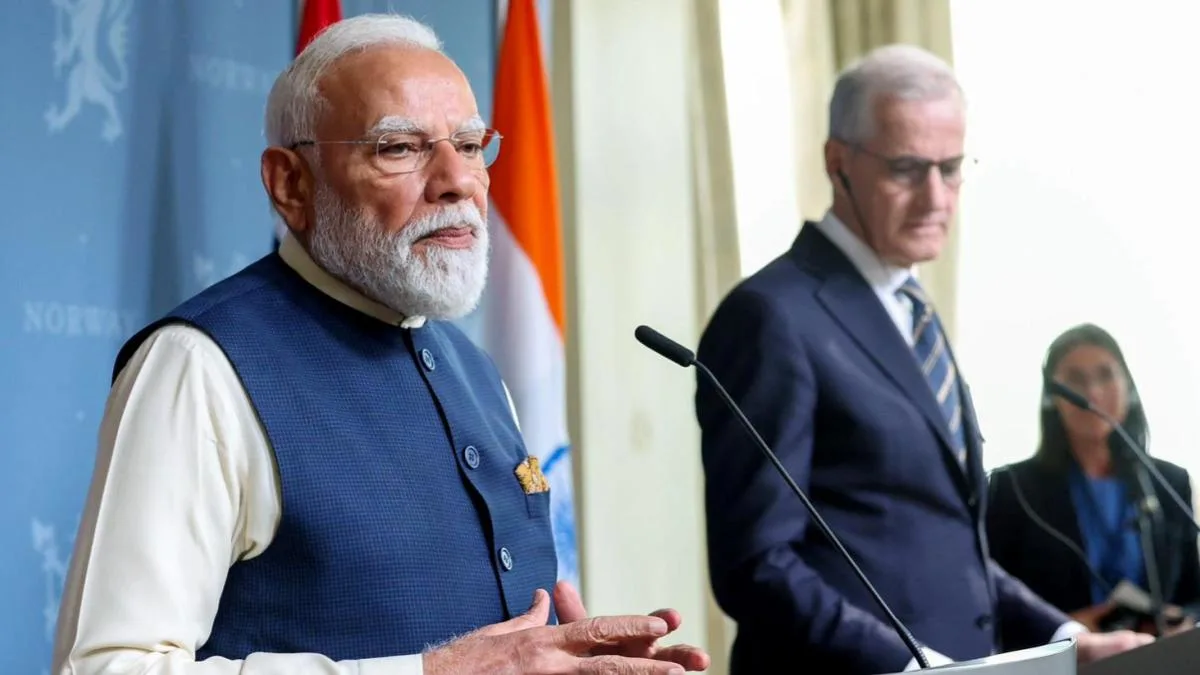
Recently, during Prime Minister Narendra Modi’s Europe visit, a moment triggered a major debate about democracy, press freedom, and human rights in India. A Norwegian journalist, Helle Lyng, tried to ask PM Modi why he avoids open press conferences and difficult questions related to human rights and media freedom. However, the Prime Minister walked ahead without answering. Within hours, the video spread across social media and international media platforms, starting a strong global discussion.
This was not just about one unanswered question. For many people, it reflected a growing concern in India — has political power become so strong that it no longer feels the need to answer uncomfortable questions? And has democracy slowly become limited to only winning elections?
The Indian government strongly rejected criticism from foreign media and described it as biased. Supporters of the government argued that many Western countries themselves have poor human rights records. They pointed to incidents such as the death of George Floyd in the United States, police crackdowns during protests in France, racial tensions in the United Kingdom, and the silence of many Western governments over the Gaza conflict. According to them, Western nations often apply different standards when judging countries like India.
This argument is not entirely wrong. Powerful countries have often been accused of hypocrisy on human rights issues. But at the same time, an equally important question arises — if Western countries are flawed, does that mean India should avoid difficult questions too?
In any democracy, the most dangerous situation begins when those in power start believing they are above public questioning. History shows that even the world’s most powerful leaders regularly face tough media scrutiny. In the United States, both Joe Biden and Donald Trump have faced aggressive questioning from journalists. In the United Kingdom, prime ministers are constantly questioned by both Parliament and the media. Even during wartime, Ukrainian President Volodymyr Zelensky answered difficult questions from international journalists. In India too, former Prime Ministers Atal Bihari Vajpayee and Manmohan Singh regularly held open press conferences where uncomfortable questions were asked and answered.
This is why the controversy is bigger than one journalist’s question. It reflects a changing political culture where leaders’ public images are becoming highly controlled and unscripted interactions are becoming rare. Interviews still happen, but critics argue that they are often conducted in safe and friendly environments. Press conferences are held, but difficult questions are limited. According to critics, this weakens the spirit of democracy.
India’s image becomes even more sensitive because several recent events have raised international concerns about human rights and social harmony. The world watched the long violence in Manipur. Questions were raised after the Delhi riots. Debates continued over arrests of journalists, activists, and students. International press freedom rankings have also shown India slipping in recent years. The government dismisses many of these reports as biased, but critics argue that simply rejecting criticism does not make the concerns disappear.
At the same time, the other side of the argument is also strong. Supporters of PM Modi believe that India’s rapid rise as a global power has made many Western institutions uncomfortable. India’s successful G20 presidency, digital growth, strong economic expansion, independent foreign policy during the Russia-Ukraine war, and growing global influence have made the country far more confident than before. According to supporters, this is one reason why some sections of Western media focus heavily on India’s problems.
However, the true strength of a nation is not shown by avoiding criticism. Real strength is shown when governments confidently face difficult questions. If India truly wants to be seen as the world’s largest and most confident democracy, it must prove its strength not only through economic growth and election victories, but also through openness and accountability.
Today, India stands at an important crossroads where both development and democracy are being tested together. Millions of people see PM Modi as a symbol of strong leadership, nationalism, and global respect. At the same time, another section of society feels worried about rising polarization, fear, and shrinking space for criticism. The truth may lie somewhere in between.
But history repeatedly teaches one lesson — democracy does not become weak when people ask questions. Democracy becomes weak when those in power stop answering them.