


India Strengthens Critical Mineral Supply Chain Under Quad Framework
The CSR Journal Magazine

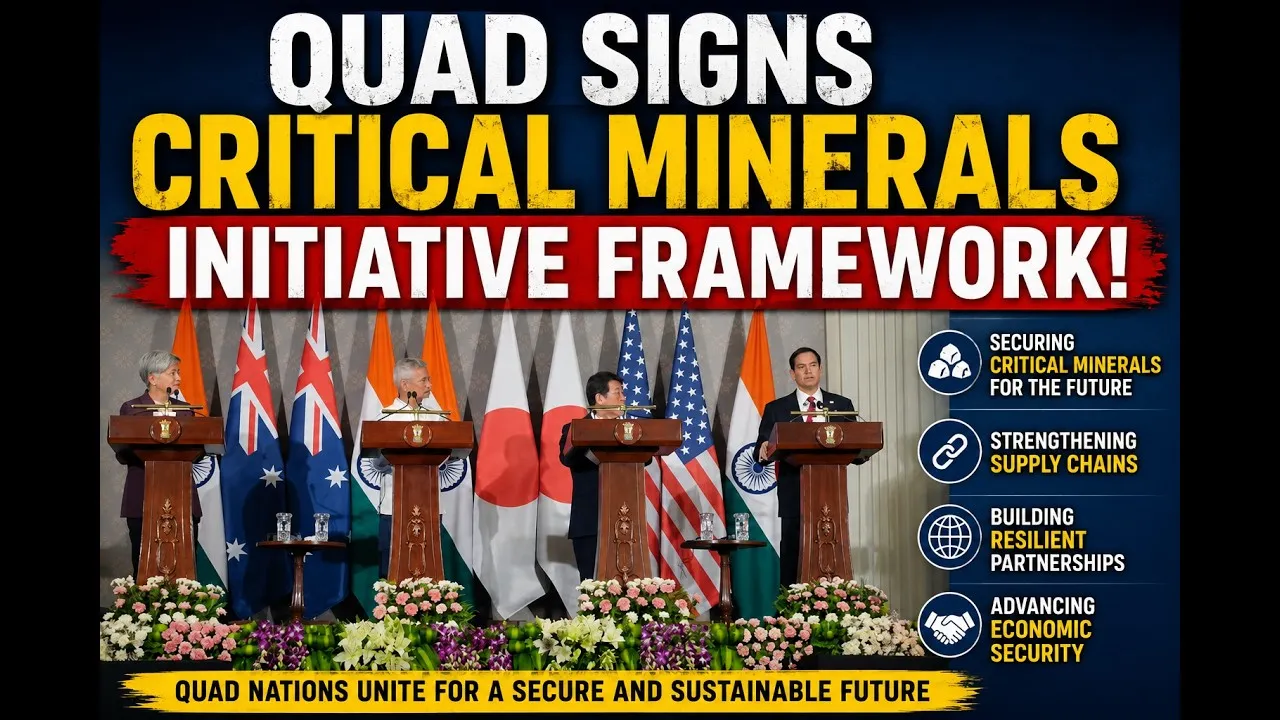
India’s involvement in the Quad critical minerals framework is set to enhance its access to essential mineral supply chains, thereby decreasing its reliance on China for imports. Sources in the industry indicate that this move comes at a crucial juncture, as China has been tightening its export controls on various minerals. The overarching goal of this collaboration is to fortify supply chains amidst global challenges.

As part of its proactive approach, India has initiated the National Critical Minerals Mission. This mission focuses on exploring overseas critical mineral assets through public sectors. According to Rajib Maitra, a partner at Deloitte India, the Quad framework will allow India to collaborate more deeply with the United States, Japan, and Australia, amplifying existing efforts in mineral supply chain development.

The Quad Critical Minerals Initiative, announced on May 26, aims to mobilise up to $20 billion from both government and private sectors. This funding will support new and existing projects in the areas of mining, processing, and recycling of critical minerals.

Potential Benefits for India in Mineral Enrichment

Experts suggest that the Quad framework could significantly benefit India by facilitating investment, project development, and regulatory cooperation in the critical minerals arena. It provides a vital opportunity for improving domestic capacities in mineral processing and recovery, consequently enhancing India’s role in this globally important value chain.

The country remains heavily reliant on foreign imports for critical minerals such as coking coal, lithium, cobalt, and nickel. As a result, India confronts supply chain vulnerabilities that include price fluctuations and geopolitical risks. Notably, since early 2025, China has tightened controls on the export of these essential minerals.

According to Niladri N Bhattacharjee, a partner at Grant Thornton Bharat, the lack of access to advanced technology for mineral processing remains a significant hurdle. However, the Quad initiative may help mobilise both government and private finance from allied nations, addressing these supply challenges while fostering the development of India’s own capabilities in mineral processing.

Collaboration with Global Partners to Unlock Resources

India’s strategic position as an emerging demand centre for critical minerals complements Australia’s role as a supply hub. This synergy allows Indian firms to partner with companies from Australia, the US, and Japan to secure stakes in mines rich in lithium, cobalt, nickel, rare earth elements, graphite, and copper. Such collaborations are viewed as vital for advancing India’s mineral exploration and processing capabilities.

Bhattacharjee highlights the need for India to acquire beneficiation and processing technologies, which are currently restricted to a few countries. These technologies are essential for exploiting India’s geological potential in key minerals such as lithium and heavy rare earth elements, on which global demand is surging.

Despite these promising developments, India’s import dependence remains notably high, particularly for refined rare earth elements and critical minerals. Reports suggest that India has near-total reliance on imports for vital minerals, including lithium and nickel. Additionally, the country depends on foreign sources for approximately 90 per cent of its coking coal necessary for steel manufacturing.

Challenges and Government Initiatives Moving Forward

Domestic companies are also beginning to expand their capacities for rare earth recycling; however, they continue to face obstacles such as financing challenges and gaps in technology. Experts note that the absence of technologies to extract and enhance the purity of minerals from geological formations hampers progress.

The Indian government has taken steps to stimulate domestic production by introducing the auctioning of critical mineral blocks since 2015. Recent figures indicate that a record 212 mineral blocks were successfully auctioned in FY26, demonstrating a significant push towards enhancing local mineral production.

Moreover, the Quad framework aims to promote financial support through development finance institutions and export credit agencies. It also encourages the establishment of commercial arrangements, such as offtake agreements, to secure sustainable access to strategic minerals from trusted partners.

Long or Short, get news the way you like. No ads. No redirections. Download Newspin and Stay Alert, The CSR Journal Mobile app, for fast, crisp, clean updates!

App Store –  https://apps.apple.com/in/app/newspin/id6746449540 

Google Play Store – https://play.google.com/store/apps/details?id=com.inventifweb.newspin&pcampaignid=web_share

Latest News

Popular Videos
