


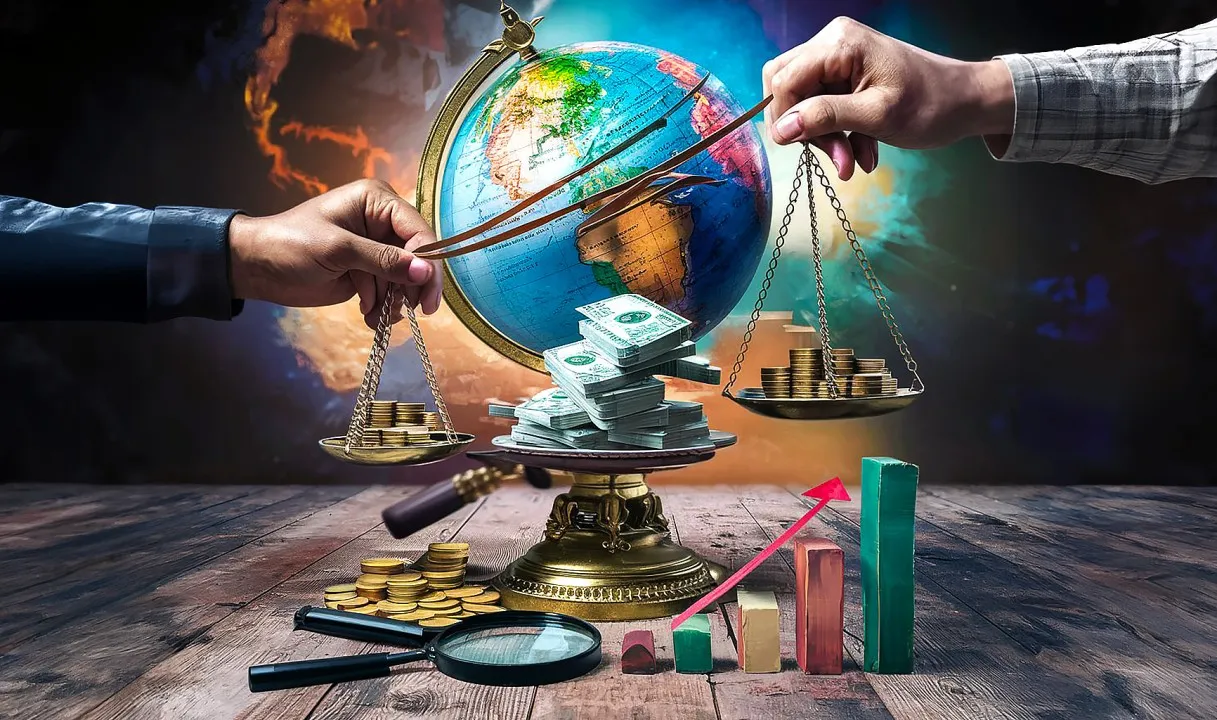


We Were Invited to the Table After the Menu Had Already Been Decided

The CSR Journal Magazine

I remember the precise moment I first encountered the full weight of globalisation’s contradiction. It was sometime in the early 2000s, standing in front of a newly opened ATM on a street in Mumbai that had, only years before, smelled of roasted corn and local chai stalls. The machine gleamed. It promised access, efficiency, connection to the world’s financial bloodstream. What no one said then, what no pamphlet or prime-time debate bothered to articulate, was the question of whose world this was, and on whose terms the connection was being offered.

That question has defined my intellectual life ever since. And today, two decades into what was supposed to be the golden century of open borders, frictionless capital, and the eventual convergence of prosperity, that question has become an indictment.

Globalisation has not failed because it was mismanaged at the margins. It has failed because its foundational architecture was designed by the powerful, for the powerful, dressed in the language of universal benefit. The data now confirms what the Global South has long known in its bones.

The Numbers That Cannot Be Wished Away

Between 1995 and 2007, global trade grew at 2x of global GDP. Since the 2008 financial crisis, that momentum has comprehensively stalled. The great machine slowed, and the slowdown was not experienced equally. In 2023, global merchandise exports fell 4.3 percent to $23.8 trillion. The decline in developing economies was sharper at 6.2 percent, compared to 2.8 percent in developed ones. Africa registered the steepest fall at 9.8 percent, and the continent imports nearly three times more manufactured goods than it exports.

Read that last sentence again. Africa imports nearly 3x more manufactured goods than it exports. This is not a temporary imbalance. It is the structural logic of a global order that extracts raw materials at suppressed prices and sells back finished products at premium ones. This is not trade. This is a reorganisation of colonial tribute flows under a new vocabulary.

UNCTAD projects global economic growth to stagnate at 2.7 percent in 2024 and 2025, a sustained drop from the 3 percent annual average between 2011 and 2019, and well below the 4.4 percent average before the 2008 financial crisis. The institutions that sold the Global South on liberalisation are now presiding over what UNCTAD itself calls a “low normal” that is insufficient to tackle development goals, climate ambitions, or the cost-of-living crisis ravaging hundreds of millions of households.

Meanwhile, look at where the wealth has accumulated. The world’s 12 richest billionaires now hold more wealth than the poorest half of humanity, over 4 billion people. The number of billionaires has surpassed 3,000 for the first time, and billionaire wealth stands at the highest levels ever recorded in history. In 2025, the collective wealth of billionaires surged by $2.5 trillion, nearly equivalent to the total wealth held by the bottom half of humanity, 4.1 billion people.

This is not an accident. It is a policy outcome. The countries of the Global North own 69 percent of global wealth, 77 percent of billionaire wealth, and 68 percent of all billionaires, despite representing only 21 percent of the world’s population. The promise of globalisation, that rising tides would lift all boats, has been exposed as the most consequential lie of the twentieth century’s closing decades.

The Architects and Their Intentions

Joseph Stiglitz, writing from the inside of the machine as a former World Bank Chief Economist, gave us the vocabulary of institutional capture. His central argument was damning in its precision: globalisation is not inherently destructive, but globalisation managed by the IMF, World Bank, and WTO has systematically prioritised the interests of financial markets and advanced economies over the developmental needs of poorer nations. In East Asia’s financial crisis, Russia’s failed conversion to a market economy, failed development in sub-Saharan Africa, and financial meltdown in Argentina, IMF policies contributed to disaster, failing to promote productive investment and lending prematurely with conditions that subverted democratic growth.

The IMF’s playbook was never neutral. It was ideological. Structural adjustment programmes demanded that governments in the Global South slash subsidies, privatise public utilities, liberalise capital accounts, and reduce wages, all while the Northern countries that designed these prescriptions maintained agricultural subsidies, erected non-tariff barriers, and protected their pharmaceutical and financial industries with ferocious vigour. The rules of the game were made by players who had already won.

Samir Saran and Shashi Tharoor, in their respective but complementary intellectual traditions, have articulated what this means from a subcontinental vantage point. The “new world disorder” is not an aberration but a consequence. The multilateral order was never truly multilateral. It was a hegemonic arrangement with a multilateral facade. The Bretton Woods institutions were built in 1944, before decolonisation had even begun in earnest, and their voting structures, governance models, and ideological assumptions reflected the world as the North wished to preserve it, not as the South was destined to transform it.

I have sat in enough international conferences, from Geneva to Singapore, to understand the texture of this condescension. The representatives of the Global South are welcomed at the table, invited to speak, and then systematically overruled or ignored in the rooms where decisions actually crystallise. The language of partnership cloaks what is, in practice, a continuation of the extractive logics that colonialism inaugurated.

TRIPS and the Pandemic Confession

If any single moment in recent history stripped the moral pretension from the globalisation project, it was the COVID-19 vaccine debacle. The pandemic was supposed to be the great equaliser, a shared human crisis that would reveal our interconnectedness. Instead, it revealed the hierarchy beneath the rhetoric of shared humanity.

India and South Africa, acting together, submitted a joint proposal to the WTO for a temporary waiver of intellectual property rights under TRIPS, to allow mass production and equitable distribution of vaccines and life-saving medical equipment. The proposal was straightforward in its humanitarian logic: a public health emergency of planetary scale required that patent protections be temporarily subordinated to the survival of billions. Countries that had long positioned themselves as advocates of human rights, egalitarianism, and democracy opposed this proposal. The United States, Germany, the United Kingdom, and the European Union blocked or delayed the waiver for over a year while their populations were vaccinated and the Global South waited.

This was not a lapse in attention. This was the system working as designed. The WTO’s TRIPS agreement, which focused on pharmaceutical profits at the expense of AIDS patients’ lives, is part of the same logic that has consistently prioritised the commercial interests of advanced-economy corporations over the basic welfare of the world’s poor.

I think of the millions of deaths in sub-Saharan Africa, in South Asia, in Latin America, that occurred while patents were being defended. I think of the Serum Institute of India, the world’s largest vaccine manufacturer by volume, which was ready and capable of producing hundreds of millions of doses but was legally constrained from doing so without licences that the Global North withheld. The moral accounting of that decision will outlast every diplomatic communique ever produced about the benevolence of the Western liberal order.

The Climate-Debt Trap: A New Colonialism in Green Language

The failure of globalisation is now most viciously expressed in the intersection of climate finance and sovereign debt. This is where the twenty-first century’s injustice is being quietly institutionalised.

Developed economies delivered $136.7 billion in climate finance in 2024, surpassing the long-delayed $100 billion goal for the third consecutive year. Yet only 7 percent of that total reached low-income countries. Seven percent. The rhetorical apparatus around climate finance dwarfs its substantive delivery to the people most exposed to the climate crisis.

Consider Malawi. By 2024, Malawi’s debt had reached 86.4 percent of GDP, with public debt interest consuming 49.2 percent of government revenue. Malawi’s carbon emissions are negligible, yet the country is repeatedly forced to borrow to rebuild from climate disasters it did almost nothing to cause. The IMF loans that follow cyclones and droughts carry conditionalities: reduce public spending, liberalise trade, privatise state enterprises, prioritise debt service. A government rebuilding from a cyclone is simultaneously being instructed to cut health budgets and reduce public sector wages.

As of early 2023, the developing world faced a combined debt burden of nearly $100 trillion. African countries faced a perfect storm of financial distress despite their minimal contribution to greenhouse gas emissions. Poor countries are spending more on servicing debt than on life-saving public services, including responding to the climate emergency. They receive meagre assistance from high-income countries whose emissions have caused global warming, and are spending twice more in debt payments than what they receive in financial assistance to fight the climate crisis.

The combined sovereign debt of G20 economies vastly outweighs the cumulative debt of countries in Africa, the Caribbean, and the Pacific by a ratio of approximately 19 to 1, a disparity that reflects deep-seated structural imbalances and colonial legacies in the global financial architecture. While Global South countries are subjected to rigid fiscal discipline, austerity, and conditionalities, G20 economies benefit from expansive borrowing, currency privilege, and financial instruments insulated from external oversight.

This is the new colonialism, written in the language of green bonds and carbon credits rather than in the language of gunboats and treaties. The substance is the same: the extraction of value from the periphery to service the centre.

The Deglobalisation Illusion and What It Conceals

It is fashionable now, particularly in Washington and Brussels, to speak of deglobalisation as though the Global North were voluntarily dismantling a system that had, in their telling, served everyone equally and has now become inconvenient due to geopolitical competition with China. This narrative demands scrutiny bordering on refusal.

The Ukraine-Russia war has accelerated the fragmentation of the world into two major blocs, one led by the US-Europe and the other by Russia-China. Coupled with rising economic discontent, trade wars in developed economies are compelling governments to look for economic and business opportunities closer to home. What the Global North calls “friend-shoring” or “strategic autonomy” is, when viewed from the Global South, a reorganisation of the rules to suit the new preferences of the same players who wrote the old rules.

The United States’ Inflation Reduction Act, celebrated in Washington as green industrial policy, triggered alarm across the developing world and even among European allies. Its domestic production incentives amounted to the most aggressive industrial policy the world’s largest economy had pursued in decades, precisely the kind of policy that IMF conditionalities had forbidden developing countries from attempting. The hypocrisy is not incidental. It is structural.

In the services sector, valued at $1.4 trillion in 2022, advanced economies account for 80 percent of exports. Developing countries account for less than 30 percent of global services export revenues. As the global economy pivots from goods to services and from hardware to data, the new infrastructure of globalisation, cloud platforms, AI systems, data centres, is overwhelmingly owned and regulated by a handful of companies headquartered in the United States and, to a lesser extent, China. The Global South is being offered access as a consumer, never as an architect.

What Convergence?

The canonical defence of globalisation rests on one empirical pillar: the reduction of extreme poverty, primarily in China and East Asia. It is a real achievement, and I do not dismiss it. But it is worth examining what it reveals about the model itself. China’s success occurred not through adherence to the Washington Consensus but through its systematic defiance of it: capital controls, state-directed industrial policy, managed exchange rates, technology transfer requirements, and the gradual sequencing of liberalisation on Beijing’s own terms. As Stiglitz recognised, the East Asian model that succeeded was precisely the model that the IMF discouraged.

From a long-run perspective, the West has soared past the global average since the nineteenth century, while sub-Saharan Africa and South and South-East Asia have lagged behind. Average income data masks inequality within countries, which has been increasing since 1980. While export-led growth has dramatically reduced poverty in East Asia and several Eastern European economies, the number of poor people in sub-Saharan Africa has stagnated since the 1990s.

Three decades of liberalisation. Thirty years of structural adjustment. An entire generation of African policymakers told to open their markets, welcome foreign capital, and trust the discipline of international institutions. The poverty statistics in sub-Saharan Africa have not meaningfully moved.

A common issue is that the benefits from trade are not shared equally between producers and consumers, and between firms and workers. Large multinational firms from advanced economies increased their profits at the expense of the margins of domestic firms in developing economies that supply them inputs. The supply chain is designed to commoditise Southern labour and Southern resources while capturing value at the Northern end, in the branding, design, financial services, and intellectual property that accompany goods from production to market.

The Governance Deficit and the Democratic Deficit

At the heart of the globalisation project sits an institutional crisis that has never been honestly addressed. The WTO, the IMF, and the World Bank were designed in 1944 and 1994 by nations that represented a fraction of the world’s population but the majority of its economic power. Their governance structures, weighted voting systems, informal agenda-setting processes, and bureaucratic cultures reflect that origin. Without government oversight, these institutions reach decisions without public debate and resolve trade disputes involving environmental, labour, and capital laws in secret tribunals without appeal to national courts.

The Global South’s demands for reform, from a greater voice in IMF governance to a restructured WTO dispute settlement mechanism to debt relief frameworks that actually function, have been consistently deferred, diluted, or denied. The G20 Common Framework, designed to provide debt relief, has, as of 2024, reached only three countries: Chad, Zambia, and Ghana, and does not systematically consider the impacts of climate change.

The gap between the rhetoric of reformed multilateralism and the reality of institutional inertia is where the failure of globalisation lives most stubbornly. The Global North has been extraordinarily skilled at acknowledging the problem in diplomatic language and reproducing the problem in institutional practice.

Towards a Different Imagination

I am not, finally, arguing for autarky or for the romanticisation of closed borders. I am arguing for something more demanding and more honest: a renegotiation of the terms of global integration from the position of those who have borne its costs most heavily.

This requires, first, an acknowledgement that the current system was not neutral. It was designed with embedded hierarchies that the rhetoric of free trade was deployed to legitimise.

Second, it requires reforming the governance of international economic institutions so that the Global South has genuine power, not merely a seat at a table whose agenda has already been set.

Third, it requires a differentiated approach to intellectual property, trade rules, industrial policy, and climate finance that recognises the developmental asymmetries that history has produced.

As Shashi Tharoor has argued across his body of work, the relationship between the Global North and South cannot be understood outside of the colonial context that structured the initial terms of their integration into the world economy. The wealth that funded the Industrial Revolution, the infrastructure of the colonial world, the suppression of indigenous manufacturing, all of this is historical context that is not ancient history. It is living consequence.

And as Samir Saran has consistently articulated, the emerging multipolar world does not represent a threat to order but an opportunity for a more honest order, one in which the Global South is no longer a passive recipient of Northern decisions but an active co-author of global rules.

I return, finally, to that gleaming ATM in early 2000s Mumbai. It was not inherently oppressive. Technology and connectivity are not the problem. The problem is the power that decides who builds the machine, who programmes the terms, who sets the transaction fees, and who determines when access is granted and when it is revoked.

Globalisation failed not because it was an impossible dream. It failed because it was a dream that some people were allowed to have in full, and others were only allowed to service.

The question now is not whether a different world is possible. It is whether those who benefited most from the old one have the honesty to admit what they built, and the political will to build something genuinely shared.

I am, after 2 decades of watching this from Mumbai, not holding my breath. But I am keeping count.

Views of the author are personal and do not necessarily represent the website’s views.

Dr. Jaimine Vaishnav is a faculty of geopolitics and world economy and other liberal arts subjects, a researcher with publications in SCI and ABDC journals, and an author of 6 books specializing in informal economies, mass media, and street entrepreneurship. With over a decade of experience as an academic and options trader, he is keen on bridging the grassroots business practices with global economic thought. His work emphasizes resilience, innovation, and human action in everyday human life. He can be contacted on jaiminism@hotmail.co.in for further communication.

Long or Short, get news the way you like. No ads. No redirections. Download Newspin and Stay Alert, The CSR Journal Mobile app, for fast, crisp, clean updates!

App Store – https://apps.apple.com/in/app/newspin/id6746449540

Google Play Store – https://play.google.com/store/apps/details?id=com.inventifweb.newspin&pcampaignid=web_share

Latest News

Popular Videos