


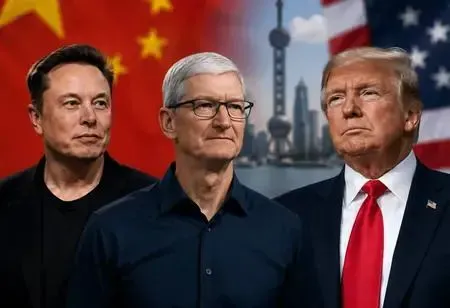

Trump Takes Top CEOs to China for Strategic Business Discussions

The CSR Journal Magazine

US President Donald Trump has embarked on a significant visit to Beijing, accompanied by a remarkable delegation of leading business and technology executives. This group includes notable figures such as Elon Musk of Tesla, Jensen Huang of Nvidia, Tim Cook of Apple, and Larry Fink of BlackRock. Alongside them are representatives from major firms like Meta, Visa, Goldman Sachs, Boeing, and Mastercard. The involvement of such a diverse range of corporate leaders surpasses the usual diplomatic agenda for a presidential visit.

The sheer number of executives has prompted speculation regarding the motivations behind this strategic move. Analysts suggest that the presence of these CEOs reflects a mix of pressing business interests, geopolitical dynamics, and the necessity for economic advancements amid ongoing tensions in US-China relations.

Focus on Business Resolutions Over Ceremonial Messaging

This trip diverges from Trump’s visit in 2017, which was heavily focused on grand trade agreements and large public demonstrations. The current visit, however, is reportedly more targeted, as many of the companies involved are facing unresolved business and regulatory challenges in China. News reports indicate that a primary requirement for executives to join the delegation was to present a “tangible ask,” aimed at achieving specific agreements or regulatory approvals during or following the summit.

These pressing business needs suggest that many of the CEOs are not merely present for symbolic appearances. Instead, they are seeking to broker vital agreements that could facilitate their operations within the Chinese market.

Among those with critical interests is Nvidia’s Jensen Huang, whose company has encountered significant hurdles in selling advanced artificial intelligence chips in China due to existing export controls and regulations. The ability to sell the H200 AI chips in China is particularly vital, given the country’s prominence in the AI and semiconductor sectors.

Significant Stakes for Other Tech Leaders

In addition to Nvidia, Elon Musk’s Tesla is similarly engaged with important business matters in China. The company is currently seeking approval to enhance its Full Self-Driving assistance system within the country, reinforcing Tesla’s reliance on the Chinese market, which is the world’s largest for automobiles. Reports have also surfaced regarding Tesla aiming to procure around $2.9 billion in solar manufacturing equipment from Chinese suppliers, making regulatory approvals essential for these expansion plans.

For Tim Cook, the CEO of Apple, China serves as both a crucial manufacturing centre and a significant consumer market. Meanwhile, Meta is reportedly facing scrutiny from Chinese authorities over its acquisition of an artificial intelligence startup, Manus, meaning that regulatory concerns are at the forefront of its operational strategy in China.

Financial institutions are also pursuing enhanced positions in the Chinese market. Visa and Mastercard are each seeking improvements to their respective roles within China’s tightly regulated payments ecosystem, with Mastercard aiming for a larger stake in its joint venture and Visa aspiring to enter the domestic bank-card clearing sector.

Implications of the Visit Amidst Broader Economic Context

This visit underscores a crucial reality: despite the ongoing trade tensions and technology-induced restrictions, American companies still regard China as an indispensable player in their global business strategies. Many firms in the delegation rely on China for various aspects like manufacturing and regulatory approvals, highlighting the interdependency between the two economies.

The timing of Trump’s visit is critical, as he aims to navigate political and economic challenges back home, including inflation and market volatility. It also signals a desire to project economic success to American businesses while maintaining a fragile trade relationship with China. The delegation’s inclusivity across sectors like artificial intelligence, finance, and agriculture illustrates the broad economic interests at stake.

While immediate major agreements may not be realised from this summit, analysts indicate that the visit could facilitate essential regulatory approvals and enhance communication channels, laying groundwork for future business opportunities. For many companies, even minor regulatory advancements could translate into significant economic benefits in the long run.

Long or Short, get news the way you like. No ads. No redirections. Download Newspin and Stay Alert, The CSR Journal Mobile app, for fast, crisp, clean updates!

App Store –  https://apps.apple.com/in/app/newspin/id6746449540 

Google Play Store – https://play.google.com/store/apps/details?id=com.inventifweb.newspin&pcampaignid=web_share

Latest News

Popular Videos