


Satellite Imagery Reveals Intense Thunderstorm Activity in Uttar Pradesh
The CSR Journal Magazine

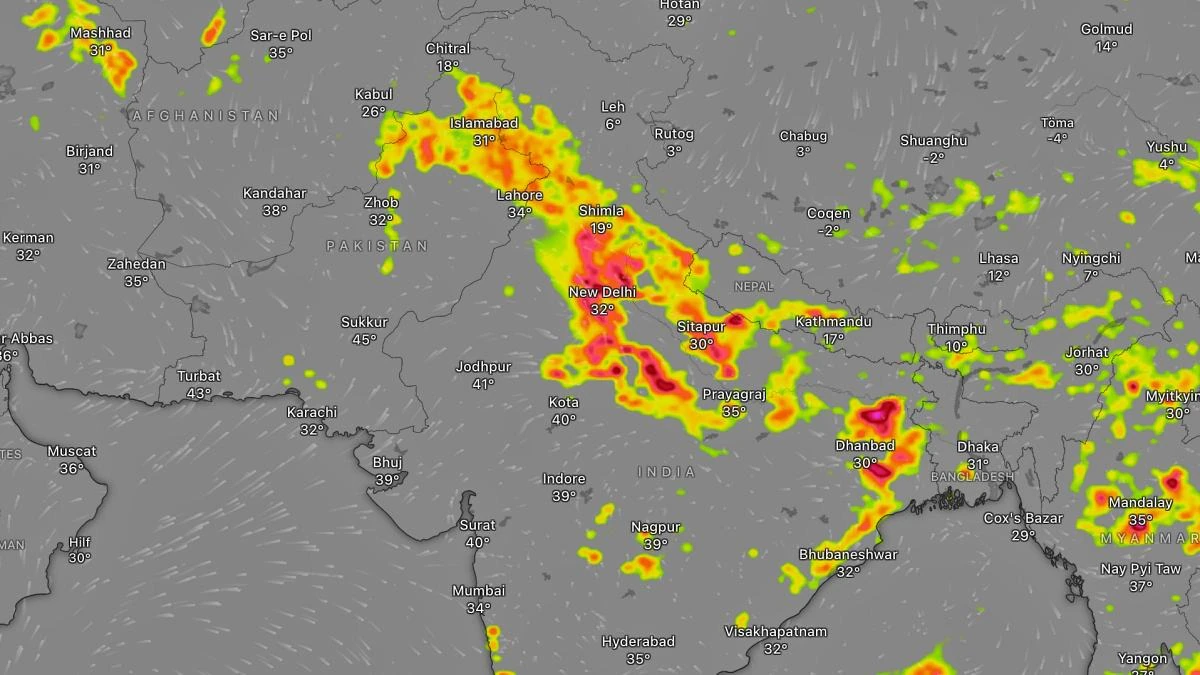
An image from the INSAT-3DS thermal infrared satellite, taken on May 13, has shown significant thunderstorm activity over northern India. Meteorologists are monitoring a robust cloud mass that is currently positioned over eastern Uttar Pradesh and parts of Bihar. This data was made available by the India Meteorological Department (IMD).

The satellite image distinctly illustrates a bright, spherical cloud formation that sits within a larger area of unstable weather patterns extending across both north and central India. Experts believe that this cloud structure likely represents a deep convective thunderstorm cell, which is being energised by substantial pre-monsoon heating and high moisture levels in the Gangetic plains.

In thermal infrared imagery, regions appearing bright white correspond to cooler cloud-top temperatures. These temperatures are characteristic of towering cumulonimbus clouds that can escalate high into the atmosphere and are capable of producing short-lived, intense weather phenomena including heavy rainfall, lightning strikes, gusty winds, and even hailstorms.

Characteristics of the Current Thunderstorm

While the observed cloud feature is noteworthy, meteorologists suggest it does not conform to the typical characteristics of a thundersquall system. Usually, a thundersquall is identified by an elongated line of thunderstorms that generate widespread damaging winds. In contrast, the current circular formation indicates an isolated but intensifying thunderstorm cell.

The vertical development of this cloud top appears to be strong and cold, which implies vigorous convection activity. Isolated storm cells of this nature are prevalent in northern India during the peak pre-monsoon season, and can develop rapidly given the right atmospheric conditions.

Additionally, the satellite image depicts a more extensive weather system that is impacting the region. Broad bands of clouds associated with a western disturbance are observed extending from northwestern India to the Himalayan region. This situation is further complicated by moisture being drawn in from the Bay of Bengal, contributing to the instability across Uttar Pradesh, Bihar, and central India.

Implications for Local Weather Conditions

The interplay of upper-level disturbances, surface heating, and moisture inflow creates optimal conditions for severe thunderstorms, commonly referred to locally as “aandhi” systems. These storms can result in sudden dust storms, lightning occurrences, and abrupt declines in temperature prior to rainfall.

It is important to note that while satellite imagery provides valuable information, it cannot alone confirm the classification of a storm as a thundersquall. Accurate verification necessitates the use of Doppler Weather Radar, ground wind measurements, assessments of lightning activity, and the tracking of the storm’s progression over time.

The INSAT-3DS satellite, designed to enhance India’s meteorological observation capabilities, is equipped to deliver high-resolution thermal and visible imagery. This technology assists forecasters in monitoring rapidly changing weather systems in nearly real time, thereby improving the accuracy of weather predictions across the region.

Long or Short, get news the way you like. No ads. No redirections. Download Newspin and Stay Alert, The CSR Journal Mobile app, for fast, crisp, clean updates!

App Store –  https://apps.apple.com/in/app/newspin/id6746449540 

Google Play Store – https://play.google.com/store/apps/details?id=com.inventifweb.newspin&pcampaignid=web_share

Latest News

Popular Videos
