


ISRO Conducts Successful Test of Solve Rocket Motor for Gaganyaan Mission
The CSR Journal Magazine

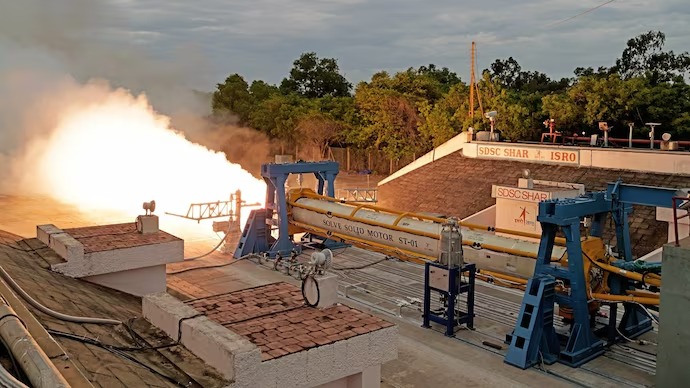
The Indian Space Research Organisation (ISRO) has successfully carried out the initial ground test of the solid motor designed for its experimental Sub-Orbital Launch Vehicle for Experiments (Solve). This achievement signifies a crucial step forward in the development of technologies for India’s upcoming human spaceflight mission, Gaganyaan.

This static test took place at the Static Test Facility located at the Satish Dhawan Space Centre (SDSC) in Sriharikota. Isro confirmed that the motor operated as intended, with all significant performance parameters aligning with mission specifications.

Designed specifically as a test platform, the Solve rocket aims to validate essential systems intended for the Gaganyaan missions. One key focus is the crew module’s parachute-based deceleration system, which plays a vital role in safely returning astronauts to Earth.

Solve Rocket’s Sub-Orbital Flight Capabilities

Unlike conventional orbital launch vehicles, the Solve rocket is engineered for sub-orbital flights. The missions are planned to transport the Gaganyaan crew module to an altitude ranging from 10 to 17 kilometres, after which the module will detach from the rocket.

Upon separation, a sequence involving 10 parachutes will be activated to progressively decelerate the crew module, ultimately ensuring a safe splashdown in the sea. These tests are designed to replicate various flight conditions that astronauts may experience, allowing engineers to assess the recovery system’s reliability prior to sending humans into space.

The solid propulsion stage of Solve is adapted from the PSLV strap-on booster motor but includes numerous modifications tailored to meet the specific testing needs of Gaganyaan. Features such as a slow burn-rate propellant, a streamlined nozzle configuration, and a secondary injection thrust vector control system have been incorporated to enhance flight navigation.

Advancements in Human Spaceflight Testing

Isro emphasised that the development of the Solve vehicle offers increased flexibility for conducting multiple Gaganyaan test missions under diverse conditions. This adaptability is crucial for verifying the crew module’s performance prior to operational human spaceflight.

The latest successful test builds upon a series of accomplishments achieved over the preceding year related to the Gaganyaan programme. These successes include integrated air-drop tests and various parachute qualification trials that are essential for ensuring astronaut safety during missions.

The Solve test platform is anticipated to play a significant role in validating astronaut recovery systems, which are one of the most critical components of any human spaceflight initiative. As India’s first crewed space mission, Gaganyaan aims to transport a group of Indian astronauts into low-Earth orbit aboard an Indian rocket and ensure their safe return to Earth, positioning India as the fourth country to accomplish independent human spaceflight.

Long or Short, get news the way you like. No ads. No redirections. Download Newspin and Stay Alert, The CSR Journal Mobile app, for fast, crisp, clean updates!

App Store –  https://apps.apple.com/in/app/newspin/id6746449540 

Google Play Store – https://play.google.com/store/apps/details?id=com.inventifweb.newspin&pcampaignid=web_share

Latest News

Popular Videos
