


The Five-C Framework Redefines Graduate Skills
The CSR Journal Magazine

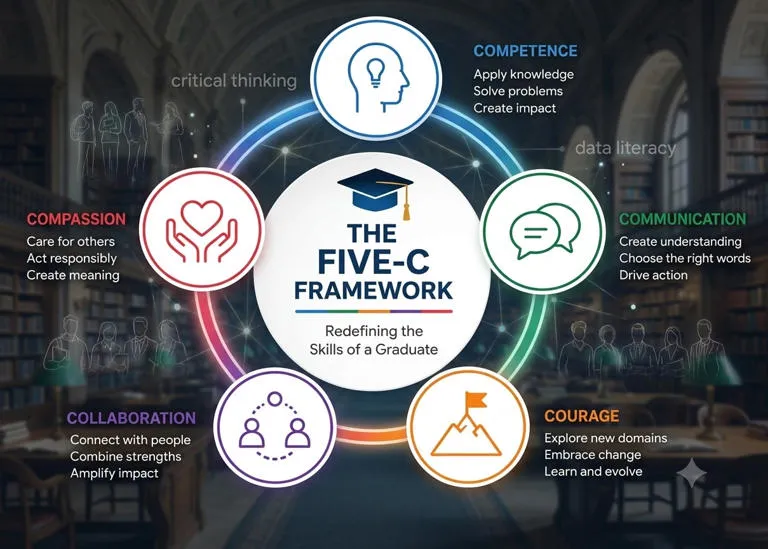
The Five-C Framework introduces a new paradigm for assessing the skills of future graduates, shifting focus beyond traditional academic achievements such as degrees and grades. In a world that is continually evolving, graduates must be equipped with a diverse set of capabilities, attitudes, and values that empower them to obtain employment, adapt to change, and make significant contributions to society.

At K.P.B. Hinduja College of Commerce, this framework informs the design of curricula, the structure of student engagement, and the criteria for evaluating institutional success. It aims not just to prepare students for today’s job market, but also to nurture thoughtful and adaptable individuals, ready to face future uncertainties.

Competence: Emphasising Practical Application

Traditionally, competence was evaluated using knowledge alone, measured through academic qualifications and subject expertise. However, in today’s context, mere knowledge is insufficient. The ability to effectively apply this knowledge in real-world situations is now the true mark of competence. Students must learn not only to understand concepts theoretically but also to utilise them to solve practical issues and enhance processes.

This approach is reflected at Hinduja College through active learning methodologies such as live projects, internships, and case studies, all aimed at fostering practical decision-making and judgement. Emphasising industry-linked projects ensures that students can apply their theoretical knowledge to real business challenges.

Contemporary definitions of competence now include not just knowledge application but also analytical reasoning, critical thinking, and ethical responsibility in the use of technology. Graduates are expected to be proficient in translating ideas into actionable plans, emphasising their role as not just information gatherers but as knowledgeable and responsible actors in the professional environment.

Communication: Beyond Basic Skills

Effective communication has always been essential in the professional realm, but its scope has transformed with the advent of advanced technologies. AI tools like ChatGPT have revolutionised the way communication is handled, now enabling the rapid drafting of various content types. Consequently, the focus for students must shift from basic content production to fostering a deeper understanding of effective communication.

Graduates must learn to discern what needs to be communicated, to whom, and through which channels. Mastery in communication involves not just conveying messages, but also engaging in listening, interpreting, and negotiating across cultures and platforms. Students at Hinduja College are encouraged to participate in diverse forums like panel discussions and seminars to practice these skills in real-world settings.

Courage: Embracing New Challenges

Courage forms a critical part of the Five-C Framework, recognising the need for graduates to step into uncharted territories. The nature of work and required skills is ever-changing, with the emergence of new technologies demanding continuous learning and adaptation. This necessitates graduates to actively question traditional methodologies and be open to acquiring new skills.

Today’s graduates face roles that may not even exist yet, necessitating a mindset geared towards exploring the unfamiliar and embracing change. Cultivating courage means encouraging students to take risks, learn from failures, and continually reskill. This adaptability becomes crucial in a landscape predicted to shift dramatically with technological advancements.

As industries evolve, fostering this sense of courage will prepare students to not only meet the demands of tomorrow’s job market but also to lead and innovate within it.

Collaboration and Compassion in the Modern Workplace

Collaboration has become essential in an era where complex challenges require collective intelligence. Graduates must learn to work alongside individuals from various backgrounds, blending different perspectives to foster innovation. The concept of collaboration also extends to interactions between students and educators, as well as between industries and educational institutions.

In tandem with collaboration, compassion is equally vital. It instils a sense of purpose, encouraging graduates to use their skills for ethical and responsible ends. Understanding community needs and making conscious decisions to promote inclusivity and social responsibility are now essential attributes for future professionals.

Together, these elements of collaboration and compassion prepare graduates not only for professional success but also for meaningful participation in society. They underline the pivotal role education plays in shaping a more responsible and empathetic workforce, capable of navigating the challenges of the future.

Long or Short, get news the way you like. No ads. No redirections. Download Newspin and Stay Alert, The CSR Journal Mobile app, for fast, crisp, clean updates!

App Store –  https://apps.apple.com/in/app/newspin/id6746449540 

Google Play Store – https://play.google.com/store/apps/details?id=com.inventifweb.newspin&pcampaignid=web_share

Latest News

Popular Videos
