




Entrepreneurs, Not Exams, Will Save India’s Next Decade

The CSR Journal Magazine

On 26 January 2022, a group of young men in Gaya, Bihar, set a passenger train on fire. Over the next 3 days, similar scenes played out in Jehanabad, Bhagalpur, Sasaram, Samastipur and Sitamarhi. Six policemen in Prayagraj were later suspended after video emerged of them thrashing job aspirants who had gathered to protest. The trigger was a railway recruitment exam.

The Railway Recruitment Board had advertised 35,281 posts under its Non-Technical Popular Categories drive. According to Ashwini Deshpande, professor of economics at Ashoka University, 1.25 crore young Indians applied for those vacancies. That works out to 354 applicants for every single job. Most of these were not high-skill positions. Many were for goods guards and traffic assistants, jobs that pay between 19,000 and 35,000 rupees a month. A twelve-year-old boy in Bihar today grows up hearing that this is what a good future looks like: a permanent seat in a queue that is 354 people deep.

I want to start with that story because I think we, as a country, keep having the wrong conversation. We debate GDP growth rates, we debate which state has the best “ease of doing business” ranking, we debate whether the stock market reflects the real economy. What we do not debate enough, at least not with the seriousness it deserves, is this: what happens to a young nation when it cannot create enough dignified work for its young people.

I do not think this is a technical economic question anymore. I think it is a question about the kind of India we are going to live in 10 years from now, and whether that India stays whole.

The numbers are not a mystery.

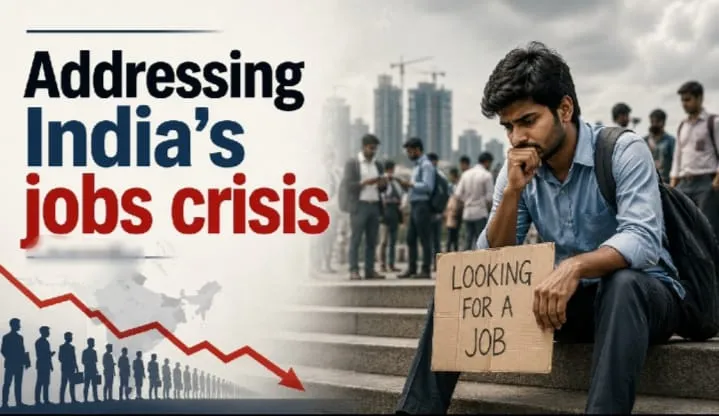
India’s overall unemployment rate has been drifting upward through 2026. According to India Macro Indicators, the rate rose to 5.1% in March 2026, up from 4.9% in February, after touching a low of 4.8% in December 2025. That headline number understates the real story.

Youth unemployment in the 15 to 29 age bracket rose to 15.2% in March 2026, up from 13.8% as recently as April 2025. Within that group, female youth unemployment stood near 17.7% against 14.3% for young men.

Manufacturing growth, measured by the PMI gauge, slowed to a 45-month low around the same period, and urban employers who had driven the 2023 to 2024 recovery moved into what analysts described as a wait and watch mode.

Look at the state level picture and it gets sharper. Kerala, a state with strong education outcomes, recorded youth unemployment of nearly 30% in the 15 to 29 bracket, with female youth unemployment above 47 percent. Lakshadweep reported youth unemployment above 36 percent, with female joblessness near 80 percent.

Among degree holders specifically, unemployment reached almost 40 percent for women in Jammu and Kashmir and 32 percent in Rajasthan, according to analysis of Periodic Labour Force Survey data published through 360info. These are not people without qualifications. These are graduates.

Now add the employability problem on top of the unemployment problem, because they compound each other. The Mercer Mettl India Graduate Skill Index 2025, based on assessment of over a million students across 2,700 campuses, found that overall graduate employability had fallen to 42.6 percent. That means well over half of India’s graduating class is, by industry assessment, not ready for the jobs that do exist.

Even the more optimistic India Skills Report, prepared by the Confederation of Indian Industry with Wheebox and AICTE, which put projected employability at around 55% for 2025, showed women’s employability actually declining, from 50.9 percent to 47.5 percent, even as men’s ticked upward.

So here is the honest picture. We are producing more graduates than ever, we are not making most of them industry ready, and the formal jobs we do create attract applicant pools three hundred times larger than the vacancies on offer.

I ask you plainly: what did we expect young India to do with that arithmetic?

I am not going to claim, and no honest analyst should claim, that unemployment is the single or direct cause of any specific riot or communal clash in India. That would be a lazy argument and it would insult the complexity of what actually happens on the ground, where local politics, historical grievance, propaganda and opportunism all play their part.

But I will make a narrower and, I think, defensible claim.

A young man with a job, a routine, a wage and a stake in tomorrow is a harder person to mobilise into a mob than a young man with none of those things. Idle time, wounded pride and a search for identity and purpose are the raw material that identity politics runs on, whether that politics wears a religious colour, a caste colour or a regional colour. When the legitimate channel for ambition, the channel of study hard, get a degree, get a government job, is clogged for lakhs of people at a time, some of that frustrated energy does not simply evaporate. It looks for other outlets. Sometimes those outlets are railway platforms. Sometimes they are darker.

Bihar, the state at the centre of the 2022 RRB protests, is instructive here for a second reason. Political parties across the spectrum, from the RJD to the Congress to the CPI, put out a joint statement at the time arguing that Bihar has among the highest concentrations of young people in the country alongside among the highest unemployment, and that students were being repeatedly promised jobs and then baton charged when they demanded them.

Whatever one’s politics, that combination, a young population and a starved job market, is a standing fire risk. It does not need a match every day. It only needs one, occasionally, and there is never a shortage of people willing to strike it.

I raise this not to be alarmist for its own sake but because I think we owe our students, the MBA candidates I teach included, an honest conversation about where a jobless growth trajectory actually leads. GDP headlines do not employ people. Jobs employ people. And when jobs are scarce, identity becomes the next best currency of belonging and status that a young person can access for free.

We built a consumption engine, not a production engine, and now the engine is coughing.

For much of the last 3 decades, Indian macroeconomic policy has leaned heavily on a Keynesian, demand-side playbook, post-1991. Boost consumption, expand welfare transfers, run fiscal stimulus during slowdowns, rely on the government as the employer and spender of last resort. There is a place for counter-cyclical spending, I am not arguing against it in a genuine downturn. But as a permanent operating philosophy for a country of 1.4 billion people with a median age around 28, demand-side management alone cannot create the tens of millions of jobs we need every single year just to keep pace with new entrants to the workforce.

Consumption without production is borrowed prosperity. It shows up in the GDP print, it shows up in retail sales data, but it does not show up as a factory floor, a supply chain, an export order book or a payroll. India’s Labour Force Participation Rate itself tells the story of an economy where too many working age people are not even in the race, not employed and not actively seeking work, because they see no point. The rate fell to 55.4 percent in March 2026 from 55.9 percent in February, according to India Macro Indicators, with rural participation declining the fastest.

When people stop looking for work altogether, unemployment numbers can even appear to improve on paper while the underlying rot deepens. That is the statistical trick of a demand-managed economy running out of runway.

I want to be direct with my fellow economists and policy commentators. We cannot keep prescribing more transfer payments, more subsidised consumption, more government scheme announcements as the answer to a jobs crisis that is fundamentally about production capacity, regulatory friction and the cost of starting and running a business in this country. That is treating the symptom with the very medicine that helped cause the disease.

Allow Entrepreneurship to breathe, to create jobs

India’s startup ecosystem, wherever it has had room to operate, has scaled at a pace almost nobody predicted a decade ago. In 2014, India had roughly 350 recognised startups. By June 2026, the Department for Promotion of Industry and Internal Trade had recognised over 2.40 lakh startups, making India the world’s third largest startup ecosystem. These recognised startups alone had created more than 23.36 lakh direct jobs as of March 2026, a 36 percent jump in one year.

55,000 new startups received DPIIT recognition in FY 2025-26, the highest single year addition since the programme began. Nearly half of all recognised startups have at least one-woman director or partner. And this is only the formally recognised layer. Industry data from Tracxn puts the broader Indian startup universe above 687,000 ventures, with over 34,000 of them funded, collectively raising close to 620 billion dollars.

This did not happen because the state planned it from a five-year plan document. It happened because, in specific pockets, digital public infrastructure like UPI, the relaxation of certain compliance burdens under Startup India, and access to early risk capital through vehicles like the Fund of Funds for Startups gave Indian entrepreneurs enough room to build. UPI itself now processes the majority of India’s digital payments and roughly half of all real time digital transactions globally. That is what happens when the state gets out of the way of a genuinely useful private innovation and lets it scale on its own logic.

Contrast that with the RRB story. One is a picture of hundreds of thousands of jobs created by entrepreneurs building things people want to buy. The other is a picture of a fixed, tiny number of government jobs being fought over by a crore aspirants, decided by exam committees, and eventually torched in frustration. Which of these two models do we actually think can absorb India’s youth bulge. I do not think the answer is close.

Gurcharan Das, who ran Procter & Gamble in India before turning to writing, put this best in his book “India Grows at Night.” His argument, distilled, is that India’s prosperity has largely happened despite the state, not because of it, and that the country has a long history of a weak, license-bound state smothering the same private enterprise it should be enabling. In an essay reflecting on the pre-1991 years, Das has written about turning from a young socialist believer in Nehru’s mixed economy into someone disillusioned by what that mixed economy actually became in practice, which he and others of his generation sardonically nicknamed the license raj. He has described watching the state act as, in his words, at best a protector of private freedoms and at worst an active destroyer of them.

Sauvik Chakraverti, one of India’s most uncompromising libertarian voices and a regular commentator on economic freedom, spent much of his writing life arguing that a state without sound money and without restraint on its own reach is, to borrow the line he liked to invoke from St Augustine, little more than an organised band of robbers dressed up in the language of welfare. His central complaint against Indian economic policy was that we had replaced genuine free enterprise with what he called funny money welfarism, propped up by central bank interventions and Keynesian demand management that create the illusion of growth while eroding the value of a rupee earned honestly through production.

This intellectual lineage goes back further than either of them. C. Rajagopalachari, one of the tallest freedom movement leaders and independent India’s first Indian Governor General, broke away from the Congress in 1957 precisely because he saw the socialist direction of Nehruvian planning as a threat to individual enterprise. He founded the Swatantra Party on the explicit position that social justice is better achieved by fostering individual initiative than by state ownership and government control, and that the party existed to protect the individual citizen against, in the founding document’s own words, the increasing trespasses of the state.

I find it remarkable that 70 years later, we are still relearning this lesson through Railway Recruitment Board riots. The state, no matter how well intentioned, cannot out-hire the private economy. It should not try. Its job is to build the rule of law, protect contracts and property, get out of the way of the entrepreneur trying to open a shop, hire a worker, import a machine or export a product, and then let millions of individual decisions do what no five-year plan ever could.

What a genuine supply-side turn would actually require

I am not calling for anarchy or for the state to disappear. Gurcharan Das himself, to his credit, argues for a strong liberal state, one capable of enforcing contracts quickly, running courts efficiently and being accountable, rather than a weak, absent one. A supply side agenda for India needs a state that does a few things extremely well rather than a state that tries to do everything and does most of it badly.

First, land and labour markets that let a manufacturer actually scale a factory without years of litigation and multiple licensing regimes across state and central authorities.

Second, credit access for small and first generation entrepreneurs that does not require the kind of collateral only the already wealthy possess.

Third, an education and vocational system tied to actual industry certification rather than degree inflation, since a 42.6% employability rate among graduates tells us our colleges are producing certificates, not capability.

Fourth, a tax and compliance architecture for small business that does not punish a shopkeeper or a small manufacturer with the same reporting burden designed for a listed conglomerate.

And fifth, and I say this as someone who has spent years around policy circles, a basic shift in status. We celebrate the person who cracks a government exam far more than we celebrate the person who builds a business that employs twenty people.

Until that cultural hierarchy flips, our best young minds will keep queuing for 35,000 railway jobs instead of building the next hundred companies that could employ ten times as many people, sustainably, at a fraction of the fiscal cost to the exchequer.

A question I would like every reader to sit with

If you are a parent of a 22-year-old today, ask yourself honestly which future you would rather bet on for your child: a seat in a government exam queue three hundred times deeper than the number of seats available, or a small business loan and the freedom to build something of their own. I suspect most of us, if we are honest, already know the answer. The tragedy is that our policy architecture has not caught up with what we already know in our own homes.

India does not need another stimulus cheque. It needs a licence raj exorcism, sector by sector, state by state, until the barriers to starting and scaling a business fall as fast as our population of aspiring entrepreneurs is rising.

The alternative, and I say this with real concern rather than rhetorical flourish, is a country where millions of capable, frustrated young people keep discovering that the fastest way to feel powerful is not a payslip but a mob, and not always one organised around economics.

We have already seen the trains burn once. I would like us to notice that warning before we see something we cannot put out.

Views of the author are personal and do not necessarily represent the website’s views.

Dr. Jaimine Vaishnav is a faculty of geopolitics and world economy and other liberal arts subjects, a researcher with publications in SCI and ABDC journals, and an author of 6 books specializing in informal economies, mass media, and street entrepreneurship. With over a decade of experience as an academic and options trader, he is keen on bridging the grassroots business practices with global economic thought. His work emphasizes resilience, innovation, and human action in everyday human life. He can be contacted on jaiminism@hotmail.co.in for further communication.

Long or Short, get news the way you like. No ads. No redirections. Download Newspin and Stay Alert, The CSR Journal Mobile app, for fast, crisp, clean updates!

App Store – https://apps.apple.com/in/app/newspin/id6746449540

Google Play Store – https://play.google.com/store/apps/details?id=com.inventifweb.newspin&pcampaignid=web_share

Latest News

Popular Videos