


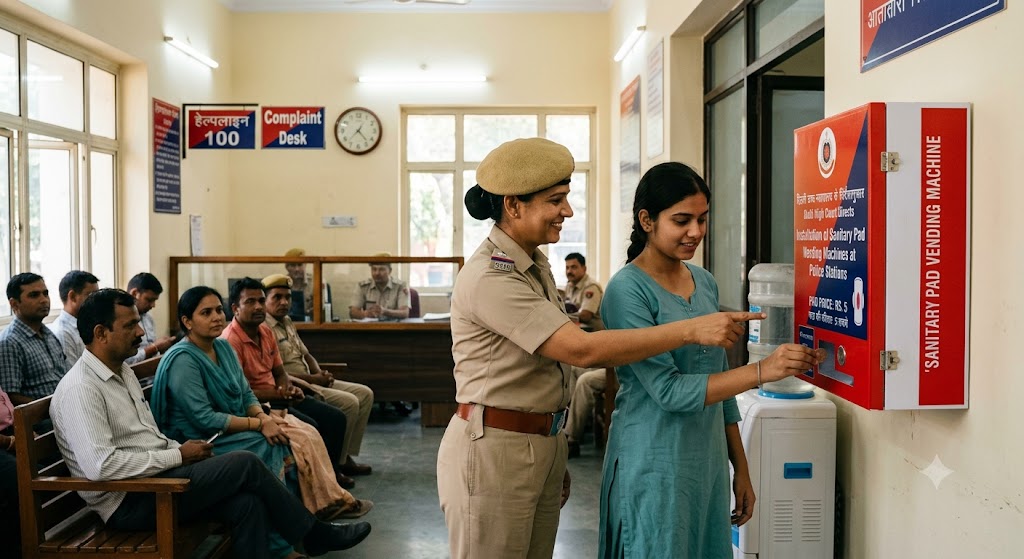
Delhi High Court Directs Installation of Sanitary Pad Vending Machines at Police Stations
The CSR Journal Magazine

The Delhi High Court has mandated that sanitary pad vending machines be installed at all police stations in the capital to support female personnel. Furthermore, it has instructed that exclusive washrooms for women be made available at these facilities. The directive, which emerged on Wednesday, was issued during a hearing led by Chief Justice DK Upadhyaya and Justice Tejas Karia.

The court has tasked the Commissioner of Police with conducting a comprehensive survey of each police station within a six-week timeframe. This survey will assess the current availability of such essential amenities, ensuring that the needs of female personnel are addressed adequately.

During the proceeding, the bench highlighted the significance of the survey results, asserting that appropriate measures must be enacted based on the findings. The hearing is scheduled for September 23, during which the police are expected to submit an affidavit detailing the actions undertaken in response to the court’s order.

Background of the Petition

The petition, advocating for improved menstrual hygiene and sanitation facilities for women police officers, was filed by the NGO Justice for Rights Foundation. It argues that lack of proper infrastructure infringes upon the constitutional rights of female personnel, particularly under Article 21, which guarantees the right to live with dignity, health, and privacy.

According to information obtained via the Right to Information Act, it was revealed that despite having a substantial number of women in service across numerous police stations in Delhi, sanitary pad vending machines are only available in a limited number of locations. The absence of dedicated hygiene facilities represents a significant oversight by the authorities.

The petition asserts that this failure to provide basic infrastructure not only undermines the dignity and health of female staff but could also breach Articles 14 and 21 of the Constitution, which enshrine the right to equality and life. It seeks explicit orders for the installation and maintenance of sanitary pad vending machines and sanitary incinerators across all units managed by the Delhi Police.

Expected Impact of Court’s Directive

The court’s directive is expected to bring about substantial improvements in working conditions for women in the Delhi Police. The installation of sanitary pad vending machines and the provision of private, clean washrooms could help foster a more inclusive and supportive work environment for female officers.

By ensuring that these essential facilities are accessible, the Delhi High Court aims to highlight the importance of prioritising women’s health and hygiene within the workplace. The initiative reflects a growing recognition of the need for gender-sensitive infrastructure in public services.

As the survey progresses and reports emerge, the court has underlined the expectation that the police will take swift and appropriate action to fulfil the requirements outlined in the petition. This case could serve as a precedent for enhancing gender equality in law enforcement and other public sectors across India.

Long or Short, get news the way you like. No ads. No redirections. Download Newspin and Stay Alert, The CSR Journal Mobile app, for fast, crisp, clean updates!

App Store –  https://apps.apple.com/in/app/newspin/id6746449540 

Google Play Store – https://play.google.com/store/apps/details?id=com.inventifweb.newspin&pcampaignid=web_share

Latest News

Popular Videos
