



When launching a new business venture, selecting the right legal framework is a foundational decision that directly impacts your personal liability, compliance costs, and daily operations. In India’s corporate ecosystem, the limited liability partnership (LLP) has emerged as a premier hybrid structure. It perfectly bridges the gap between the operational flexibility of a traditional partnership and the asset protection of a private limited company.
However, an LLP is not a one-size-fits-all solution. While high-growth startups aiming for venture capital funding almost always require a private limited structure, a limited liability partnership is the ideal choice for several other distinct business models.
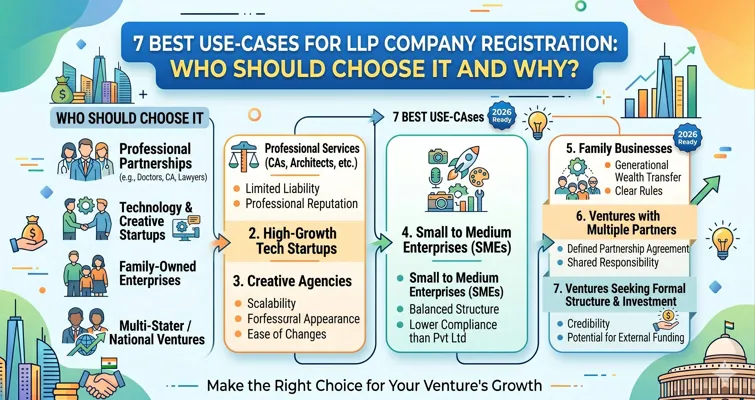
Here are the 7 best use-cases for an LLP company registration, detailing who should choose it and why.
1. Professional Service Consultants (CAs, Lawyers, and Architects)
Historically, professionals like Chartered Accountants, legal consultants, and architects were restricted to traditional partnerships. This meant they faced unlimited personal liability.
-
Why choose an LLP: A limited liability partnership protects individual partners from joint liability arising from another partner’s professional misconduct or negligence. If one partner faces a malpractice suit, the personal assets of the other partners remain entirely insulated.
2. Bootstrapped Tech Startups and Agencies
For software development agencies, digital marketing firms, and bootstrapped SaaS startups that intend to fund their growth entirely through revenues rather than external equity dilution, a corporate structure is still needed to sign contracts.
-
Why choose an LLP: It provides the corporate status required to sign enterprise clients without the heavy compliance machinery of a private limited company. There are no requirements to hold quarterly board meetings or maintain exhaustive statutory registers, allowing the team to focus entirely on product and service delivery.
3. Family-Owned and Managed Businesses
Many multi-generational family businesses operate as traditional partnerships or Hindu Undivided Families (HUFs), which can lead to severe personal asset exposure and internal disputes.
-
Why choose an LLP: It allows family members to institutionalize their business under a separate legal entity. By completing an LLP registration, the family safeguards its personal real estate and generational savings from unexpected commercial liabilities or business bankruptcies.
4. Real Estate Special Purpose Vehicles (SPVs) and Joint Ventures
Real estate projects typically involve a group of investors and landowners coming together for a specific, time-bound project.
-
Why choose an LLP: An LLP structure allows for highly customized profit-sharing ratios that do not necessarily have to align with the capital contributed by each partner. Furthermore, once the project is completed, dissolving an LLP or distributing the profits is administratively simpler and more tax-efficient than winding down a private limited company.
5. Small to Medium Enterprises (SMEs) with Limited Initial Capital
For manufacturing units or regional distribution businesses that require a formal legal status to secure bank loans but operate on tight initial budgets, compliance costs matter.
-
Why choose an LLP: LLPs are exempt from mandatory audits unless their annual turnover crosses ₹40 lakh or their total capital contribution exceeds ₹25 lakh. This significant concession saves early-stage SMEs thousands of rupees annually in professional auditing fees.
6. Co-founded Advisory and Knowledge-Based Firms
Consultancies specializing in corporate training, HR advisory, or financial planning rely heavily on the distinct skill sets of individual co-founders.
-
Why choose an LLP: Unlike a private limited company, where ownership is strictly tied to share percentage, an LLP allows partners to govern the business based entirely on an LLP Agreement. You can easily define unique operational roles, voting rights, and exit clauses without altering share capital structures.
7. Boutique Creative Agencies and Design Studios
Fashion labels, interior design studios, and production houses often scale by collaborating with multiple creative partners over time, without a fixed ceiling on the number of stakeholders.
-
Why choose an LLP: While a private limited company restricts the number of shareholders to 200, a limited liability partnership allows for an unlimited number of partners. This makes it exceptionally easy to onboard new creative collaborators or regional partners as the studio expands.
Summary: Is an LLP Right For You?
Choose a Private Limited Company If… |
Choose a Limited Liability Partnership If… |
You plan to raise venture capital or angel funding. |
You are bootstrapping or funding growth via revenue. |
You want to offer equity-based ESOPs to employees. |
You want to distribute profits directly to partners. |
You are targeting rapid, massive global equity scaling. |
You want to minimize annual audit and regulatory costs. |