


Delhi Experiences Its Most Polluted July in Seven Years
The CSR Journal Magazine

Delhi concluded July with significant variations in its weather and air quality, marking the most polluted July in the last seven years. The average Air Quality Index (AQI) during the month reached 119, the highest monthly average for July since 2019, when it recorded an AQI of 134. This figure represents a substantial increase compared to last July’s average of 78, indicating a stark deterioration in air quality.

In an unexpected turn, the city did witness its first “good” air quality day in nine years on July 22, with the AQI dropping to 48, the lowest daily minimum AQI for July since 2017. Conversely, the AQI peaked at 261 during the month, marking the highest daily maximum recorded in July in the past five years, surpassing the 266 recorded in 2021. Throughout the month, Delhi registered 15 days of “moderate” air quality, 12 days classified as “satisfactory,” and one day deemed “good,” with no days falling into the “very poor” category.

The Central Pollution Control Board (CPCB) categorises AQI readings from 0 to 50 as “good,” 51-100 as “satisfactory,” 101-200 as “moderate,” 201-300 as “poor,” 301-400 as “very poor,” and 401-500 as “severe.” At the end of July, on Thursday, the AQI stood at 117, remaining in the “moderate” spectrum.

Monsoon Rainfall Surpasses Normal Levels

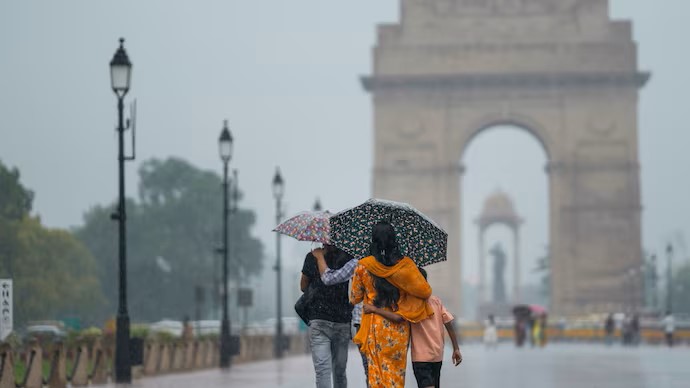
July also saw an unexpected surge in monsoon rainfall, with the Safdarjung base station recording 254.7 mm, significantly exceeding the normal of 201.9 mm by 52.8 mm, which is an excess of 26 per cent. This above-normal rainfall was noted across most weather stations, despite a prolonged dry spell during the month. Since the onset of the southwest monsoon, which began earlier in the season, Safdarjung accumulated a total of 296.5 mm of rainfall, against a seasonal average of 276 mm, reflecting a surplus of 20.5 mm or 7 per cent.

The Ridge observatory achieved the highest rainfall surplus, receiving 285.5 mm compared to a normal of 188.5 mm, which accounts for an excess of 97 mm, or 51 per cent. Since the monsoon’s onset, it has recorded a rainfall total of 338.1 mm, surpassing the seasonal expected amount by 88.9 mm, or 36 per cent. Lodhi Road and Ayanagar also reported considerable excess rainfall, while Palam experienced a shortfall of 19.1 mm, falling short of its expected rainfall.

Temperature Trends Noted for July

Delhi registered its warmest average temperatures for both day and night in two years during July, with averages of 35.4 degrees Celsius for maximum temperatures and 27.7 degrees Celsius for minimums. The last time temperatures were higher was in 2024. On Thursday, the maximum temperature at Safdarjung was recorded at 35.8 degrees Celsius, which is 1.4 degrees Celsius above normal levels.

Palam recorded a maximum of 35 degrees Celsius, which is marginally above normal, while Lodhi Road and Ayanagar reported temperatures of 35.3 degrees Celsius and 35.2 degrees Celsius, respectively, both exceeding normal levels by over half a degree. In the last reporting period, rainfall was also recorded at several stations, with the Ridge observing the highest accumulation at 7.6 mm.

The prolonged break in monsoon activity this season is attributed to multiple weather systems, resulting in fewer rainy days. Despite this, rainfall remained significant due to a number of intense rainfall events. Meteorological experts have noted that while the number of rainy days was lower than usual, the intensity of some of those rainfall events offset the discrepancy in totals.

Long or Short, get news the way you like. No ads. No redirections. Download Newspin and Stay Alert, The CSR Journal Mobile app, for fast, crisp, clean updates!

App Store –  https://apps.apple.com/in/app/newspin/id6746449540 

Google Play Store – https://play.google.com/store/apps/details?id=com.inventifweb.newspin&pcampaignid=web_share

Latest News

Popular Videos
