


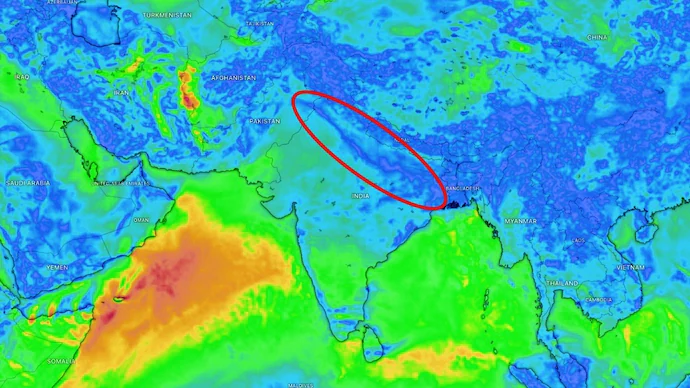
Satellite Images Show 1,500-Km Monsoon Rain Band From Bengal to Kashmir
The CSR Journal Magazine

The latest satellite imagery reveals the creation of a monsoon trough extending nearly 1,500 kilometres from the northern Bay of Bengal to Jammu and Kashmir, offering promising news for Delhi and surrounding regions. After a prolonged period of excessive heat and a delayed southwest monsoon, this development may lead to substantial rainfall in the coming days.

The India Meteorological Department (IMD) confirmed that the monsoon trough has emerged, albeit remaining close to the Himalayan foothills at present. As the trough gradually shifts south towards its typical position, meteorologists anticipate a significant uptick in thunderstorm activity across northern India, which could enable the monsoon to fully establish itself between July 1 and July 4.

An accompanying satellite image provided by INSAT-3DS illustrates a wide area of dense cloud cover stretching from eastern India into the Himalayan region, signalling an increase in monsoon circulation after nearly three weeks of stagnation.

Understanding the Monsoon Trough

The monsoon trough is essential for the southwest monsoon, functioning as an elongated region of low atmospheric pressure. It facilitates the movement of moisture-laden winds from the Arabian Sea and the Bay of Bengal into the Indian mainland. When positioned further north, precipitation remains concentrated near the Himalayan foothills, leaving places like Delhi, Haryana, and Rajasthan experiencing hot and predominantly dry conditions.

This pattern has been evident throughout June. On June 30, Delhi experienced a heatwave, with temperatures soaring above 42°C at Safdarjung and reaching 43.4°C at Delhi Ridge. Rohtak registered 43.5°C, while Sriganganagar in Rajasthan emerged as the hottest spot, recording 45.1°C.

The combination of extreme heat and high humidity levels has intensified discomfort, even as isolated thunderstorms were reported in parts of Haryana, Rajasthan, and the National Capital Region. Meteorologists indicate that the evolving weather dynamics now support a gradual shift to more active monsoon conditions.

Increased Rainfall Expected in Northern India

In addition to the advancing monsoon trough, weather models predict the formation of a fresh low-pressure area over the Bay of Bengal later this week. This system is expected to enhance monsoon flows, introducing more moisture into northern India while generating widespread showers and thunderstorms across Delhi, Punjab, Haryana, western Uttar Pradesh, and Rajasthan.

While isolated pre-monsoon thunderstorms are anticipated over the next two days, the chance of more organised and sustained rainfall is expected to rise from mid-week onwards. Should the forecast materialise, Delhi is poised to experience the long-anticipated arrival of the monsoon during the initial week of July, potentially alleviating one of the hottest and most humid phases of the season.

The development of weather patterns contributing to the forthcoming monsoon creates optimism among residents enduring the oppressive heat. This transition signals not only a change in weather but also the beginning of the vital rainy season for agriculture and water resources in the region.

Long or Short, get news the way you like. No ads. No redirections. Download Newspin and Stay Alert, The CSR Journal Mobile app, for fast, crisp, clean updates!

App Store –  https://apps.apple.com/in/app/newspin/id6746449540 

Google Play Store – https://play.google.com/store/apps/details?id=com.inventifweb.newspin&pcampaignid=web_share

Latest News

Popular Videos
