


China Strengthens Military Presence in Space, US Warns of Growing Counter-Space Threat
The CSR Journal Magazine

China’s rapidly expanding space capabilities are increasingly becoming a concern for the United States, with Washington warning that Beijing has emerged as its principal competitor in the space domain. The People’s Liberation Army (PLA) is expanding its satellite fleet, space-launch infrastructure and counter-space capabilities, while also developing technologies that could be used to disrupt or attack an adversary’s space assets during a conflict.

The US intelligence community’s Annual Threat Assessment has described China as having overtaken Russia as the key US competitor in space. The assessment said Beijing’s expanding capabilities could allow it to challenge US military and technological superiority in space and use the domain to advance its wider strategic objectives.

China Emerges as Major US Space Competitor

The US intelligence community’s assessment said China’s rapid deployment of space capabilities was positioning Beijing to use space to advance its foreign policy objectives, challenge US military and technological superiority and project power globally.

The assessment represents a significant shift in the balance of space capabilities. Russia was the first country to launch a satellite and has traditionally been regarded as a major space power, but China’s programme has expanded considerably in recent years.

China conducted 92 orbital launches in 2025, according to the report. Unlike the United States, where civilian and military space activities are institutionally separated between NASA and the Pentagon, China’s space programme operates within a system closely linked to the PLA.

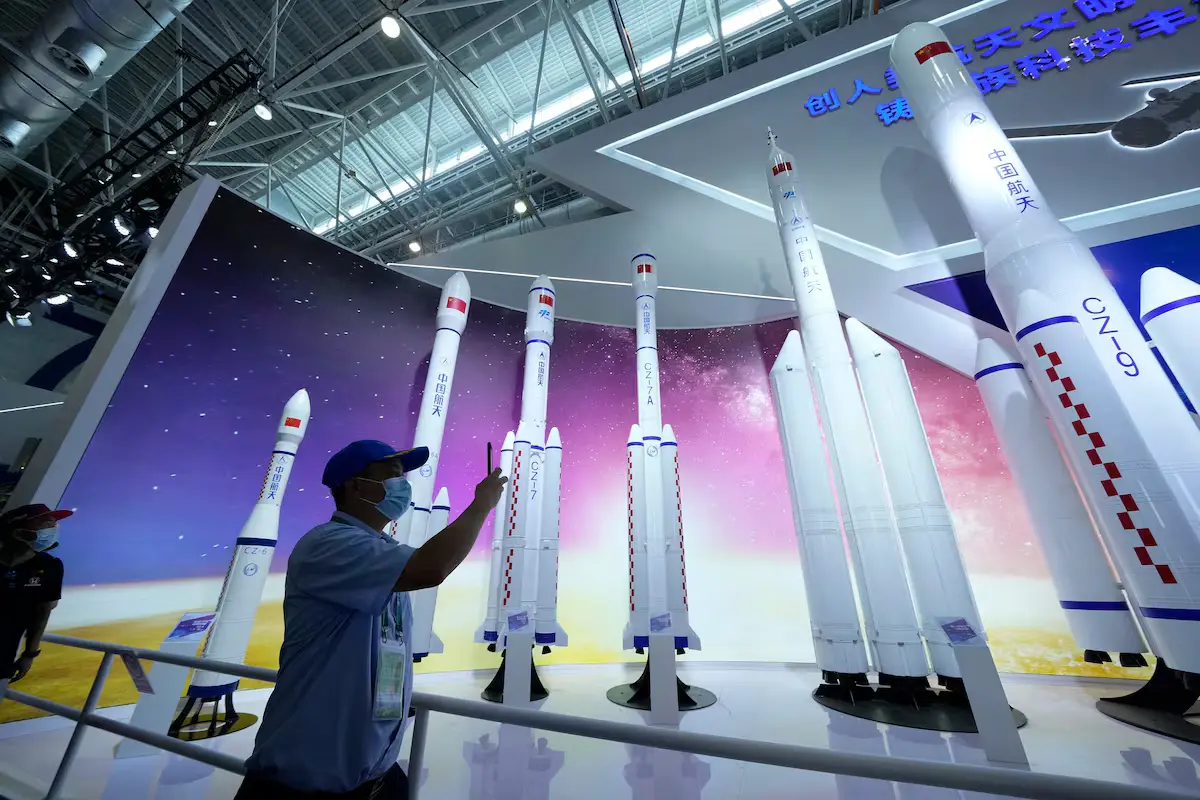
Beijing also operates six spaceports capable of launching new-generation heavy-lift rockets carrying entire satellite constellations. China has additionally set a goal of conducting a crewed Moon landing by 2030.

Beijing Sees Space as Strategic Domain

Chinese military documents have repeatedly described space as a critical component of future warfare and international strategic competition.

Chinese official documents have referred to space as the “commanding heights” that provide “indispensable strategic supports for winning informationized wars”. Beijing has also described space as a “critical domain in international strategic competition”.

The PLA’s 2020 Science of Military Strategy document argued that space had become a new domain of military conflict and was changing traditional forms of warfare while expanding competition for national strategic interests.

The US has similarly warned that space-based services are becoming increasingly vulnerable during periods of tension. Its Annual Threat Assessment said disruptive attacks against space services had become more common and could become normalised during crises.

Growing Risk of Attacks on Space Systems

The US assessment highlighted the increasing use of satellite jamming by adversaries and warned that cyberattacks against satellite communications systems were becoming a greater concern as global dependence on digital infrastructure increased.

China is central to these concerns. US officials and military analysts have increasingly pointed to evidence that Beijing is developing and rehearsing capabilities that could be used for offensive and counter-space operations.

These activities include manoeuvring satellites close to one another, monitoring foreign spacecraft and developing technologies that could interfere with an adversary’s communications, navigation and intelligence systems.

In March 2025, the US Space Force observed five Chinese objects manoeuvring around one another in a coordinated manner. General Michael A. Guetlein, Vice Chief of Space Operations, described the activity as “dogfighting in space”.

Guetlein said the manoeuvres demonstrated that China was practising tactics, techniques and procedures for conducting on-orbit operations involving one satellite and another.

Chinese Satellites Practise Close Manoeuvres

An earlier incident in 2022 also raised concerns among US officials. The American patrol satellite USA 270 reportedly observed two newly launched Chinese satellites ahead of it while operating in a highly sensitive region of space.

One of the Chinese satellites subsequently slowed down and manoeuvred behind USA 270 as it passed, at an altitude of around 22,000 miles above Earth.

Although no satellite was destroyed during the encounter, the manoeuvre raised questions among American controllers about China’s intentions and its ability to rapidly alter the position and orientation of spacecraft.

Such manoeuvres can have military significance because a spacecraft capable of approaching another satellite could potentially be used for surveillance, disruption or other counter-space operations.

China Maintains Its Space Programme Is Peaceful

Beijing has consistently rejected allegations that it is pursuing military dominance in space and has said its space programme is intended for peaceful purposes.

Liu Pengyu, spokesperson for the Chinese Embassy in Washington, said in December 2025 that China opposed an arms race and the weaponisation of outer space.

“China is committed to the peaceful use of outer space, and opposes any arms race in outer space or weaponizing it. China has no intention to engage in a space race with any country, nor do we seek so-called advantage in outer space,” Liu said.

However, US officials and analysts argue that China’s development of advanced satellite constellations, reusable rockets and other dual-use technologies suggests that Beijing is preparing for military applications alongside civilian activities.

Military-Civil Fusion Expands Space Capabilities

China’s commercial space sector has also become an important component of its broader space strategy. The country has accelerated the development of large satellite constellations designed to provide communications resilience and has expanded its reusable rocket programme.

The Pentagon’s 2025 report on China’s military capabilities noted that many Chinese commercial companies form part of the country’s military-civil fusion strategy, under which dual-use technologies developed by private companies can eventually be incorporated into military applications.

“Many of China’s commercial companies are part of its military-civil fusion strategy to develop dual-use technologies in the commercial sector for eventual integration into the military,” the Pentagon report said.

The report noted that commercial space development was included in the Chinese Communist Party’s government work report for the first time in 2024, reflecting its growing importance.

Satellites Could Support Military Operations

US officials have questioned whether some Chinese satellites are specifically designed to support military operations against other countries’ space-based assets.

The Chinese TJS-3 satellite, for instance, has repeatedly approached satellites belonging to other countries in geostationary Earth orbit. Beijing describes TJS-3 as a communications technology test satellite.

China has also conducted rendezvous and proximity operations involving different groups of spacecraft. Some satellites, including Shijian-21, are equipped with robotic arms capable of manipulating and reorienting other satellites.

The Shiyan-24C satellite trio demonstrated complex rendezvous and proximity operations throughout 2024, with the spacecraft at times approaching within one kilometre of one another.

Space Surveillance Becomes Routine

Close approaches are increasingly becoming a routine feature of military space operations. Countries regularly monitor the satellites of competitors, including by photographing spacecraft and analysing their externally visible features.

Surveillance can also involve monitoring the data transmissions sent to and received by satellites.

China currently has more than 970 surveillance satellites in orbit, according to the report. These systems can track military bases, deployed forces and aircraft carriers, providing information that can support military planning and targeting.

The US Space Force reported that the PLA launched 20 satellites between March and June 2024 designed to facilitate “long-range precision strikes against US and allied forces”.

Space Particularly Important in Indo-Pacific

Satellite surveillance has particular importance in the Indo-Pacific because of the region’s vast geography and maritime operating environment. Space-based sensors can provide information on the location and movements of military forces, naval formations and aircraft over large distances.

Reuben F. Johnson, writing in the Asian Military Review, argued that satellites would be especially important in any conflict in the Asia-Pacific because information about the location and disposition of opposing forces would be critical to military operations.

“The point is just how critical the use of satellites will be during any conflict in the Asia-Pacific theater, compared to other parts of the world. Space has now become a new battleground in Asia, one in which up-to-date information on the location and disposition of an adversary’s forces is far more critical than in the European region of operations,” Johnson wrote.

PLA Developing Counter-Space Capabilities

The US military has warned that China is developing a broad range of counter-space capabilities designed to restrict an adversary’s ability to use satellites during a conflict.

A report by the US Army Training and Doctrine Command titled How China Fights in Large-Scale Combat Operations said China’s aerospace forces could employ cyber, kinetic and directed-energy counter-space operations against communications, positioning, navigation and timing systems, as well as intelligence, surveillance and reconnaissance assets.

The report said such operations could be used to deny an adversary the ability to communicate, navigate and understand an opponent’s intentions.

The Pentagon has similarly assessed that China views the US military’s dependence on space for intelligence gathering and communications as a potential vulnerability.

China Has Multiple Anti-Satellite Options

According to the Pentagon, the PLA is likely preparing both terrestrial and space-based kinetic and non-kinetic anti-satellite operations for a potential conflict with the United States.

China’s counter-space capabilities include cyberattacks against ground and control systems, navigation satellite spoofing, lasers, jammers and anti-satellite missiles.

Beijing demonstrated its anti-satellite missile capability in 2007 by destroying a defunct satellite in orbit with a ground-launched missile.

The Pentagon has also assessed that China is likely developing systems capable of interfering with synthetic aperture radar satellites, potentially denying an adversary access to imagery and targeting information.

Jamming Could Disrupt Communications

China is also believed to be developing jammers capable of targeting satellite communications across multiple frequency bands, including frequencies used by the US military.

Such systems could interfere with communications between satellites and ground stations or disrupt signals transmitted through space.

In a conflict, the ability to jam satellite systems could affect early warning of missile launches, conceal military assets from satellite-based sensors or disrupt communications between commanders and deployed forces.

These capabilities could therefore allow China to weaken an adversary’s ability to collect intelligence and coordinate military operations without necessarily destroying satellites.

US Analysts Warn of Space Escalation

A RAND Corporation report titled China’s Growing Risk Tolerance in Space, authored by Howard Wang, Gregory Graff and Alexis Dale-Huang, examined China’s approach to military competition in space.

The researchers concluded that the PLA views the United States with “a profound sense of threat” and “deep suspicions”. They also noted that Chinese military analysts have characterised US space strategy as an effort to secure and extend American “space hegemony”.

The RAND researchers argued that these perceptions could make China more willing to compete aggressively with the United States in space rather than cooperate to prevent escalation.

They wrote that Chinese leaders were likely to direct the PLA towards competition with the United States and the US Space Force rather than cooperation.

Risk of Unintended Conflict Rising

In 2023, an official from the Arms Control Research Center of the China Institutes of Contemporary International Relations, affiliated with China’s Ministry of State Security, argued that US policies had increased the risk of conflict in space.

The official said the “current risk of a space war has far surpassed that of the Cold War”.

The RAND researchers similarly warned that the PLA could adopt aggressive deterrence operations in space, potentially including the use of lethal force.

They said China’s greater willingness to accept risk could make space a more dangerous operating environment for all countries, particularly given Beijing’s suspicion of US intentions and reluctance to cooperate on American initiatives.

Space Could Become New Normal of Military Friction

The RAND report warned that China’s leadership had pushed the PLA towards a more proactive and risk-accepting posture, potentially creating a new normal of heightened friction during routine space operations.

The researchers also noted that sustained communication channels between China and the United States would be unlikely to remain available during a major space crisis, increasing the possibility that incidents could escalate unexpectedly.

They assessed that the PLA was likely to remain assertive in space during peacetime while avoiding actions that would threaten China’s broader political objectives.

The report suggested that US Space Command should therefore anticipate continued Chinese manoeuvres and provocations as part of routine operations in space.

US Seeks To Maintain Space Advantage

The expanding Chinese space programme has prompted US military leaders to stress the need for continued investment in American space capabilities.

General Stephen Whiting, Commander of US Space Command, has warned that China and other countries are manoeuvring spacecraft in ways that could provide them with a positional advantage during a conflict.

“So we want to make sure that we stay ahead as the world’s leading space power, and that we develop our own maneuver capabilities to remain in a position of advantage and to defend ourselves,” Whiting said.

The growing competition reflects a broader transformation in military strategy, with space increasingly viewed not simply as an arena for scientific exploration and communications but as a potential battlefield.

As China expands its satellite constellations, launch capabilities and counter-space technologies, the United States is seeking to preserve its advantage while monitoring increasingly sophisticated Chinese manoeuvres in orbit. The space race between the two powers is therefore becoming an increasingly important component of their wider strategic competition.

Long or Short, get news the way you like. No ads. No redirections. Download Newspin and Stay Alert, The CSR Journal Mobile app, for fast, crisp, clean updates!

App Store –  https://apps.apple.com/in/app/newspin/id6746449540 

Google Play Store – https://play.google.com/store/apps/details?id=com.inventifweb.newspin&pcampaignid=web_share

Latest News

Popular Videos
