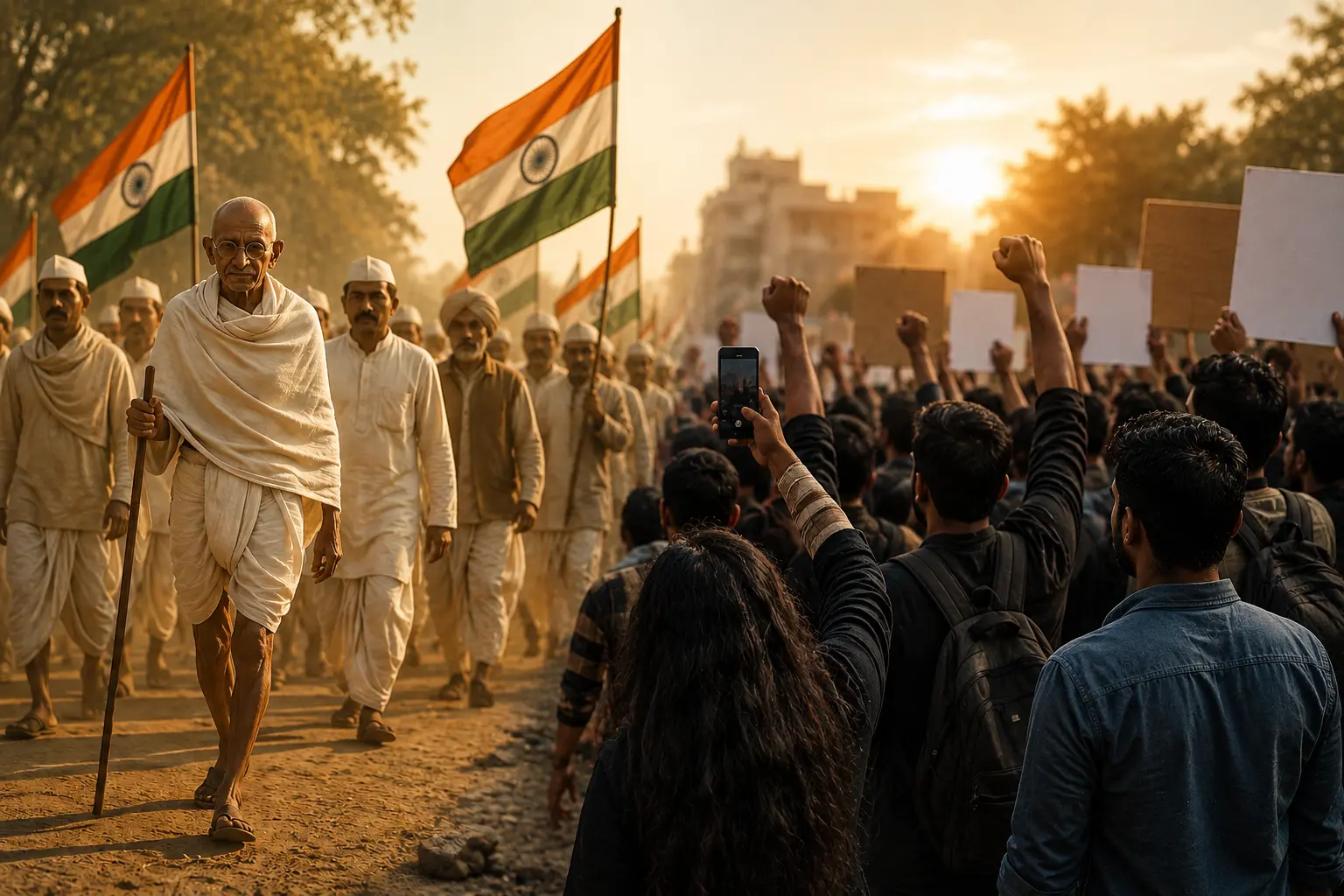
Gandhi’s Freedom Movement Changed India Forever While Modern Protests Struggle to Create Lasting Change

The CSR Journal Magazine

When Mahatma Gandhi launched the Non-Cooperation Movement in 1920, thousands of young Indians walked away from colleges, government jobs, and comfortable futures. When he led the Salt March in 1930, he walked over 380 kilometres to challenge an unjust law, inspiring an entire nation to stand up against an empire. During the Quit India Movement in 1942, countless young men and women willingly entered prisons, knowing they might never return to normal lives.

They did not do it for followers, they did not do it for visibility, they did not do it because it was fashionable, they did it because they believed some causes were bigger than themselves and that is perhaps the biggest difference between Gandhi’s movements and many movements we see today.

The youth of Gandhi’s era sacrificed their comfort for a collective dream. Much of today’s activism, while often driven by genuine concerns, is increasingly shaped by instant outrage, social media validation, and the desire for immediate results. A hashtag trends for a day, a protest dominates headlines for a week and then the public attention moves on. Gandhi’s movements lasted years because they were built not on emotion alone, but on discipline, patience, and sacrifice.

When Gandhi asked Indians to boycott British goods, people burned clothes they had paid for with hard-earned money. When he called for civil disobedience, people willingly accepted beatings and imprisonment. Compare that with today’s culture, where many are prepared to post, comment, criticize, and condemn, but far fewer are willing to endure personal hardship for the causes they support.

Gandhi never taught Indians to merely demand rights. He taught them to earn freedom through responsibility. Before challenging the British, he spoke about self-discipline, cleanliness, honesty, and character. He understood a truth that feels increasingly forgotten: a nation cannot be transformed unless its citizens are willing to transform themselves.

The tragedy of modern times is not that young people have stopped caring. It is that many have been taught that raising their voice is enough. Gandhi showed that raising a voice is only the beginning. The real test is what one is willing to sacrifice after the slogans end and the cameras leave.

If Gandhi were alive today, he would probably ask a simple question: “What have you given up for the cause you believe in?” History does not remember those who were merely angry. History remembers those who were willing to suffer, struggle, and sacrifice for something greater than themselves. That  is why the Salt March is still remembered nearly a century later, while countless trending movements of recent years have already faded from public memory.

Gandhi did not create moments. He created a generation of people willing to place their nation above themselves and perhaps that is the lesson modern society needs most—not more outrage, not more division, but more courage, more character, and a deeper commitment to the common good. The youth of India today possess far more education, technology, and opportunity than Gandhi’s generation ever did. Imagine what this country could achieve if that power was combined with the same sense of duty, sacrifice, and purpose that once helped win India’s freedom.

If today’s generation truly wants to create movements that change society rather than merely dominate headlines, it must learn to combine passion with purpose and outrage with responsibility. Real movements are not built in a day, nor are they sustained by hashtags alone. They are built through organization, discipline, sacrifice, and an unwavering commitment to the cause long after public attention has faded. Gandhi’s success did not come from making the loudest noise; it came from creating a clear vision, uniting people across divisions, setting an example through his own actions, and being willing to endure personal hardship for a larger goal. The youth of today must ask themselves not only what they are fighting against, but what they are fighting for. They must build movements that offer solutions, not just slogans; dialogue, not just outrage; and long-term commitment, not just momentary anger. History shows that governments, institutions, and societies rarely change because people shout the loudest. They change when ordinary citizens remain united, disciplined, and determined for years, even when the spotlight disappears. If the young generation can match its incredible energy, education, and technological power with the patience, sacrifice, and sense of duty that defined Gandhi’s era, it will not merely win battles for its rights—it will create lasting change for generations to come.

A movement becomes historic not when it goes viral, A movement becomes historic when people are willing to pay a personal price for a larger cause.


Latest News

Popular Videos