


Could Balloons Help India’s Astronauts Return Home Safely?
The CSR Journal Magazine

As India prepares for its first human spaceflight mission under the Gaganyaan programme, attention has largely centred on rockets, crew capsules and astronaut training. But an Indian aerospace startup believes the key to safer space missions may lie much closer to Earth, in the stratosphere.

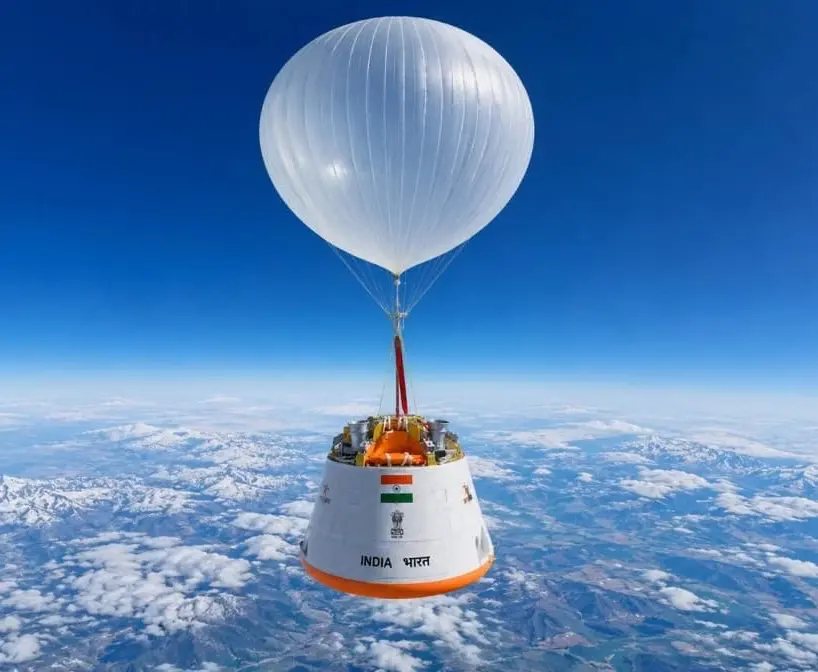
Founded in 2025 by veterans of the Indian space sector, Red Balloon Aerospace is developing high-altitude balloon platforms that could serve as a low-cost testing ground for future crew capsules, lunar sample return missions and even astronaut training. The company recently achieved a milestone by carrying out India’s first private super-pressure balloon launch, placing the country among a select group of nations with such capabilities.

For the startup’s founders, the stratosphere represents one of the least explored regions for commercial and scientific activity and could provide a bridge between ground-based tests and actual missions in space.

Three Platforms Designed For Near-Space Missions

Red Balloon Aerospace has developed three separate platforms aimed at different applications.

The first, called Vista, is a super-pressure balloon capable of conducting long-duration flights in the stratosphere. The second platform, Altis, is a tethered aerostat designed for surveillance and communication purposes, while the third, Helix, is a reusable airship platform intended for controlled descents and repeated use.

According to co-founder and chief executive officer Dr C V S Kiran, the airship system is designed to function much like an aircraft, returning to the ground after completing a mission and undergoing maintenance before being launched again.

The company offers both dedicated and rideshare missions, allowing universities, startups and research institutions to access near-space environments at lower costs. Its first flight in May 2026 reached an altitude of 25 kilometres and remained airborne for ten days.

The startup says larger systems under development could eventually carry payloads weighing several tonnes.

Applications Beyond Space Exploration

Beyond testing spacecraft hardware, the founders see applications across telecommunications, disaster management, climate research and Earth observation.

Operating at altitudes of around 20 kilometres, the platforms can remain above a particular region for extended periods and offer services similar to satellites while being much closer to the ground. This allows lower latency and higher-quality imaging capabilities.

The company believes the technology could prove especially valuable during natural disasters, when high-altitude platforms could rapidly restore communications and help map affected areas.

Dr Kiran said one of the biggest engineering challenges involved retaining the hydrogen gas that provides lift. The company has developed patented materials designed to minimise gas leakage and enable missions lasting up to six months.

Potential Role In Gaganyaan And Future Missions

The startup’s founders believe high-altitude balloons could become an important testing platform for India’s human spaceflight ambitions.

According to them, releasing capsules from altitudes of 25, 35 and 45 kilometres could help engineers better understand how spacecraft behave during atmospheric re-entry and validate systems such as parachutes, thermal protection shields and flight dynamics before astronauts are placed on board.

The concept could eventually extend to astronaut training, simulating descent and recovery conditions that are difficult to replicate on the ground.

Such capabilities may gain greater significance as India advances plans for regular human spaceflight, the Bharatiya Antariksh Station and future lunar missions.

Having completed a pre-seed funding round, Red Balloon Aerospace is now preparing to demonstrate its Altis and Helix platforms later this financial year while seeking fresh investment.

For a country preparing to send astronauts into orbit, the company believes giant balloons floating quietly in the stratosphere could become an unexpected but vital component of India’s next chapter in space exploration.

Long or Short, get news the way you like. No ads. No redirections. Download Newspin and Stay Alert, The CSR Journal Mobile app, for fast, crisp, clean updates!

App Store –  https://apps.apple.com/in/app/newspin/id6746449540 

Google Play Store – https://play.google.com/store/apps/details?id=com.inventifweb.newspin&pcampaignid=web_share

Latest News

Popular Videos
