


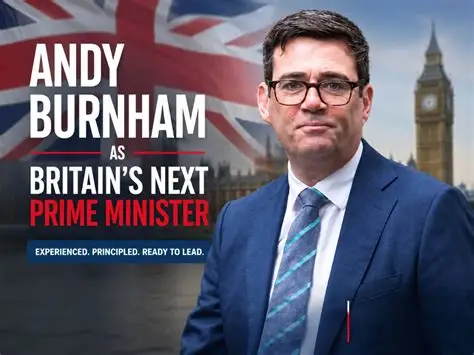
Andy Burnham Assumes Office As Britain’s Next Prime Minister
The CSR Journal Magazine

Andy Burnham officially becomes Britain’s 59th Prime Minister on Monday, succeeding Keir Starmer, who resigned after two years in office. The change in leadership comes amid significant expectations for Burnham, who has returned to central politics after a decade in Greater Manchester.

Burnham previously left Westminster in 2017 to serve as the Mayor of Greater Manchester. His recent victory in a by-election allowed him to re-enter Parliament, highlighting his sustained popularity within the Labour movement. Joshi Herrmann, the founder of Manchester news site The Mill, noted that many individuals have high hopes for Burnham in terms of Labour’s values and governance.

Growing up in Liverpool, Burnham emerged as a prominent figure in Manchester. His upbringing in a close-knit Catholic family, with his father working as a British Telecom engineer and his mother as a receptionist, contributed to his development. Burnham has acknowledged that his Catholic upbringing and connection to the Labour Party played a role in shaping his ideals regarding social justice.

Burnham’s Background and Political Journey

Burnham made history as the first in his family to attend university, graduating from Cambridge. His former English teacher, Stephen Harrington, recalled that Burnham initially hesitated to apply due to doubts about fitting in as a working-class student. However, he successfully completed his degree in English and later developed a career in journalism before moving into politics.

He was elected as the MP for Leigh in 2001 and served in various high-profile roles under Labour Prime Ministers Tony Blair and Gordon Brown, including Chief Secretary to the Treasury and Health Secretary. In 2009, he became a prominent advocate for the families of victims of the Hillsborough disaster, helping to demand a new inquest and increased accountability from public officials.

Following Labour’s loss in 2010, Burnham ran unsuccessfully for the party leadership in both 2010 and 2015. In 2017, he transitioned to the role of Mayor of Greater Manchester, where his policies focused on community engagement and collaboration. His approach, dubbed “Manchesterism”, aimed to leverage both public and private investments for regional development.

Plans and Challenges Ahead

During his tenure as mayor, Burnham successfully integrated the public transport system and oversaw significant urban development. His public persona evolved as he embraced a more casual style of dress and engaged actively with local culture. He gained recognition for his confrontational stance against the UK government’s perceived neglect of northern cities during the COVID-19 pandemic, earning him the title “King of the North”.

With Starmer’s resignation, Burnham’s opportunity to lead the party arose swiftly. His recent by-election win in Makerfield, where he achieved a considerable margin over the Reform UK candidate, solidified his status as a notable political figure. Now, as Prime Minister, Burnham aims to promote unity and establish an economy beneficial to all regions.

However, he faces significant challenges, including criticism regarding the clarity of his policies and how he plans to address issues such as economic weakness and public service pressures. Observers note that Burnham’s experience in foreign policy is limited, a factor that could affect his governance in an increasingly complex international landscape. Despite this, his determination and ability to engage with various stakeholders may prove beneficial as he embarks on this new chapter in leadership.

Long or Short, get news the way you like. No ads. No redirections. Download Newspin and Stay Alert, The CSR Journal Mobile app, for fast, crisp, clean updates!

App Store –  https://apps.apple.com/in/app/newspin/id6746449540 

Google Play Store – https://play.google.com/store/apps/details?id=com.inventifweb.newspin&pcampaignid=web_share

Latest News

Popular Videos
